

Drawings and documents
National Archives restored drawings: drawing
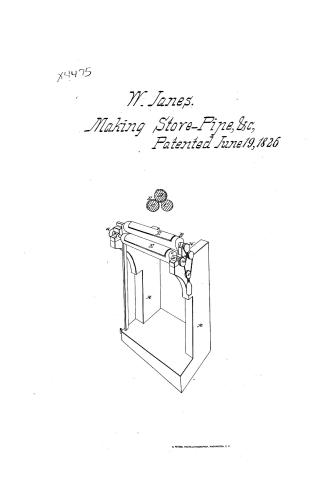
W. Janes' Patent Drawing for a Machine for Bending Tires for Carriages and Other Wheels, Metallic Bands and Hoops, Stovepipe Factory Cans, Tin Ware, etc.

National Archives, Restored Patent Drawings (Record Group 241) · Full-size scan at the National Archives · Catalog record
Show the text on the drawing Hide (122 words)
Words on the drawing as machine-read by the National Archives; not checked. Useful mainly for searching.
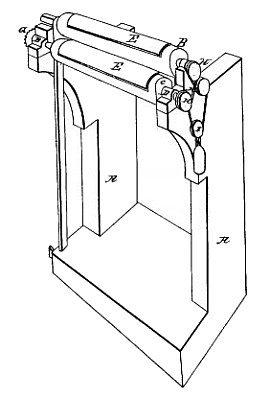
113. SHEET METAL/WARE. MAKING, / Tubing, / Lock learning / Straight / voe.6.p.75. / Lock2seaming / 4475 VY JANIES / Bending Tire for carriage Gollier Wherels, Metalic bunds i hoojis, Factory cans, Tin ware lcc / #4475 X / Patel June 19.1826. / Pater / /75cm / A. Frame / B. USIDER Roller / C. Bollers / D. Boxes. / T: Sheet being bent / 7: Clask to Roller adjusted below / G. Rateli Wheel / HI Banz / I. Pulley / Rollers may be / trical and man have / 9/6 / groor to received wind edge. / X is a wright to / streech the beed / Fa rod to / present the matter / roller from springing / to budd. tey / urterer served / Shichland DAT / Made under the direction / in conformity with act of 3 / Morr / com
USPTO scan
The patent as scanned by the USPTO
-
 Page 1
-
 Page 2
-
 Page 3


U.S. Patent and Trademark Office · Google Patents
Show the transcription Hide (771 words)
Machine transcription (LightOnOCR) of the pages as scanned by the USPTO, most of them the handwritten copies made when the records were restored after the 1836 fire. Not checked; it can misread handwriting, so compare it with the scan.
Page 1.
x4475
W. James.
Making Store-Pipe, &c,
Patented June 19, 1826

R. PETER, PHOTO-LITHOGRAPHER, WASHINGTON, D. C.
Page 2.
X0004475
June 19, 1826
Walter James
Letters Patent. Dated June 19, 1826.
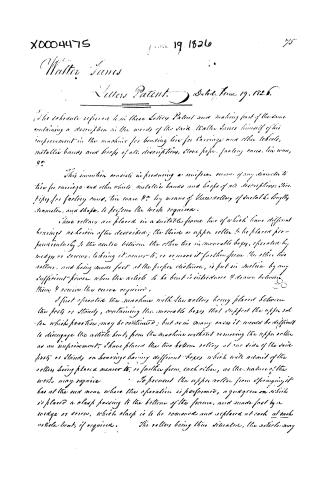
The schedule referred to in these Letters Patent and making part of the same, containing a description in the words of the said Walter James himself of his improvement in the machine for bending wire for Carriages and other wheels, metallic bands and hoops of all descriptions, stone pipes, factory cans, tin ware, &c.
This invention consists in producing a uniform curve of any diameter to wire for carriages and other wheels, metallic bands and hoops of all descriptions, stone pipes for factory cans, tin ware &c. by means of three rollers of suitable length, diameter, and shape, to perform the work required.
These rollers are placed in a suitable frame, two of which have different bearings as herein after described; the third or upper roller to be placed perpendicularly to the centre between the other two in movable boxes, operated by wedges or screws, taking it nearer to, or removing it farther from the other two rollers, and being made fast at the proper distance, is put in motion by any sufficient power when the article to be bent is introduced & drawn between them & receive the curve required.
I first operated the machine with the rollers being placed between two posts or stands, containing the movable boxes that support the upper roller which practice may be continued; but as in many cases it would be difficult to disengage the article bent, from the machine without removing the upper roller as an improvement, I have placed the two bottom rollers at one side of the said posts or stands, on bearings having different boxes which will admit of the rollers being placed nearer to, or farther from, each other, as the nature of the work may require.
To prevent the upper roller from springing, it has at the end near where the operation is performed, a quadrant on which is placed a clamp passing to the bottom of the frame, and made fast by a wedge or screw, which clamp is to be removed and replaced at each article bent, if required. The rollers being thus situated, the article may
Page 3.
76.
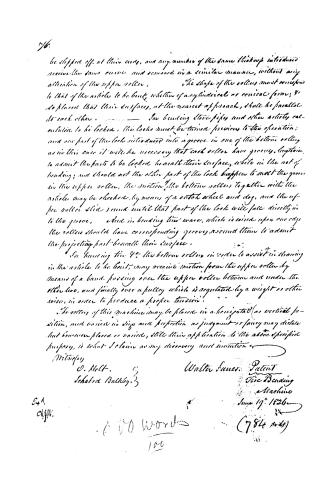
be slipped off at their ends, and any number of the same thickness introduced receives the same curve and removed in a similar manner, without any alteration of the upper roller. The shape of the rollers must correspond to that of the article to be bent, whether of a cylindrical or conical form; & so placed that their surfaces, at the nearest approach, shall be parallel to each other. For bending steel pipes and other articles calculated to be locked, the locks must be turned previous to the operation; and one part of the lock introduced into a groove in one of the bottom rollers, as in this case it will be necessary that each roller have grooves, lengthwise, to admit the parts to be locked beneath their surface, while in the act of bending; and should not the other part of the lock happen to meet the groove in the upper roller, the motion of the bottom rollers together with the article may be checked, by means of a notch wheel and dog, and the upper roller slides round until that part of the lock will fall directly in to the groove, when in bending this ware, which is raised upon one edge the rollers should have corresponding grooves around them to admit the projecting part beneath their surface.
In bending the 90° the bottom rollers in order to assist in drawing in the article to be bent, may receive motion from the upper roller by means of a band passing over the upper roller between and under the other two, and finally over a pulley which is regulated by a weight or other means, in order to produce a proper tension.
The rollers of this machine may be placed in a horizontal (or vertical) position, and varied in size and proportion as judgment or fancy may dictate but however placed or varied, still their application to the above specified purpose, is what I claim as my discovery and invention.
Witness
O. Holt.
Schabre Buckley.
Walter James. Patent
Tire Bending
Machine
June 19th 1826.
(784 words)
Expt.
cl. 17.
$\frac{1}{2} \times 100 \text{ words} = 100$
Published accounts: journal notice
Notice in the monthly list of patents
Franklin Journal and American Mechanics' Magazine, vol. 2 (1826), p. 128 · View the page
In the machine for bending tire for wheels, June 19, Walter Janes, Ashford, Connecticut.
DATAMP: illustration
Illustrations from DATAMP

DATAMP (Directory of American Tool and Machinery Patents), via the Internet Archive · Archived DATAMP page
About this record
- Patentee
- DATAMP
- Date
- the Name and Date index of patents, DATAMP, USPTO records
- Invention
- DATAMP
- Listed in
- the Name and Date index of patents, DATAMP, USPTO records, Jim Shaw's X-patent list, the Journal of the Franklin Institute, S. A. Elliot's printed list of patents, Burke's List of Patents (1847)
- The Franklin Institute's journal spells the name differently.
- The Franklin Institute's journal gives a different date.
- S. A. Elliot's printed list of patents gives the same name and date.
- Burke's 1847 Patent Office list gives the same patent.