

Drawings and documents
USPTO scan
The patent as scanned by the USPTO
-
 Page 1
-
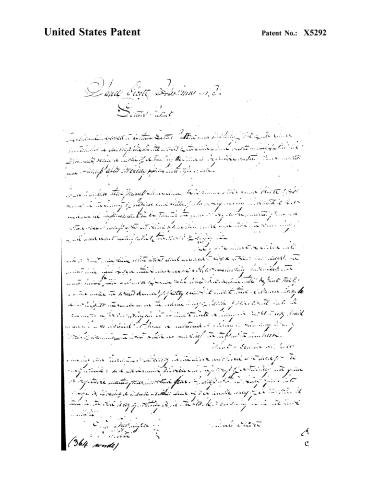 Page 2


U.S. Patent and Trademark Office · Google Patents
Show the transcription Hide (198 words)
Machine transcription (LightOnOCR) of the pages as scanned by the USPTO, most of them the handwritten copies made when the records were restored after the 1836 fire. Not checked; it can misread handwriting, so compare it with the scan.
Page 2.
United States Patent
Patent No.: X5292
David Scott, Lexington, Ky.
Patent Specification
The following is a detailed description of the invention, including its structure, operation, and advantages over prior art. The invention relates to a novel method and apparatus for the efficient processing of materials in industrial applications, particularly in the field of manufacturing and material handling.
The apparatus comprises a series of interconnected components designed to optimize the flow and transformation of materials. Key elements include:
- A primary processing unit with adjustable parameters for material conditioning.
- A secondary unit for fine-tuning and quality control.
- A control system integrated with sensors for real-time monitoring and adjustment.
The invention is particularly suited for use in environments where precision and efficiency are critical. It offers significant improvements in throughput and reduces waste, making it ideal for large-scale production facilities.
The following table summarizes the key features of the invention:
<table>
<thead>
<tr>
…
Published accounts: journal notice
Notice in the monthly list of patents, with remarks
Journal of the Franklin Institute, new ser., vol. 3 (1829), p. 189 · View the page
3. For Extracting the Gum or Vegetable Matter from unrotted Flax or Hemp, after its being spun into rope-yarn; Sands Olcott, Harsimus, Bergen county, New Jersey, December 1.
Remarks. The yarn is to be coiled within tubs, or vats; these are to be filled with water, and the yarn allowed to soak for three or four days; at the end of this time, the water is to be drawn off, and renewed, and this repeated until it passes off perfectly clear. The yarn may then be tarred, or it may have the water wrung out, and be hung up to dry. The process may be hastened by elevating the temperature of the water.
About this record
- Patentee
- the Journal of the Franklin Institute, Journal
- Date
- DATAMP
- Invention
- DATAMP
- Listed in
- the Name and Date index of patents, DATAMP, USPTO records, Jim Shaw's X-patent list, the Journal of the Franklin Institute
- The name conflict was settled by Burke's 1847 list.
- The sources give different dates; the date shown is the one most of them agree on.
- The patentee's full name comes from the Franklin Institute's journal.
- The Franklin Institute's journal gives a different date.