

Drawings and documents
National Archives restored drawings: drawing
Edward Clark's Patent Drawing for an Unknown Machine

National Archives, Restored Patent Drawings (Record Group 241) · Full-size scan at the National Archives · Catalog record
Show the text on the drawing Hide (55 words)
Words on the drawing as machine-read by the National Archives; not checked. Useful mainly for searching.
134-70 / 91. FAB MNG. / losit / (107) Planents: Lead. / 5293- / RI / Figl. / 6 E / Edward Clark / Patented Die Whises. / Fig rig.2. 2. / 94 Reipued June 20ᵗʰ1836. / Yee loles,5 Prestered Patents. / c. / Fig VL. / Fig. V. V. / .A / 24 / of / Fig): ViI. / Fig V. / Fig. VIT. / E11 / PO
USPTO scan
The patent as scanned by the USPTO
-
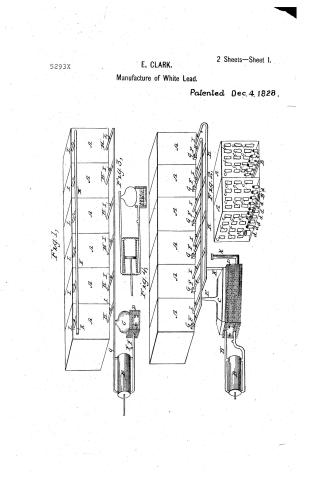 Page 1
-
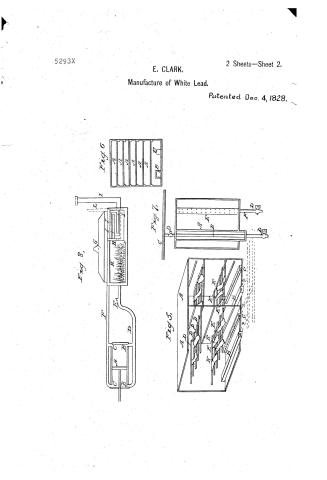 Page 2
-
 Page 3


U.S. Patent and Trademark Office · Google Patents
Show the transcription Hide (150 words)
Machine transcription (LightOnOCR) of the pages as scanned by the USPTO, most of them the handwritten copies made when the records were restored after the 1836 fire. Not checked; it can misread handwriting, so compare it with the scan.
Page 1.
5293X
E. CLARK.
Manufacture of White Lead.
Patented Dec. 4, 1828.
2 Sheets—Sheet 1.
Fig. 1.
Fig. 3.
Fig. 4.
Fig. 2.
Page 2.
5293X
E. CLARK.
Manufacture of White Lead.
Patented Dec. 4, 1828.
2 Sheets—Sheet 2.
Fig. 6
Fig. 7
Fig. 8
Fig. 5
Page 3.
United States Patent Office
PTO - BOYERS, PA Duty Station
MISSING PAGE TEMPORARY NOTICE
PATENT # 5293 X FOR ISSUE DATE 12-4-1828
HAS BEEN SCANNED, BUT WITH MISSING PAGE(S). UPON RECEIVING OF MISSING PAGE(S), THE ENTIRE DOCUMENT WILL BE RESCANNED.
PLEASE CALL IMAGE DATA ADMINISTRATION STAFF OF 557-6154 IF YOU HAVE A QUESTION. ASK FOR DAVE GROOMS, ANITA YOUNG OR POLA JONES.
THIS NOTICE IS FOR THE MISSING PAGE CONTAINING:
COLUMN # All Text
Data Conversion Operation
Boyrs, Pa
Published accounts: specification
Specification printed in the Journal of the Franklin Institute
Journal of the Franklin Institute, new ser., vol. 11 (1833), p. 107 · View the page
Text of the specification as printed in the Journal, from OCR; not proofread.
Specification of a patent for an improvement in the manufacture of White Lead, and other metallic salts. Granted to EDWARD CLARK, of the city of New York, Civil Engineer; dated December 4, 1828. Surrendered and reissued on an amended specification, July 3,1832. To all whom it may concern, be it known, that I, Edward Clark, of the city of New York, have invented or discovered a new and useful improvement in the manufacture of the metallic salts, usually denominated white, or carbonate of, lead, carbonate of copper, acetate of lead, acetate of copper, and the acetate, or peracetate of iron, and that the following is a full description thereof. As the process to be performed depends upon the same principles, which ever of the salts in question is to be manufactured, with no other difference than that which will suggest itself to any chemist, I shall confine myself, in describing my mode of procedure, principally to the manufacture of white lead. In preparing white lead, or other metallic salts, I construct cisterns, or apartments, which I denominate corroding cisterns, or apartments. The corroding cisterns may be made of wood, or of brick, or stone-work, or otherwise, either cylindrical, square, oblong, or in any other shape. When cylindrical, I have usually made them about six or eight feet in diameter, and the same in height. I find them more convenient, however, when made oblong, about eight or ten feet high, three or four feet in width, and fifteen or twenty feet in length, as the slats, or shelves, upon which the metal to be corroded is placed, or suspended, are more readily supported upon cleats attached to the sides, than they are when the width of the cistern is greater; the metal also appears to corrode better in cisterns of this form. Shelves of slats, or laths, or plank perforated with numerous holes, or of small scantling, or of strips of wood of sufficient strength, supported by cleats, are placed one above the other, at convenient heights, and when white lead is to be made, the metallic lead, made into sheets, is placed upon the shelves in coils, or is suspended from the slats, or otherwise so disposed of that the whole, or nearly the whole, surface of the lead may be exposed to the action of the vapours by which it is to be converted into white lead. When the lead is so disposed, the vapour and gases which are to effect the required changes are introduced into the corroding cistern, or are generated therein. These agents are CLARK'S manufacture of White Lead. the vapour of vinegar, carbonic acid, and oxygen gas. The vapour of vinegar may be formed by placing that fluid at the bottom of the cistern, or in separate vessels placed in it for that purpose, and heated by steam conducted through the vinegar, or in any other way by which a temperature of about 150 to 180 degrees Fah. may be sustained in the corroding cisterns. In my original specification, I described the mode in which the cistern, or vessel, containing the vinegar, might be replenished, and also other tubes and cocks which might be employed, but did not intend, and did not, in fact, claim them as parts of my exclusive right, as they may and will be used or omitted according as the other parts of the apparatus, or process, is modified. So far as the vinegar is concerned, it is manifest that my whole object is to expose the lead to the action of its vapour, produced by artificial heat, and this may be accomplished either by causing the heat to evaporate the vinegar within the cistern, or by placing it in a boiler or still without the corroding cistern, conducting it in by means of a pipe; or, instead of this, the boiler may be placed within the cistern, which may be provided with a feeding door to supply and regulate the fire, and tubes with cocks may also lead from and to the boiler to exhaust or supply it. Any practical engineer, or machinist, is competent to the making of such arrangements, and of adapting them to the purposes intended. The quantity of carbonic acid necessary to be introduced within the corroding cistern is not great, and may be readily supplied from the fuel burnt to evaporate the vinegar. As, however, it is absolutely necessary for the success of my process to admit atmospheric air, for the sake of its oxygen, the quantity of carbonic acid required may be admitted at the same time. A gasometer, like those in gas works, may contain the atmospheric air, and a portion of that air which has passed through the fire may be allowed to commingle with it in the gasometer, being conducted into it from the escape, or smoke flue, through tubes properly fixed for that purpose, in the progress through which, it may be washed and purified if required. As no great quantity of carbonic acid is required, a work-shop, or laboratory, where there are fires, and a number of persons at work, will frequently contain the required amount; and where there is a deficiency, a small quantity of charcoal may be burnt, and its vapour conducted into the corroding cistern, or, circuitously, into a gasometer, should this method of supply be preferred. There are various other sources known to the chemist, from which the requisite supply of carbonic acid may be obtained; such, for instance, as limestone, chalk, and all the varieties of wood and coal. During the whole time the process is going on, that is, whilst the vapour of the acid, heated to the required degree, is operating upon the metallic lead, I supply the cistern, or apartment, freely with atmospheric air, which readily parts with its oxygen in the quantity required to oxygenate the metal. This supply may be given in the way indicated by means of a gasometer, or it may be forced in by bellows, or by other means. In some cases I have made suitable openings into the cistern, or apartment, and have RICHMOND & CASWELL'S Spades. through them allowed of a spontaneous supply of atmospheric air and carbonic acid gas, without the use of any forcing apparatus. I rest my claim to invention on the introduction, or admittance, of atmospheric air, or air containing oxygen gas, with the other agents or materials named; that is, the vapour of vinegar, and carbonic acid generated by the combustion of fuel, or disengaged from chalk or carbonate of lime, either pure or mixed with such irrelative matter as will not interfere with the process, in whatever way they may be generated, or produced, or by whatever means or apparatus their introduction, or admittance, may be effected, into cisterns or apartments, appropriately supplied with metallic lead, or with the metal required to be acted on. EDWARD CLARK.
Published accounts: journal notice
Notice in the monthly list of patents, with remarks
Journal of the Franklin Institute, new ser., vol. 3 (1829), p. 189 · View the page
The claim is as follows. "What I claim as new, and my own invention, or discovery, in the above described art, and for the use 1 American Patents for December, with Remarks. of which I ask an exclusive privilege, is, the process of extracting the gum or vegetable matter from unrotted flax or hemp, after its being spun into rope yarn, it being a much quicker and less expensive way of extracting it, than the old way of rotting it in the stalk, or cleansing it in the hurl." 4. For an improved mode of manufacturing the metallic salts, usually denominated White Lead, or Carbonate of Lead; Carbonate of Copper; Acetate of Copper; and Acetate, or per Acetate of Iron; Edward Clark, Civil Engineer, New York, December 4.
Remarks. The patentee is now engaged in testing the principles, and perfecting the process for which he has obtained a patent, and will hereafter supply an article upon the subject, which will be more valuable than the outline which we should otherwise give.
Published accounts: journal notice
Notice in the monthly list of patents
Journal of the Franklin Institute, new ser., vol. 11 (1833), p. 93 · View the page
1. For an improvement in the Process of manufacturing White Lead; Edward Clark, Civil Engineer, city of New York. First patented December 4th, 1828.
Published accounts: journal notice
Notice in the monthly list of patents
Journal of the Franklin Institute, new ser., vol. 11 (1833), p. 107 · View the page
Specification of a patent for an improvement in the manufacture of White Lead, and other metallic salts. Granted to EDWARD CLARK, of the city of New York, Civil Engineer; dated December 4, 1828.
About this record
- Patentee
- DATAMP
- Date
- the Name and Date index of patents, DATAMP, USPTO records
- Invention
- DATAMP
- Listed in
- the Name and Date index of patents, DATAMP, USPTO records, Jim Shaw's X-patent list, the Journal of the Franklin Institute, Burke's List of Patents (1847)
- The Franklin Institute's journal spells the name differently.
- Burke's 1847 Patent Office list gives the same patent.