

Drawings and documents
National Archives restored drawings: drawing
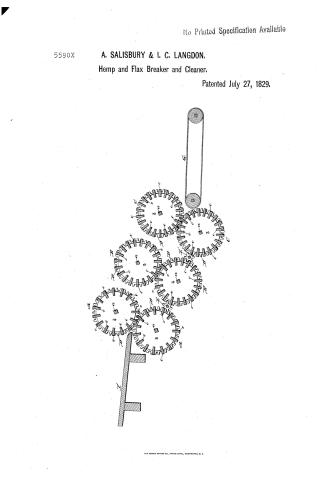
A. Salisbury and J. C. Landon's Patent Drawing for a Machine for Hemp and Flax - Breaker and Cleanser

National Archives, Restored Patent Drawings (Record Group 241) · Full-size scan at the National Archives · Catalog record
Show the text on the drawing Hide (105 words)
Words on the drawing as machine-read by the National Archives; not checked. Useful mainly for searching.
13. BRAKES & GINS. / 62 / [78] Brakes. / CL ASSIFICATION / 5.590+ / DIVISION. / AoSalisbury be Cangdon's / Hemp S Flax Breaker & Cleanser. / Pat: 27 July 1829. / Longitudinal Section. / A.A. References. Feirst set of rollers. / B.B. Second ditte / C.C. Third ditto / &e. Shafts / b,b,b,& Hanges or heads. / &ge Stats / D,D,&e. bog wheels. / E.E.E. Pinions / F. Matform / G. Apron / qio / Patent Office. 20th Aug 20th 1839. / Made under the direction of the Commiprioner of Satents, / in conformity with act: 3d March 1837 / Benne / NISUMOM / bomm: of Patents.
USPTO scan
The patent as scanned by the USPTO
-
 Page 1
-
 Page 2


U.S. Patent and Trademark Office · Google Patents
Show the transcription Hide (149 words)
Machine transcription (LightOnOCR) of the pages as scanned by the USPTO, most of them the handwritten copies made when the records were restored after the 1836 fire. Not checked; it can misread handwriting, so compare it with the scan.
Page 1.
No Printed Specification Available
5590X
A. SALISBURY & I. C. LANGDON.
Hemp and Flax Breaker and Cleaner.
Patented July 27, 1829.

THE NORRIS PETERS CO., PHOTO-LITHO., WASHINGTON, D. C.
Page 2.
United States Patent Office
PTO - BOYERS, PA Duty Station
MISSING PAGE TEMPORARY NOTICE
PATENT # 5590X FOR ISSUE DATE 7-27-1829
HAS BEEN SCANNED, BUT WITH MISSING PAGE(S). UPON RECEIVING OF MISSING PAGE(S), THE ENTIRE DOCUMENT WILL BE RESCANNED.
PLEASE CALL IMAGE DATA ADMINISTRATION STAFF OF 557-6154 IF YOU HAVE A QUESTION. ASK FOR DAVE GROOMS, ANITA YOUNG OR POLA JONES.
THIS NOTICE IS FOR THE MISSING PAGE CONTAINING:
COLUMN # All Text
Data Conversion Operation
Boyers, Pa
Published accounts: journal notice
Notice in the monthly list of patents, with remarks
Journal of the Franklin Institute, new ser., vol. 4 (1829), p. 266 · View the page
36. For an improved method of Breaking and Dressing Hemp and Flax; Amos Salisbury and John C. Langdon, Troy, New York, July 29.
Remarks. At page 129, we have published a specification of a patent obtained by the same gentlemen, for a similar purpose, in which the flutes of the rollers used for breaking were formed of slats secured at their ends into round pieces, or heads, fixed at each end of the rollers. In the machine now patented, the general arrangement bears some resemblance to the former, whilst in several particulars it is essentially different. The breakers consist of fluted rollers, of which there may be five pairs, which it is proposed to make of cast-iron; they may be about two feet in length, and about six inches in diameter; they are, however, to diminish in size, gradually, from the first to the last pair; thus the first pair may be 6 inches in diameter, the second 63, and so on to the fifth pair, which, on this scale, would be 6 inches. The upper part of the frame in which the rollers are sustained, is an inclined plane, so that each successive pair of rollers stand a little below the preceding pair. The first pair may have five flutes, leaving five ridges, or leaves, from end to end; each successive pair to be finer than the last, the fifth pair having fourteen flutes. The rollers are placed in pairs over each other; the flutes, or spaces, between the ridges, or leaves, are two or three times the width of the leaves, in order that there may be sufficient space for the hemp, or flax, which is to be broken, to pass between them, as they mash into each other. Each of the rollers is turned by a cog wheel upon its axis, which causes each leaf to stand in the centre of its corresponding flute. The material to be broken is delivered by a feeding apron to the first pair of rollers, and is at length received on another apron from the last pair. In addition to the breaking rollers, there is a pair, denominated flyers, which follow the last pair of breakers; these are wooden cylinders, each furnished with six strips of iron about inch wide, and inch thick, placed at equal distances apart, and extending from end to end; the strips mash between each other like the leaves of the breakers, the cylinders are moved with considerable velocity, which causes the strips to operate so as partially to dress the hemp, or flax, before its delivery upon the receiving apron. To complete the dressing, two other pairs of rollers are to be used. The first pair may be cylinders of wood, of ten or twelve inches in diameter, and of any desired length; along these, straight strips of metal are to be placed, like those on the last described rollers, and between each of these, other strips which are to be indented, or toothed. These cylinders run horizontally together, the strips of one mashing between those of the other; and the broken hemp, or flax, held in, and managed by, the hand, is to be allowed to hang down between them, it being moved up and down as required. Two other cylinders, called adjusting cylinders, are placed beneath these; they are smaller in diameter than the former, stand immediately under them, and are intended to prevent the fibres from becoming tangled, adhering to, and passing round, the dressing rollers. The claims are to the gearing of the rollers at each end, so as to give firmness and strength to their movement; to the arrangement by which the ridges are kept in the centres of the flutes on the corresponding rollers; to the successive diminution of the rollers, and the corresponding diminution in the size and depth of the flutes; to the dressing cylinders with straight and indented plates; to the adjusting cylinders, and to the manner and principle in which the whole are regulated and made to operate.
About this record
- Patentee
- the Journal of the Franklin Institute, Journal
- Date
- the Name and Date index of patents, USPTO records
- Invention
- the Name and Date index of patents
- Listed in
- the Name and Date index of patents, USPTO records, Jim Shaw's X-patent list, the Journal of the Franklin Institute, Burke's List of Patents (1847)
- The sources give different dates; the date shown is the one most of them agree on.
- The patentee's full name comes from the Franklin Institute's journal.
- The residence comes from the Franklin Institute's journal.
- The Franklin Institute's journal gives a different date.
- Burke's 1847 Patent Office list gives the same patent.
- Burke's 1847 Patent Office list gives a slightly different date; the date shown follows the standard lists.