

Drawings and documents
National Archives restored drawings: drawing
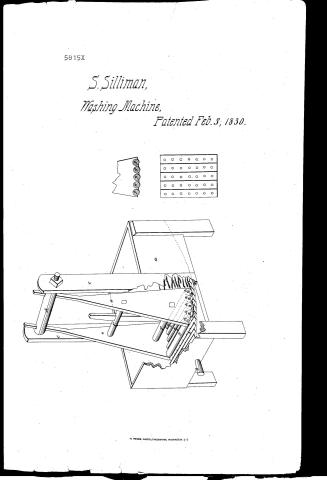
Samuel Lilliman's Patent Drawing for a Vibrating Washing Machine

National Archives, Restored Patent Drawings (Record Group 241) · Full-size scan at the National Archives · Catalog record
Show the text on the drawing Hide (114 words)
Words on the drawing as machine-read by the National Archives; not checked. Useful mainly for searching.
63. UNDRY. / 401] Weatung Mach's / RECIPROCATING RUBBER. / $150 / Samul Silliman / 5815-X / Vibrating Washing Machine. / Vol. Vol. 10.mg151 / Preferences. / Patented Feb. 3. 1830. / a tubwith four legs. / b the plug / c.e side posts. / d shaft. / ee side precess of the vibrating frame. / off croppicless handle. / 9.9.9.9.9 wooden rollers. / h hhh h metallic boses. / i wash board. / E. / section ofvibrating frame. / perforated in the flutes / Top view of a part of the wash board. / Patent affice June 29th 18th / made under the direction of the Commifiener of Patents / in conformity with act of 3d march 1837. / ch. L. Hischmam froit / nL Sumath / Commissioner of Patints.
USPTO scan
The patent as scanned by the USPTO
-
 Page 1
-
 Page 2
-
 Page 3
-
 Page 4


U.S. Patent and Trademark Office · Google Patents
Show the transcription Hide (847 words)
Machine transcription (LightOnOCR) of the pages as scanned by the USPTO, most of them the handwritten copies made when the records were restored after the 1836 fire. Not checked; it can misread handwriting, so compare it with the scan.
Page 1.
5815X
S. Silliman,
Washing Machine,
Patented Feb. 3, 1830.

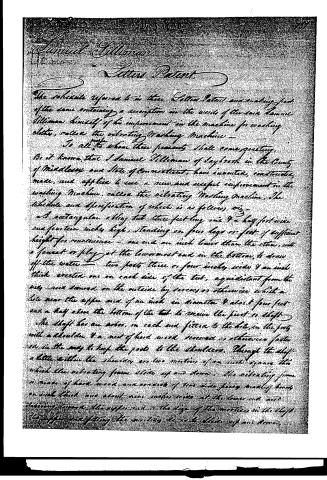
Page 2.
Samuel Silliman
Letters Patent.
The schedule referred to in these Letters Patent and making just after the same containing a description in the words of the said Samuel Silliman himself of his improvement in the machine for washing clothes, called the vibrating Washing Machine.
To all to whom these presents shall come, greeting.
Be it known that I Samuel Silliman of Saybrook in the County of Middlesex and State of Connecticut, have invented, constructed, made, and applied to use a new and useful improvement in the washing Machine, called the vibrating Washing Machine, the schedule and specification of which is as follows viz:
A rectangular tub, three feet long, one 9 and a half feet wide, and fourteen inches high, standing on four legs or feet of sufficient height for convenience—one end an inch lower than the other, with a faucet or plug at the lowermost end in the bottom, to draw off the water. Two posts, three or four inches wide and an inch thick, erected one on each side of the tub, equidistant from the ends and secured on the outside by screws or otherwise with a hole near the upper end of an inch in diameter and about four feet and a half above the bottom of the tub to receive the first or shaft.
The shaft has an arbor, on each end fitted to the hole in the posts with a shoulder and a nut of hard wood screwed or otherwise fastened in the way to keep the posts to the shoulders. Through the shaft a little within the shoulders are two mortises of an inch square, through which the vibrating frame slides up and down. The vibrating frame is made of hard wood and consists of two side pieces, making boards an inch thick and about nine inches wide at the lower end and tapering towards the upper end to the size of the mortises in the shaft. The upper end fitting the mortises so as to slide up and down.
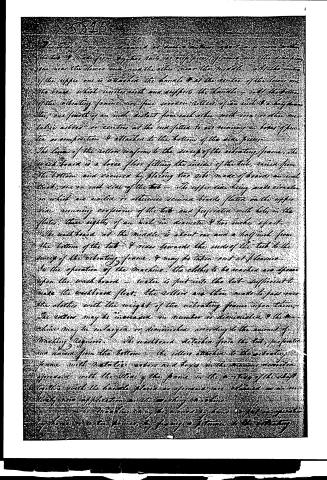
Page 3.
The side pieces are secured at such a distance apart as to insure that the tub is made firm by two rails or stiff pieces, screwed into the side pieces, one near the lower end and the other near the middle. At the center of the upper one is attached the handle, and at the center of the lower one the brace, which sustains and supports the handle. All the bottom of the vibrating frame are five wooden rollers, of an inch and a half diameter, one fourth of an inch distant from each other, with iron axles, one of which is brass or centers at the end fitted to run running in boxes of leather or composition, and attached to the bottom of the side pieces.
The lines of the rollers conform to the sweep of the vibrating frame. The wash board is a loose floor filling the inside of the tub, raised from the bottom and secured by placing two ribs made of boards or wood blocks, one on each side of the tub. The upper one being made circular in which are nailed or otherwise secured boards, fitted on the upper side running acrosswise of the tub and perforated with holes in the plates, three eighths of an inch in diameter and two inches apart.
The wash board at the middle is about one and a half inch from the bottom of the tub and rises towards the ends of the tub to the sweep of the vibrating frame, and may be taken out at pleasure.
In the operation of the machine, the clothes to be washed are spread upon the wash board. Water is put into the tub sufficient to make the wash board float. The rollers are then made to pass over the clothes with the weight of the vibrating frame upon them. The rollers may be increased in number or diminished, and the machine may be enlarged or diminished according to the amount of washing required. The wash board detaches from the tub, perforated and raised from the bottom. The rollers attached to the vibrating frame with metallic axles and boxes in the manner herein described, with the lines of the frame in the center of the shaft together with the handle, plates, or if desired, are obtained as an entirely new application in the washing machine.
The machine may be moved by hand or by an operator by horse or water power, by fixing a piston to the vibrating
Page 4.
I do hereby certify that the foregoing is a true specification & schedule of my improvement as above described. I have hereunto set my hand & seal this 17th day of December, A.D. 1827.
Milwaukie
Robert Peters
Eli Mann
Samuel Lilliman
Ex: Chy
Published accounts: journal notice
Notice in the monthly list of patents, with remarks
Journal of the Franklin Institute, new ser., vol. 5 (1830), p. 290 · View the page
5. For a Machine for Washing Clothes, called the VIBRATING WASHING MACHINE; Samuel Silliman, Saybrook, Middlesex county, Connecticut, February 3.
Remarks. A vibrating frame is supported by two uprights above a trough, or box, which is to contain the clothes and suds, " at the bottom of the vibrating frame are five wooden rollers of an inch and half diameter, one-fourth of an inch distant from each other, with iron, or other metallic arbors, or centres, at their ends, fitted to, and running in, boxes of pewter, or composition, and attached to the bottom of the side pieces. The line of the rollers conform to the sweep of the vibrating frame." A false bottom, consisting of fluted boards, and perforated with holes, is retained by ledges in a situation suited to the action of the rollers. The gudgeons of the vibrating frame work in a slot, or mortise, to enable it to adapt itself to the inequality in the thickness of the clothes; the false bottom also gives way, as there are no ledges below it, but it is forced up against those above it, by the water in which it floats. The vibrating frame is worked by a handle, which is affixed to one of the cross pieces which unite its two sides, and this handle is further secured by a brace extending to another cross piece. We mention these minute points, because they appear to the inventor of great importance, as is evinced by the attention paid to them in the claim, which is as follows:"The wash board detached from the tub, perforated and raised from the bottom; the rollers attached to the vibrating frame, with metallic arbors and boxes in the manner described, aforesaid, with the slide of the frame in the mortises of the shaft, together with the handle placed as aforesaid, are claimed as an entirely new application in the washing machine." Unfortunately, nearly the whole of these entirely new applications, have been long known and used; the floating bottom may be new.
DATAMP: illustration
Illustrations from DATAMP


DATAMP (Directory of American Tool and Machinery Patents), via the Internet Archive · Archived DATAMP page
About this record
- Patentee
- DATAMP
- Date
- the Name and Date index of patents, DATAMP, USPTO records
- Invention
- DATAMP
- Listed in
- the Name and Date index of patents, DATAMP, USPTO records, Jim Shaw's X-patent list, the Journal of the Franklin Institute, Burke's List of Patents (1847)
- Burke's 1847 Patent Office list gives the same patent.