

Drawings and documents
National Archives restored drawings: drawing
Nathan Crary and E. P. Crary's Patent Drawing for Improvement in the Mode of Making Pill Boxes

National Archives, Restored Patent Drawings (Record Group 241) · Full-size scan at the National Archives · Catalog record
Show the text on the drawing Hide (189 words)
Words on the drawing as machine-read by the National Archives; not checked. Useful mainly for searching.
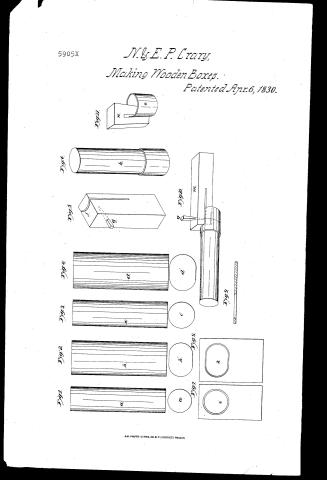
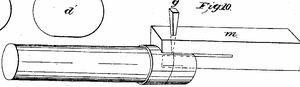
144. WOOD WORKING. / Bopes of Care / 3. SPECIAL WORK MACHINERY. / apr, 6, 1830 / [30] Making Boxes. / #2- Baxillachmis / Nathan brary & E. Plerary / CLASSIFICATION / 5905 X / Improvement in the mode of making Pill Boxes. / Vol. io ps.455. / Fig.1. / Sign / Зол Roller / Figh. / Patented april 6. 1830. / Oval box Roller / Pround Roller / Oval Cover Rother. / fig.b. / Side / Jide view. / lide view / Lide / Aig.5 / Aig.11 / Preferences. / Sigh a. round roller. lide view Topica / This 2 b. oval roller Side vida B' topo / this C wind rollar for / high d oval willer for Cover Topoie / eys e, splitting guage. circular / g. steelpoint. h. Proligmith / Fig.7 i Iteel plate for round / Sig K Heelplate for oval / Sig.9 L section of lp / Jiy.10 m a gauge and Cover / Sig 11. n a gripe a o having. / C' / all / Joy view a / Jiy.10 / Sig.7 / Fig. 8. / Patent affier March 71. 1842 / K. / made wader the dinetion of the Comm prone / sharing is shoul arrund still roller V / of texts in Can formity with act ofs March / Figg / head inserted while in that probion / Wh Ellnorth / ch. L. Hinhmana rl. / Commissions of Patints
USPTO scan
The patent as scanned by the USPTO
-
 Page 1
-
 Page 2
-
 Page 3
-
 Page 4


U.S. Patent and Trademark Office · Google Patents
Show the transcription Hide (919 words)
Machine transcription (LightOnOCR) of the pages as scanned by the USPTO, most of them the handwritten copies made when the records were restored after the 1836 fire. Not checked; it can misread handwriting, so compare it with the scan.
Page 1.
5905X
N. & E. P. Crary,
Making Wooden Boxes.
Patented Apr. 6, 1830.
Fig. 1.
Fig. 2.
Fig. 3.
Fig. 4.
Fig. 5.
Fig. 6.
Fig. 7.
Fig. 8.
Fig. 9.
Fig. 10.
A.M. PHOTO-LITHO. CO. N.Y. (OSBORNE'S PROCESS)
Page 2.
No. 105.
Nathan Bray & Edward P. Bray, Citizens.
Letters Patent.
The schedule referred to in these Letters Patent and making part of the same, containing a description in the words of the said Nathan Bray & Edward P. Bray themselves of their improvement in the mode of making or manufacturing Pill Boxes.
To all Persons to whom these shall come:
Nathan Bray of New York & Edward P. Bray of the Town of Bronxville, in the County of Westchester & State of New York, both, being.
Be it known that we the said Nathan & Edward P. Bray have invented, constructed, made & applied to use, a new & useful improvement in the mode of making or manufacturing Pill Boxes or the small circular or oval boxes, commonly known & distinguished by that name to whatever purpose applied, which improvement consists in the construction, application & use of the rollers & the splitting gauge, the steel plate & the gipses, specified in the words following:— The rollers are solid cylinders of wood, of a convenient length, of which rollers one is required for the bodies & one for the covers of boxes of the same size, & which rollers at their circular surface, are respectively of a diameter equal to that of the inner part of the bodies of the boxes & of the bodies of the covers respectively and around which rollers the bodies of the boxes and their covers are respectively wound to be placed or fastened. If the boxes to be manufactured are to be of a certain of round, the rollers have an oval surface instead of the circular & number of these rollers is required equal to the number of box bodies & half the number of cover bodies which are in progress of being or fastening at the same time. The splitting gauge is a piece of wood of convenient size with two flat surfaces
Page 3.
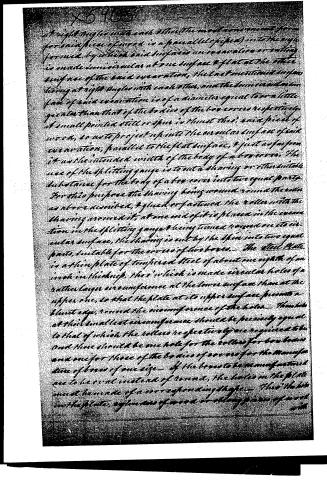
at right angles with each other (the most convenient form for said piece of wood is a parallelepiped) into the angle formed by which said surfaces in excavation or cutting is made semicircular at one surface & flat at the other surface of the said excavation, the last mentioned surface lying at right angles with each other, and the semicircular surface of said excavation is of a diameter equal to or a little greater than that of the bodies of the boxes respectively. A small pointed stick or spur is thrust thru' said piece of wood, so as to project up into the circular surface of said excavation, parallel to the flat surface, & just as far from it as the intended width of the body of a box cover. The use of the splitting gauge is to cut a shaving or other suitable substance for the body of a box cover into two equal parts. For this purpose the shaving being wound round the roller as above described, & glued or fastened the roller with the shaving around it, at one end of it is placed in the excavation in the splitting gauge & being turned round on its circular surface, the shaving is cut by the spur into two equal parts, suitable for the covers of two boxes. The Steel Plate is a thin plate of tempered steel of about one eighth of an inch in thickness, thru' which is made circular holes of a rather larger circumference at the lower surface than at the upper one, so that the plate at its upper surface presents a blunt edge, round the circumference of the holes. Though at their smallest circumference should be precisely equal to that of which the rollers respectively are required to be round there should be one hole for the roller for box bodies and one for those of the bodies of covers for the manufacture of boxes of one size. If the boxes to be manufactured are to be oval instead of round, the holes in the plate must be made of a corresponding shape. Thru' the holes in the plate, cylinders of wood or other pieces of wood with
Page 4.
The box bodies & covers are to be made of one material precisely equal size for one and to one other in cylinders or pieces of wood one them cut up of a suitable length for rollers.
The Cylinders are blocks of wood or other proper substance with cuttings or openings in them of a wedge shape rather larger at the top of the cutting & smaller at the bottom than the diameter of the box bodies or the cover bodies respectively & into which cuttings the box bodies & cover bodies being wound around the rollers & glued are respectively pressed or wedged to stay.
In testifying that the above is a true specification of our said improvement as above described we have hereunto set our hands & seals this twenty-first day of January in the year of our Lord one thousand & eight hundred & thirty.
Insignes
Sethian Piffes dunn
John B. Gallup
Sathan Gray
Edward B. Gray
Published accounts: journal notice
Notice in the monthly list of patents, with remarks
Journal of the Franklin Institute, new ser., vol. 6 (1830), p. 4 · View the page
10: For an improved mode of Manufacturing Pill Boxes; Nathan Crary, of Knox, and Edward P. Crary, of Bern, Albany county, New York, April 6.
Remarks. We are not acquainted with all the modes adopted for making pill boxes, but those described in the present patent are so simple and obvious in their character, that we should apprehend that they, or others equally good, must have been long known and practised. Cylinders of wood are used for making round boxes, and their covers, and oval formers for those which are to have that shape; round these the chip is bent for the purpose of glueing it. These moulds are to be made true by forcing them through round or oval holes in a steel plate prepared for that purpose. Blocks of wood, with wedge shaped channels are used to retain the bodies in their places whilst the glue is drying. A cutting gauge is employed to divide the glued pieces into proper widths. This is the whole amount of the patent, and as no claim is appended to the specification, all the modes described must be considered by the patentees as constituting it.
DATAMP: illustration
Illustrations from DATAMP

DATAMP (Directory of American Tool and Machinery Patents), via the Internet Archive · Archived DATAMP page
About this record
- Patentee
- DATAMP
- Date
- the Name and Date index of patents, DATAMP, USPTO records
- Invention
- DATAMP
- Listed in
- the Name and Date index of patents, DATAMP, USPTO records, Jim Shaw's X-patent list, the Journal of the Franklin Institute, Burke's List of Patents (1847)
- Burke's 1847 Patent Office list gives the same patent.