

Drawings and documents
USPTO scan
The patent as scanned by the USPTO
-
 Page 1
-
 Page 2
-
 Page 3


U.S. Patent and Trademark Office · Google Patents
Show the transcription Hide (690 words)
Machine transcription (LightOnOCR) of the pages as scanned by the USPTO, most of them the handwritten copies made when the records were restored after the 1836 fire. Not checked; it can misread handwriting, so compare it with the scan.
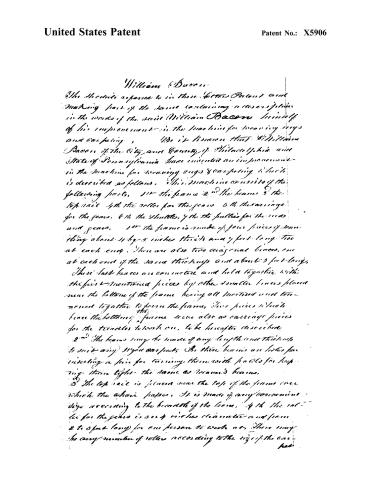
Page 2.
United States Patent
Patent No.: X5906
William Bacon
The Heretofore referred to in these Letters Patent and making part of the same containing a description in the words of the said William Bacon himself of his improvement in the machine for weaving rugs and carpeting.
Be it known that William Bacon of the City and County of Philadelphia and State of Pennsylvania have invented an improvement in the machine for weaving rugs & carpeting which is described as follows. This machine consists of the following parts, 1st the frame 2nd the beams 3rd the top rail 4th the roller for the gears 5th the carriage for the gears, 6th the shuttle, 7th the pulleys for the rods and gears.
1st The frame is made of four pieces of something about 1/4 by 5 inches thick and 7 feet long, two at each end. There are also two diagonal braces, one at each end of the same thickness and about 3 feet long. These last braces are connected and held together with the first mentioned pieces by other smaller braces placed near the bottom of the frame being all mortised and tenoned together to form the frame. Five pieces which brace the bottom of the frame serve also as carriage pieces for the trundles to work on, to be hereafter described.
2nd The beams may be made of any length and thickness to suit any sized carpets. On these beams are holes for inserting a pin for turning them with, for keeping them tight the same as Weaver’s beams.
3rd The top rail is placed near the top of the frame over which the chain passes. It is made of any convenient size according to the breadth of the loom. 4th The roller for the gears is 3 or 4 inches diameter and from 2 to 3 feet long for one person to work on. There may be any number of rollers according to the size of the carpet.
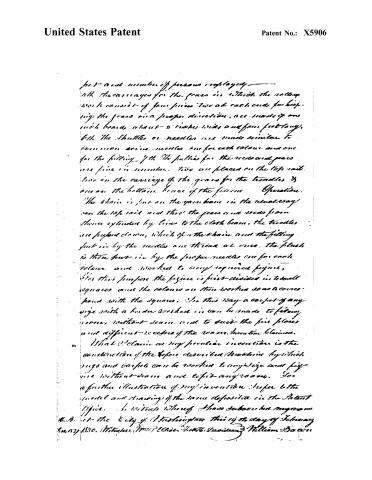
Page 3.
United States Patent
Patent No.: X5906
first and number of persons employed—
5th. The carriage for the gears in which the needle
work consists of four pieces two at each end, for keep-
ing the gears in a proper direction, are made of one
inch board, about 5 inches wide and four feet long,
6th. The shuttles or needles are made similar to
common sewing needles, one for each colour and one
for the filling. 7th. The pulleys for the rods and gears
are five in number, two are placed on the top rail,
two on the carriage of the gears for the treadles &
one on the bottom brace of the frame. Operation.
The chain is put on the yarn beam in the usual way,
over the top rail and then the gears and rods from
there extended by lines to the cloth beam, the treadles
are pushed down, which opens the chain and the filling
put in by the needles one thread at once. The plush
is then put in by the proper needles one for each
colour and worked to any required figure.
For this purpose the figure is first divided into small
squares and the colours are then worked so as to corre-
spond with the squares. In this way a carpet of any
size with a border worked in can be made to fit any
room, without seam and to suit the fine places
and different recesses of the room. Invention Claimed.
What I claim as my peculiar invention is the
construction of the before described machine by which
rugs and carpets can be worked to any size and fig-
ure without seam and to fit any room. See
a further illustration of my invention. Refer to the
model and drawing of the same deposited in the Patent
Office. I, William Bacon, have subscribed my name
A.B. at the City of Washington this 19th day of February
1850. Witness: Mr. E. Choe. Notary: William Bacon
Published accounts: journal notice
Notice in the monthly list of patents, with remarks
Journal of the Franklin Institute, new ser., vol. 6 (1830), p. 5 · View the page
11. For an improvement in the Machine for Weaving Rugs and Carpeting; William Bacon, Philadelphia, Pennsylvania, April 7.
Remarks. Without a drawing it would be in vain to attempt to describe a loom of almost any kind; and, in the present instance, although the drawing is well executed, it does not appear to us that the construction and operation of the machine are given with sufficient clearness. The object proposed is to weave rugs and carpeting, not only of the ordinary width, but also without seam, sufficiently large for a room. The loom, as represented in the drawing, is so constructed that the carpet to be woven stands in an oblique position. Its operation of weaving is thus described. "The chain is put on the yarn beam in the usual way, over the top rail, and through the gears and reeds; from thence extended, by lines, to the cloth beam. The treadles are pressed down, which open the chain, and the filling put in by the needles, one thread at once; the plush is then put in by the proper needles, one for each colour, and worked to any required figure. For this purpose the figure is first divided into small squares, and the colours are then worked so as to correspond with the squares. In this way a carpet of any size, with a border worked in, may be made to fit any room, without seam, and to fit the fire-place and different recesses of the room." "The roller for the gears is two or three feet long, for one person to work at. There may be any number of rollers, according to the size of the carpet, and number of persons employed." " Invention claimed.-What I claim as my peculiar invention, is, the construction of the before described machine, by which rugs and carpets can be worked to any size and figure, without seam, and to fit any room." It wil thus be seen that the whole machine is claimed, without any reference whatever to any particular arrangement of its parts, although these parts are, in general, similar to such as are found in other looms. To sustain such a claim, the whole construction ought to be new.
DATAMP: illustration
Illustrations from DATAMP

DATAMP (Directory of American Tool and Machinery Patents), via the Internet Archive · Archived DATAMP page
About this record
- Patentee
- DATAMP
- Date
- the Name and Date index of patents, DATAMP, USPTO records
- Invention
- DATAMP
- Listed in
- the Name and Date index of patents, DATAMP, USPTO records, Jim Shaw's X-patent list, the Journal of the Franklin Institute, Burke's List of Patents (1847)
- Burke's 1847 Patent Office list gives the same patent.