

Drawings and documents
National Archives restored drawings: drawing
Patent Drawing for Shaw's Electric Blasting

National Archives, Restored Patent Drawings (Record Group 241) · Full-size scan at the National Archives · Catalog record
Show the text on the drawing Hide (164 words)
Words on the drawing as machine-read by the National Archives; not checked. Useful mainly for searching.
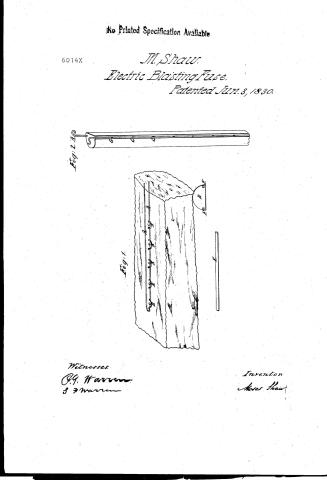
150 / 10m / PR / 7+10 / Illeting Dires. / Thaw's Electric Blasting / Patented June Feel 1830 / dig.No2 / CLASSIFICATION / 6014-X / DIVISION. / Description of the Graught. / Dig Nil / GI / thig. 1. The lock to be split / A The wire conductor B / GI / C The tamping D plan of the end of / the rod E the rod F the wires asplain / in the Groove G the globules of ig- / F R / M iting power between he / beaks of the conductor / Jug 2 Enlargementy the rad. / Signed in presence you / Moses there / City and County J chen York / New york fanilary J1 1838 / state of New york J, / on the 22d day of / OCI Warren / February 1838 before the subscribes Commissions / L. / of deeds in a for the said county personally affeared / Mores show ith in of the mode of electron Hosting / and made oath thorther drawing / in a Co rree Tire presentate of his / patenter A.D. 1830. / Aprai Dud,
USPTO scan
The patent as scanned by the USPTO
-
 Page 1
-
 Page 2
-
 Page 3


U.S. Patent and Trademark Office · Google Patents
Show the transcription Hide (776 words)
Machine transcription (LightOnOCR) of the pages as scanned by the USPTO, most of them the handwritten copies made when the records were restored after the 1836 fire. Not checked; it can misread handwriting, so compare it with the scan.
Page 1.
No Printed Specification Available
6014X
M. Shaw.
Electric Blasting Fuse.
Patented Jun. 3, 1830.
Fig. 1.
Fig. 2.
Witnesses:
C. G. Warren
S. F. Warren
Inventor:
Moses Shaw
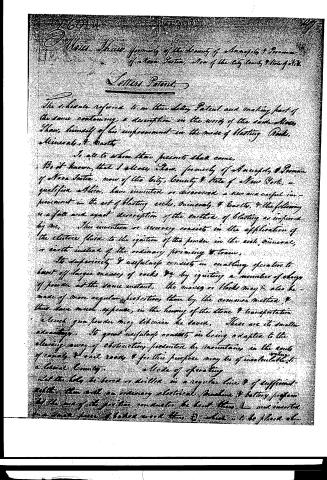
Page 2.
June 3, 1830
Ollie Shaw, formerly of the County of Annapolis & Person of Nova Scotia, now of the City County & State of New York
Letters Patent
The scheme referred to in their Letters Patent and making part of the same containing a description in the words of the said Ollie Shaw, himself of his improvement in the mode of blasting Rocks, Minerals, & Earths.
To all to whom these presents shall come,
Be it known, that I Ollie Shaw, formerly of Annapolis & Person of Nova Scotia, now of the City, County & State of New York, a qualified citizen, have invented or discovered a new and useful improvement in the art of blasting rocks, Minerals, & Earths, & the following is a full and exact description of the mode of blasting as improved by me.
This invention or discovery consists in the application of the electric fluid to the ignition of the powder in the rock, Mineral, or earth instead of the ordinary priming & train.
Its superiority & usefulness consists in enabling operators to burst off larger masses of rocks & by igniting a number of charges of powder at the same instant, the masses or blocks may also be made of more regular proportions than by the common method & thus save much expense, in the hewing of the stone & transportation thereof, gun powder may likewise be saved. These are its smaller advantages. Its great usefulness consists in being adapted to the clearing away of obstructions produced by mountains in the route of canals & rail roads & for this purpose may be of incalculable value to a broad country.
Mode of operating
Let the holes be bored or drilled in a regular line & of sufficient depth, then with an ordinary electrical machine & battery prepare the ends of the positive conductor be bent there & not inserted into the holes, but placed over them & which is to be placed when
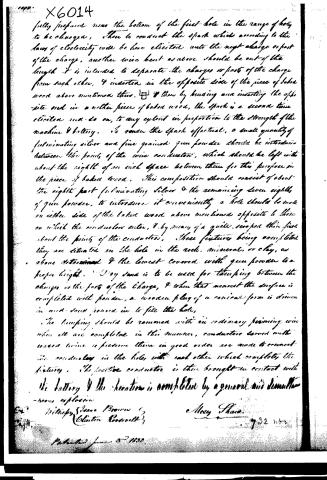
Page 3.
X6014
fully prepared near the bottom of the first hole in the range of holes to be charged. Then to conduct the spark which according to the laws of electricity will be here electric into the next charge or part of the charge, another wire bent as above should be out of the length it is intended to separate the charges or parts of the charge from each other, & inserted in the opposite side of the piece of baked wood above mentioned thus. & then by bending and inserting the opposite end in another piece of baked wood, the spark is a second time elicited and so on, to any extent in proportion to the strength of the machine & battery. To render the spark effectual, a small quantity of fulminating silver and fine grained gun powder should be introduced between the points of the wire conductor, which should be left with about the eighth of an inch space between them for this purpose in the piece of baked wood. This composition should consist of about the eighth part fulminating silver & the remaining seven eighths of gun powder, to introduce it conveniently a hole should be made on either side of the baked wood above mentioned opposite to those on which the conductors enter, & by means of a quite scraped thin sheet about the points of the conductors. These fixtures being completed they are situated in the hole in the rock, mineral, or clay, as above determined & the lowest covered with gun powder to a proper height. Dry sand is to be used for tamping between the charges or the parts of the charge, & when that nearest the surface is completed with powder, a wooden plug of a conical form is driven in and sand poured in to fill the hole.
The tamping should be resumed with an ordinary priming wire when all are completed in this manner, conductors carved with waxed twine to preserve them in good order are made to connect the conducting in the holes with each other which completes the fixture. The positive conductor is then brought in contact with the battery & the operation is completed by a general and simultaneous explosion.
Witness: Anna Brown
Clinton Roosevelt
e Mary Shaw. 732 hts
Patented June 8th 1830.
Published accounts: journal notice
Notice in the monthly list of patents, with remarks
Journal of the Franklin Institute, new ser., vol. 6 (1830), p. 218 · View the page
3. For a New Method of Blasting Rocks; Moses Shaw, formerly of Nova Scotia, but now of the city of New York, June 3.
Remarks. The mode of blasting rocks for which this patent has issued, was described in Professor Silliman's Journal, about a year since, (vol. 16, p. 372,) to which we refer our readers, as the account there given, though brief, is much more clear than the description supplied by the patentee, and the wood cut accompanying the former illustrates the design more perfectly than the very indifferent drawing which makes a part of the latter. The object proposed is to blow off very large masses of rock, by making a number of simultaneous explosions; to effect which a number of holes are to be bored, which may stand round in a circle, and be so inclined as to point to one common focus. A priming compounded of fulminating silver and gunpowder, is to be ignited by a shock from the electrical machine, there being a suitable arrangement of wires made for that purpose. "Its superiority and usefulness," we are informed, "consists in enabling operators to burst off large masses of rocks, &c. by igniting a number of charges of powder at the same instant: the masses, or blocks, may also be made of more regular proportions than by the common method, and thus save much expense in the hewing of the stone, and in transportation. Much gunpowder may likewise be saved. These are its smaller advantages. Its great usefulness consists in being adapted to the clearing away of obstructions presented by mountains, in the routes of canals and rail-roads, and for this purpose may be of incalculable value to a liberal country." To remove mountains, either by faith or by works, requires that either should be exercised with a degree of energy beyond the ordinary gauge of us mortals, in the present imperfect state of our moral and physical powers. We know the high anticipations of Mr. Shaw upon this subject, having heard him state them; we, however, were compelled to lag far behind him, probably because we imitate the many who "make mountains of mole hills," instead of exercising the rare talent of making mole hills of mountains. We wish that Mr. Shaw's specification had been written by some one better acquainted with the subject of electricity, and with the other points necessary to a clear specification of this invention, than appears in the instrument before us. The result of the various experiments which have been made, with a view to the obtaining of a patent, ought to have furnished a more perfect detail than 1 has been given: at all events the particular points claimed should have been stated, and not left, as it now is, to be collected from the general tenor of the instrument.
About this record
- Patentee
- DATAMP
- Date
- the Name and Date index of patents, DATAMP, USPTO records
- Invention
- DATAMP
- Listed in
- the Name and Date index of patents, DATAMP, USPTO records, Jim Shaw's X-patent list, the Journal of the Franklin Institute, Burke's List of Patents (1847)
- Burke's 1847 Patent Office list gives the same patent.