

Drawings and documents
National Archives restored drawings: drawing
Nathaniel C. Langford and Erastus C. Parmelee's Patent Drawing for a Iron-tooth Rake

National Archives, Restored Patent Drawings (Record Group 241) · Full-size scan at the National Archives · Catalog record
Show the text on the drawing Hide (132 words)
Words on the drawing as machine-read by the National Archives; not checked. Useful mainly for searching.
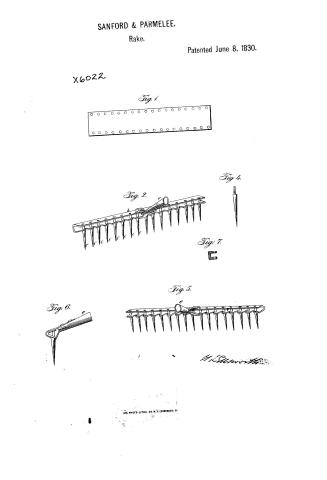
47. GARDEN & ORCHARD. / $2- [77] Rakes. a fraulture Hoes Spades Shoreb of / CLASSI TCATION / 6022.+ / Nathaniel b. Landford Q. Erastus P. Parmelee / DIV ISION. / Iron tooth hake. / Vol io pg. 203 / Patented June 8. 1830. / References. / Jig.1. / Sig i. a. The head / 2 b. The same head turned off. / The same head with teeth.c.c.c.e.e. / Fig.7. / 44 / Fig 4 a tooth. / fection. / e the soket. / big 5 an other mode of making the hake. / Fig. 6 a third mode. I. / Jig.7 shows the made of making the holes. / Ty.2 / for this hotrolar hand / are Checification / big 6. / Jjg5 / Patent affice July 31 1841. / made under the direction of the Commifsioner / ch. L. Heischmann del: / of Patents m leonformity with act ofs? march 1837 / Commifriance of Patents
USPTO scan
The patent as scanned by the USPTO
-
 Page 1
-
 Page 2
-
 Page 3
-
 Page 4


U.S. Patent and Trademark Office · Google Patents
Show the transcription Hide (1,104 words)
Machine transcription (LightOnOCR) of the pages as scanned by the USPTO, most of them the handwritten copies made when the records were restored after the 1836 fire. Not checked; it can misread handwriting, so compare it with the scan.
Page 1.
SANFORD & PARMELEE.
Rake.
Patented June 8, 1830.
X6022
Fig. 1.
Fig. 2.
Fig. 4.
Fig. 7.
Fig. 5.
Fig. 6.
H. L. Shumway
A.M. PHOTO-LITHO. CO. N.Y. (OSBORNE'S PI)
Page 2.
June 8, 1830
Nathaniel C. Sanford, & Cratus P. Parmelee of Herndon, Co. of New Haven,
Letters Patent
6022X
The schedule referred to in these Letters Patent, and making part of the same,
containing a description in the words of the said Nathaniel C. Sanford, and
Cratus P. Parmelee themselves, of their improvement in the Iron Tooth Rake.
To all to whom these presents shall come: Be it known that we, Nathaniel
C. Sanford and Cratus P. Parmelee of Herndon, in the County of New Haven,
in the State of Connecticut, citizens of the United States, have invented a
new and useful improvement in the iron tooth rake, and that the following is a full
and exact description of the construction and operation of the said machine, as invented
or improved by us. The head of the rake is made of sheet or hoop iron,
about two inches in width, and of sufficient length for the rake intended, and of
about one sixteenth of an inch thick. Holes are punched or drilled through
this plate of iron, near the edges, about one eighth of an inch from the outer
edges and sufficient distance apart for the space designed between the teeth.
The holes through the part intended for the bottom or underside of the head
may be round or an oblong square, having the longest diameter at right
angles with the edge of the plate. The holes in the edge designed for the top
of the head should be fitted on the upper side with a countersink, for
the purpose of rivetting the teeth. About half an inch in width of each
edge of the plate is then turned off at right angles with the back part of
the head, so that the holes in the upper lower edges may be exactly opposite to each other; or when preferred, the top part may be so turned as
to form an acute and the bottom an obtuse angle with the back.
The teeth which are also made of iron or steel and of any desired shape,
are made with a shoulder, about one inch from the upper end above
the shoulder, of a size and shape to fit the holes in the head. The lower end
of the teeth to be tapered nearly to a point. The teeth are then inserted
through the holes in the head and rivetted on the upper side, so as to bring the
shoulders of the teeth firmly against the under side of the head. The space
between the teeth may be scalloped out, a pipe or socket to receive the
Page 3.
2.
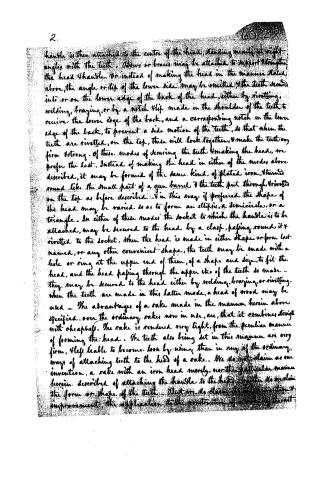
handle is then attached to the centre of the head, standing nearly at right angles with the teeth. Braces or braces may be attached to support or strengthen the head handle. Or instead of making the head in the manner stated above, the angle or lip of the lower side may be omitted, the teeth screwed into or on the lower edge of the back of the head, either by rivetting, welding, brazing, or by a notch slip made in the shoulder of the teeth, to receive the lower edge of the back, and a corresponding notch in the lower edge of the back, to prevent a side motion of the teeth, so that when the teeth are rivetted, on the top, these will lock together, and make the teeth very firm and strong. Of these modes of securing the teeth and making the head, we prefer the last. Instead of making the head in either of the modes above described, it may be formed of the same kind of plated iron, turned round like the small part of a gun barrel, and the teeth put through rivetted on the top as before described. In this way, if preferred, the shape of the head may be varied so as to form an ellipse, a semicircle, or a triangle. In either of these modes the socket to which the handle is to be attached, may be secured to the head by a clamp, passing round it and rivetted to the socket. When the head is made in either shape or form last named, or any other convenient shape, the teeth may be made with a hole or ring at the upper end of them, of a shape and size, to fit the head, and the head passing through the upper ends of the teeth so made, they may be secured to the head either by welding, brazing, or rivetting. When the teeth are made in this latter mode, a head of wood may be used. The advantages of a rake made in the manner herein above specified, over the ordinary rakes now in use, are, that it combines strength with cheapness. The rake is rendered very light, from the peculiar manner of forming the head. The teeth also being set in this manner are very firm, less liable to become loose by using than in any of the ordinary ways of attaching teeth to the head of a rake. We do not claim as our invention, a rake with an iron head merely, nor the particular manner herein described of attaching the handle to the head, nor the form or shape of the teeth. But we do claim as our invention and improvement, the application to the construction of a rake of the art
Page 4.
6022 X 3
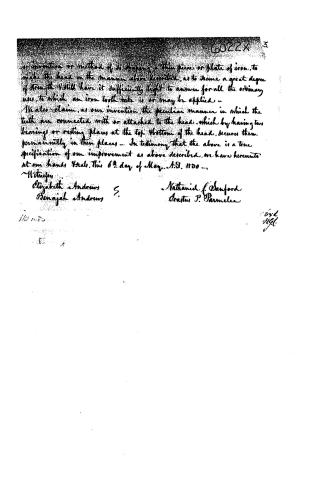
or invention or method of so shaping a thin piece or plate of iron, to make the head in the manner above described, as to secure a great degree of strength & still have it sufficiently light to answer for all the ordinary uses, to which an iron tooth rake is or may be applied — We also claim, as our invention, the peculiar manner in which the teeth are connected with or attached to the head, which by having two bearings or resting places at the top & bottom of the head, secures them permanently in their places — In testimony that the above is a true specification of our improvement as above described, we have hereunto set our hands & seals, this 6th day of May, A.D. 1850 —
Witnesses
Elizabeth Andrews
Benajah Andrews
Nathaniel C. Sanford
Crestus P. Parmelee
1/10 n. 75
6022
1196.
Published accounts: journal notice
Notice in the monthly list of patents, with remarks
Journal of the Franklin Institute, new ser., vol. 6 (1830), p. 223 · View the page
11. For an Iron Tooth Rake; Nathaniel Sanford and Erastus P. Parmelee, Meriden, New Haven county, Connecticut, June 8.
Remarks. The object proposed is to form the head of a rake of iron so that it shall at the same time be cheap, light, and durable. The head is to be formed of sheet iron about 1 inch thick, and two inches wide; the length being governed by the size required. About half an inch of the sheet iron is to be turned back at right angles, along each edge, so that its section will appear thus ]. The top of each tooth is to pass through a hole in the lower of these ledges, and to be rivetted into another hole in the upper ledge. In the middle of the plate a socket is to be fixed, for the handle to pass into. It is proposed, sometimes, to bend the sheet iron round, so as to form a tube, through one side of which the teeth are to pass, and be rivetted into holes made in the opposite side. The specification is of considerable length, but these are its leading features. The claim is to the shaping the piece which forms the head, in the manner described, so as to insure a great degree of strength, with the desired lightness; the teeth having two bearings, or resting places, at the top and bottom, which secures them permanently.
About this record
- Patentee
- DATAMP
- Date
- the Name and Date index of patents, DATAMP, USPTO records
- Invention
- DATAMP
- Listed in
- the Name and Date index of patents, DATAMP, USPTO records, Jim Shaw's X-patent list, the Journal of the Franklin Institute, Burke's List of Patents (1847)
- Burke's 1847 Patent Office list gives the same patent.