

Drawings and documents
National Archives restored drawings: drawing
Bernard Loll and James Doyle's Patent Drawing for an Apparatus for Making Soap by the Application of Steam

National Archives, Restored Patent Drawings (Record Group 241) · Full-size scan at the National Archives · Catalog record
Show the text on the drawing Hide (47 words)
Words on the drawing as machine-read by the National Archives; not checked. Useful mainly for searching.
87. OILS, FATS & GLUE. / [06] Soap Boiling. / $250 / OLLB. / CLASSIFICATION DIVISION 6084-4 Bornard Zoll James Doyle's / Apparatus for making Loap by the application of Iteam. / Patented: 19th July. 1830. / of / el / LM / LS / 48
USPTO scan
The patent as scanned by the USPTO
-
 Page 1
-
 Page 2
-
 Page 3
-
 Page 4


U.S. Patent and Trademark Office · Google Patents
Show the transcription Hide (959 words)
Machine transcription (LightOnOCR) of the pages as scanned by the USPTO, most of them the handwritten copies made when the records were restored after the 1836 fire. Not checked; it can misread handwriting, so compare it with the scan.
Page 1.
6084X
B. ZOLL & J. DOYLE.
MAKING SOAP.
Patented July 19, 1830.

Page 2.
November 23, 1839
Bernard Joll and James Doyle of Baltimore City.
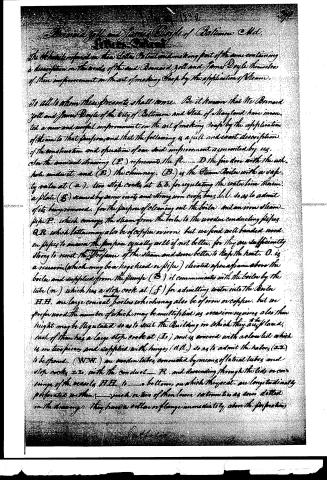
To all to whom these presents shall come. Be it known that We Bernard Joll and James Doyle of the City of Baltimore and State of Maryland have invented a new and useful improvement in the art of making Soap by the application of Steam to that purpose, and that the following is a full and exact description of the construction and operation of our said improvement as illustrated by us.
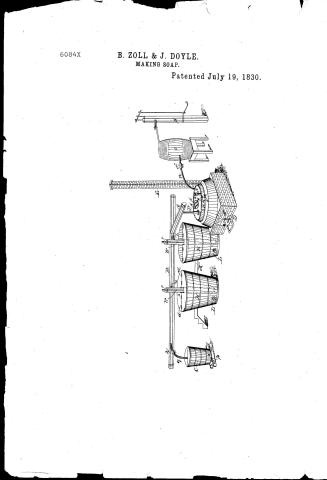
In the annexed drawing (E.) represents the flue—D the fire door with the ash hole under it, and (E.) the chimney. (B.) is the Steam Boiler with a safety valve at (a), two stop cocks at b.b. for regulating the water line therein, a plate (E) secured by screw irons and strong iron cross bars l.l. so as to admit of its being removed for the purpose of cleaning out the boiler and an iron Steam pipe P. which conveys the steam from the boiler to the wooden conducting pipes Q.R. which latter may also be of copper or iron, but we find well hewn wood in pipes to answer the purpose equally well if not better, for they are sufficiently strong to resist the pressure of the steam and serve better to keep the heat. O. is a reservoir (which may be a large head or pipe) elevated upon a frame above the boiler and supplied from the pumps (S) it communicates with the boiler by the tube (m) which has a stop cock at (f) for admitting water into the boiler. H.H. are large conical boilers which may also be of iron or copper, but we prefer wood, the number of which may be multiplied as occasion requires, also their height may be regulated so as to suit the Building in which they are to be placed, each of them has a large stop cock at (E) and is covered with a cover lid which is in two pieces and supplied with hinges (d.d.) so as to admit the water (x.x.) to be poured. (N.N.) are wooden tubes connected by means of lateral tubes and stop cocks z.z. with the conduit—R. and descending through the lids or coverings of the vessels H.H. to the bottoms on which they rest, are longitudinally perforated within—such holes of their lower extremities as are dotted in the drawing. They have a collar or flange immediately above the perforations.
Page 3.
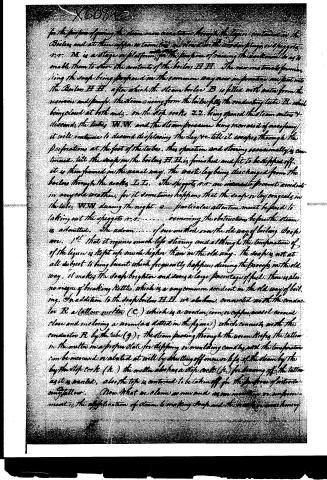
for the purpose of giving the steam more circulation through the liquor contained in the Boilers, and at the same time to transmit and direct to the wooden plugs or spigots, n.r. It is a stage or platform for the purpose of raising the contents of the boilers E.E. The raw materials forming the soap being prepared in the common way are now introduced into the Boilers E.E. after which the steam boiler B is filled with water from the reservoir and pumps. The steam rising from the boiler fills the conducting tube R, which being closed at both ends, on the stop cocks Z.Z. being opened the steam enters & descends the tubes W.W. and the steam pressure being increased if necessary it will continue to descend displacing the layer &c till it escapes through the perforations at the foot of the tubes. This operation and stirring occasionally is continued till the soap in the boilers E.E. is finished and fit to be dipped off, it is then formed in the usual way, the waste layer being discharged from the boilers through the cocks I.I. The spigots n.r. are intended to prevent accidents in very cold weather, for it sometimes happens that the soap or layer congeals in the tubes W.W. during the night, a particular attention must be paid to taking out the spigots n.r. removing the obstruction before the steam is admitted. The advantages of our method over the old way of boiling soap are: 1st that it requires much less stirring and although the temperature of the liquor is kept up much higher than in the old way, the soap is not at all subject to being burnt which frequently happens during the process in the old way. It makes the soap brighter and saves a large percentage of fuel. There is also no risque of breaking bottles, which is a very common accident in the old way of boiling. In addition to the soap boilers E.E. we also have connected with the conductor R a tallow melter (C) which is a wooden iron or copper vessel covered close and enclosing a worm (as dotted in the figure) which connects with the conductor R by the tube (g); the steam passing through the worm keeps the tallow in the melter in a proper state for dipping or moulding candles and the temperature can be increased or abated at will by shutting off more or less of the steam by the stop cock (h) the melter also has a stop cock (j) for drawing off the tallow as it is wanted, also the top is contrived to be taken off for the purpose of intro- ducing tallow. Now what we claim as new and as our invention or improvement is, the application of steam to making soap and the means or machinery
Published accounts: journal notice
Notice in the monthly list of patents, with remarks
Journal of the Franklin Institute, new ser., vol. 6 (1830), p. 300 · View the page
29. For the Application of Steam in the Art of Making Soap; Bernard Zell and James Doyle, Baltimore, Maryland, July 19.
Remarks. There is no novelty whatever in the apparatus described in this specification, nor do the patentees make any pretension of the kind. Tubes from a boiler conduct the steam into tubs, or vats, containing the ordinary materials for making soap. Another tub is added which contains tallow, and which is to be kept in a melted state by the steam, for the purpose of making candles: this, however, is not alluded to in the claim, which is to "the application of steam to making soap, and the vessels and machinery herein described and specified for that purpose." The latter part of the foregoing claim is fraught with danger, for the reason already given; and the former part does not, we apprehend, stand upon the most secure basis. In the manufacture of sugar, and of various other articles, vaporization has been effected by the application of steam; and although many patents have issued for the boiling of sugar in this way, they have all been for the structure of the apparatus employed, no one among the patentees having broadly claimed the application of steam, which is now as familiar as the application of heat by a naked fire.
About this record
- Patentee
- DATAMP
- Date
- the Name and Date index of patents, DATAMP, USPTO records
- Invention
- DATAMP
- Listed in
- the Name and Date index of patents, DATAMP, USPTO records, Jim Shaw's X-patent list, the Journal of the Franklin Institute, Burke's List of Patents (1847)
- Burke's 1847 Patent Office list gives the same patent.