

Drawings and documents
National Archives restored drawings: drawing
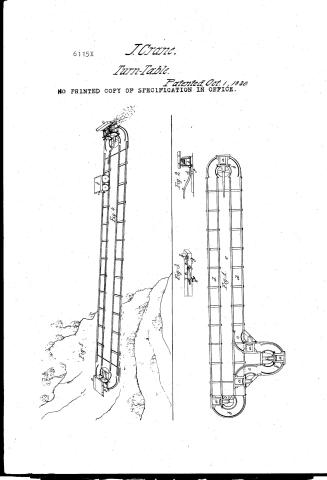
Jonathan Crane's Patent Drawing for a Turn About for Railroads

National Archives, Restored Patent Drawings (Record Group 241) · Full-size scan at the National Archives · Catalog record
Show the text on the drawing Hide (88 words)
Words on the drawing as machine-read by the National Archives; not checked. Useful mainly for searching.
104. RAILWAYS. / Tables / JONA / date 1 1830 / The "Way." / [120] / Turn Tables. / Turn about for Rail-roads / Patented / Oct. 1830 / $35 / I Crane / CLASSIFICATION / 6115-1 / DIV ISION. / Figs / Frig 4 / horizontal line / Adrawing of the Circular barr Receiver for which / a patent was granted to In athan brave of the / city of Schencetady of the state of Are York, bearing / Fig 3. / Fige: / date of October the first, Anno Domini, Eighteen / Jg / hundred and thirty. / Gigs / 40 fect / Scale / Klein.
USPTO scan
The patent as scanned by the USPTO
-
 Page 1
-
 Page 2
-
 Page 3


U.S. Patent and Trademark Office · Google Patents
Show the transcription Hide (823 words)
Machine transcription (LightOnOCR) of the pages as scanned by the USPTO, most of them the handwritten copies made when the records were restored after the 1836 fire. Not checked; it can misread handwriting, so compare it with the scan.
Page 1.
6115X
J. Crane.
Turn-Table.
Patented Oct. 1, 1830.
NO PRINTED COPY OF SPECIFICATION IN OFFICE.

Fig. 1
Fig. 2
Fig. 3
Fig. 4
Fig. 5
Page 2.
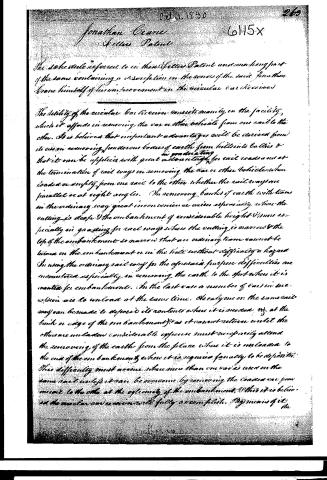
The schedule referred to in these Letters Patent and much hereof is of the same containing a description in the words of the said Jonathan Crane himself of his improvement in the circular car (herein)
The utility of the circular car (herein) consists mainly in the facility, which it affords in removing the car or other vehicle from one rail to the other. It is believed that important advantages will be derived from its use in removing sand or loose earth from hills into valleys & that it can be applied with great advantage in grading for rail roads and at the termination of rail ways in removing the car or other vehicle when loaded or empty from one rail to the other whether the rail ways are parallel or at right angles. In removing banks of earth with teams in the ordinary way great inconvenience arises especially where the cutting is deep & the embankment of considerable height & more especially in grading for rail ways where the cutting is narrow & the top of the embankment so narrow that an ordinary team cannot be turned on the embankment or in the field without difficulty or hazard. In using the ordinary rail way for the aforesaid purpose difficulties are encountered especially in removing the earth to the spot where it is wanted for embankment. In the last case a number of cars in succession are to unload at the same time. The only one on the same rail way can be made to deposit its contents when it is needed viz at the bank or edge of the embankment & as it cannot return until the others are unloaded considerable expense must necessarily attend the removing of the earth from the place where it is unloaded to the end of the embankment where it is required to be deposited. This difficulty must arise when more than one car is used on the same rail unless it can be overcome by removing the loaded car from one rail to the other at the extremity of the embankment. This it is believed the circular car herein will fully accomplish. By means of it the
Page 3.
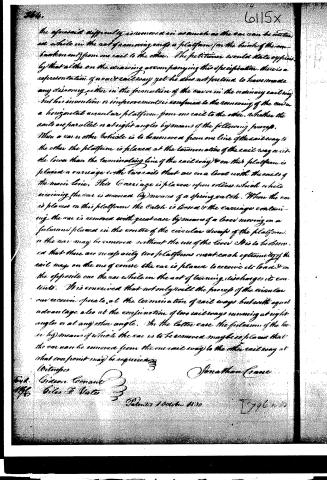
the aforesaid difficulty is removed in so much as the car can be entered or while in the act of removing upon a platform for the bank of the embankment only from one rail to the other. The petitioner would state expressly that all this on the drawing accompanying this specification, there is a representation of a car & railway yet he does not pretend to have made any discovery either in the formation of the curve in the ordinary railway but his invention or improvement is confined to the removing of the car on a horizontal circular platform from one rail to the other, whether the rails are parallel or at right angles by means of the following process.
When a car or other vehicle is to be removed from one line of the railway to the other the platform is placed at the termination of the railway (with the lower than the terminating line of the railway) & on this platform is placed a carriage with two rails that are on a level with the rails of the main line. This Carriage is placed upon rollers which while receiving the car is secured by means of a spring catch. When the car is placed on this platform the catch is loose & the carriage containing the car is removed with great ease by means of a lever moving on a fulcrum placed in the centre of the circular sweep of the platform, or the car may be removed without the use of the lever. It is to be observed that there are respectively two platforms over each extremity of the rail way, on the one of course the car is placed to receive its load & on the opposite one the car while in the act of turning, discharges its contents. It is conceived that not only will the process of the circular car receive its scale at the termination of rail ways but with equal advantage also at the conjunction of two railways running at right angles or at any other angle. In the latter case the fulcrum of the lever by means of which the car is to be removed maybe so placed that the car can be removed from the one railway to the other railway at that point may be required.
Witnesses
End. Sidon Conant
1856 Giles H. Bates
Jonathan Crane
Patented October 1850
Published accounts: journal notice
Notice in the monthly list of patents, with remarks
Journal of the Franklin Institute, new ser., vol. 7 (1831), p. 13 · View the page
81. For a Circular Car Receiver; Jonathan Crane, of the City of Schenectady, New York, October 1.
Remarks. We are informed that "the utility of the circular car receiver, consists mainly in the facility which it affords in removing the car, or other vehicle, from one rail to the other. It is believed that important advantages will be derived from its use in removing ponderous bodies of earth from hills into vallies, and that it can be applied with great advantage in graduating for rail-roads; and at the termination of rail-ways, in removing the car, or other vehicle, when loaded or empty, from one rail (track] to the other, whether the rail-ways are parallel, or at right angles." The principal object of the patentee appears to be to aid in the construction of rail-roads, where embankments are to be made.
About this record
- Patentee
- DATAMP
- Date
- the Name and Date index of patents, DATAMP, USPTO records
- Invention
- DATAMP
- Listed in
- the Name and Date index of patents, DATAMP, USPTO records, Jim Shaw's X-patent list, the Journal of the Franklin Institute, Burke's List of Patents (1847)
- Burke's 1847 Patent Office list gives the same patent.