

Drawings and documents
National Archives restored drawings: drawing
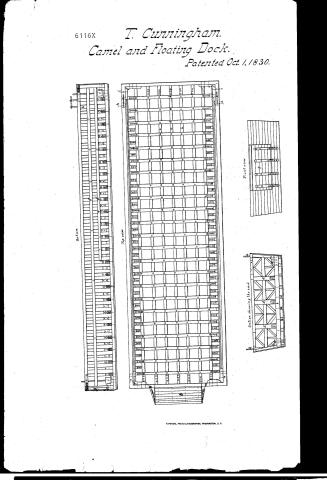
Thomas Cunningham's Patent Drawing for a Graving Dock

National Archives, Restored Patent Drawings (Record Group 241) · Full-size scan at the National Archives · Catalog record
Show the text on the drawing Hide (111 words)
Words on the drawing as machine-read by the National Archives; not checked. Useful mainly for searching.
114 / OLASS 114. SHIPS / 51, Camels & Floating Decks, / CLASSIFICATION / 6116.+ / Thomas Cunningham / Vol.io pg. s'oy / DIV ISION / Patented Oct 1. 1830. / Iraving Doch. / Section / section showing the End / Top view. / Front view. / Preferences. a.a.a.a &e. bottom timber. / b.b.b.b. de floor timber / ... Knees. / tolo / d.d.d King posts. i' walltimber / ceeeeede side timber / ffff corner Knees. / in / g the gate h.h.the pumpo z.z. scuttle holes. / Patent Office December 7 1841. / made under the direction of the bom missioner of Patents / in conformity with act of 3R much 1837. / 112 eumorts / of Patents
USPTO scan
The patent as scanned by the USPTO
-
 Page 1
-
 Page 2
-
 Page 3


U.S. Patent and Trademark Office · Google Patents
Show the transcription Hide (665 words)
Machine transcription (LightOnOCR) of the pages as scanned by the USPTO, most of them the handwritten copies made when the records were restored after the 1836 fire. Not checked; it can misread handwriting, so compare it with the scan.
Page 1.
6116X
T. Cunningham.
Camel and Floating Dock.
Patented Oct. 1, 1830.

Page 2.
Oct. 1, 1830 6116X 507
Thomas Cunningham of Pittsburg Penn
Letters Patent
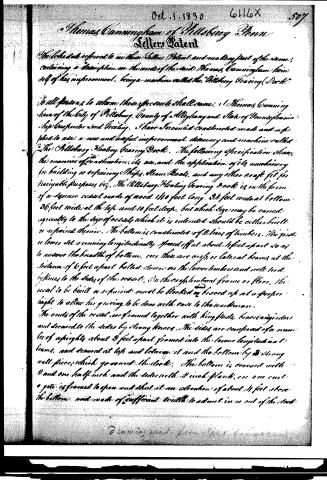
The schedule referred to in these Letters Patent and making part of the same, containing a description on the words of the said Thomas Cunningham him self of his improvement, being a machine called the "Pittsburg Drying Dock."
To all persons to whom these presents shall come: I Thomas Cunningham of the City of Pittsburg, County of Alleghany and State of Pennsylvania Ship Carpenter and Drying, Have Invented constructed made and applied to use: a new and useful improvement discovery and machine called the "Pittsburg Heating Drying Dock." The following Specification shows the manner of construction, its use, and the application of its machinery for building or repairing Ships, Steam Boats, and any other craft fit for Navigable purposes viz. The Pittsburg Heating Drying Dock is in the form of a square vessel made of wood 140 feet long, 34 feet wide at bottom, 36 feet wide at the top and 10 feet deep, but which size may be varied according to the size of vessels which it is intended should be either built or repaired therein. The bottom is constructed of 2 lines of timbers. The first or lower set running longitudinally, spaced off at about 18 feet apart so as to answer the breadth of bottom, over these are 2 or 3 lateral beams at the distance of 6 feet apart bolted down on the lower timbers and well tied fastness to the sides of the vessel. On these 2 or 3 lateral frame or floor, the vessel to be built or repaired must be blocked and boarded up at a proper height to allow her growing to be done with ease to the workman. The ends of the vessel are framed together with king posts, braces and joists and secured to the sides by strong knees. The sides are composed of a number of uprights about 3 feet apart framed into the lower longitudinal beams, and secured at top and below it and the bottom by 2 strong wall pieces which go round the dock. The bottom is covered with 2 and one half inch and the sides with 2 inch plank, on one end a gate is framed to open and shut at an elevation of about 11 feet above the bottom and made of sufficient width to admit in or out of the dock.
Dunning made from 1830
Page 3.
Such vessels as may have occasion to use it. It is hung on its lower horizon -al edge by large strap hinges and joints are made water tight by means of leather and bird's eye joints and is raised or let fall by means of ropes with tackles and pulleys. The 3 pumps are constructed on the end of rails to that when the gate is placed and scuttle holes are provided in each angle of the dock. To use this gravity dock it must be sunk in whatever water it is moved. The gate must be thrown open and the vessel to be repaired washed into her. The gate is then closed, the pumps geared to the steam engine and in a short time she will be dry inside and again afloat with the vessel to be repaired braced up on her stocks. After building or repairing is completed the scuttle holes are opened and the floating Diving Dock sunk. The gate thrown open and the vessel built or repaired floats off and immediately after another vessel is washed in for repair and the foregoing operation goes on in regular succession as business may require.
Witnesses
M. B. Laurie
W. W. Matsumas
H. Cunningham
Patented October 1830
Published accounts: journal notice
Notice in the monthly list of patents, with remarks
Journal of the Franklin Institute, new ser., vol. 6 (1830), p. 367 · View the page
17. For a Floating Graving Dock, to be used in building or repairing of ships, steam boats, and other craft, called the "Pittsburgh Floating Graving Dock;" Thomas Cunningham, Pittsburgh, Allegheny county, Pennsylvania, October 1.
Remarks. This floating dock is proposed to be made 140 feet long, 34 feet wide at the bottom, 36 at the top, and 10 feet deep. These dimensions may, of course, be varied according to circumstances. When the dock is to be used, the water is allowed to enter it, so that it may sink at its moorings, and admit the vessel which is to be repaired to float in. A gate at the stern is then raised to enclose the vessel, and the water is to be pumped out, care being taken to support the vessel's keel with proper blocks, and her sides with shores. Directions are given respecting the size of the timbers, the knees, and the thickness of the plank; but we are not told what there is in the structure upon which to found a claim to a patent. Without travelling abroad, to learn what has been done in other countries, we refer our readers to the detailed report of a committee of the Franklin Institute, on Commodore Barron's floating dock, at page 3, vol. iii. of the Franklin Journal, first series; and to another report in the same volume, p. 424, on a floating dock, invented by Edward Clark, Esq. civil engineer. We think that a perusal of these alone would suffice to convince the patentee, that if a floating dock is patented, he ought to tell in what particulars that which he claims to have invented, differs from those which have been before known.
About this record
- Patentee
- DATAMP
- Date
- the Name and Date index of patents, DATAMP, USPTO records
- Invention
- DATAMP
- Listed in
- the Name and Date index of patents, DATAMP, USPTO records, Jim Shaw's X-patent list, the Journal of the Franklin Institute, Burke's List of Patents (1847)
- Burke's 1847 Patent Office list gives the same patent.