

Drawings and documents
National Archives restored drawings: drawing
S. Slater's Patent Drawing for a Thrashing and Winnowing Machine

National Archives, Restored Patent Drawings (Record Group 241) · Full-size scan at the National Archives · Catalog record
Show the text on the drawing Hide (43 words)
Words on the drawing as machine-read by the National Archives; not checked. Useful mainly for searching.
Entered / 130. THRASHING / [159] Throughing Iach's / Cyl o S.SLATER'S / Pat'd- Oct.1 830. / $252 / Thrashing & Winnowing machine. / 6163 X / Patented Oct. 1st 1830. / Patented Oct t-1ˢ30 1st / Cr / ELE
USPTO scan
The patent as scanned by the USPTO
-
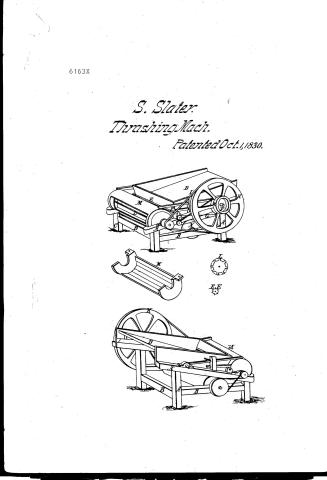 Page 1
-
 Page 2
-
 Page 3
-
 Page 4
-
 Page 5
-
 Page 6


U.S. Patent and Trademark Office · Google Patents
Show the transcription Hide (1,765 words)
Machine transcription (LightOnOCR) of the pages as scanned by the USPTO, most of them the handwritten copies made when the records were restored after the 1836 fire. Not checked; it can misread handwriting, so compare it with the scan.
Page 1.
6163X
S. Slater.
Thrushing Mach.
Patented Oct. 1, 1830.

Page 2.
Samuel Slater, Northern Liberties, Philada. Pa.
Letters Patent.
The Schedule referred to in these Letters Patent, and making part of the same, containing a description in the words of the said Samuel Slater himself of his improvement in the machine called Slater's Threshing and Winnowing Machine.
To all persons to whom these presents shall come.
I Samuel Slater of the Northern Liberties in the County of Philadelphia, State of Pennsylvania, Citizen, do hereby know that I Samuel Slater have invented, discovered, and applied to use, as a new and highly useful improvement in a Machine called known as Slater's Threshing and Winnowing Machine, for the purpose of threshing and cleaning all kinds of small grain, and particularly that of rice; a fan is connected with the machinery, that completely separates the straw and chaff from the grain at the same operation. It has also the desirable effect of expelling the dust from the person who attends the Machine; without that improvement the dust would be a great inconvenience to the operator, which has from practical experience been pronounced a superior to any Machine heretofore known or invented. A.A., the frame, made of scantling of either hard or soft wood, or of metal, if of wood scantling, five inches square iron in proportion, about six feet in length, and from two to three in width; the frame standing in the front two feet six inches in height, in the rear about four feet which gives it the position of an inclined plane; the above is calculated for a beam twenty-one inches in length, which will be hereafter described. B.B. the girts and joint bolts near the bottom, running from the back to the front posts on each side, and a cross back post to the other; in front is a girt within ten inches of the top, extending across the corresponding front posts, which are secured by joint bolts, on which rests the mouth of the Drawing.
Page 3.
the fan. C. The front posts, are about eighteen inches shorter than the rear posts which are about four feet in height. D. the inclined plane or flooring for the grain in the beam by which it is conducted to the feeding rolls, is made of pine or other boards worked smooth, of sufficient length to contain the longest sheaf of grain in the box, which is represented in the cut E, F. The feeding rolls, are constructed of wood or iron, if made of wood and iron it is necessary to have a wooden cylinder about three inches in diameter, fluted out in eight or ten places or more, half an inch in depth to receive pieces of common hoop iron set in edgewise, leaving it projecting out one fourth of an inch which will conduct the sheaves to the beater. The feeding rolls have a shaft or quidgans passing through the ends and extending across the frame, of sufficient length to admit the bearings and pulleys; the said pulleys are about four inches in diameter and grooved on the edge to admit a turned band that connects with the drawing pulley on the main wheel shaft. F. The main balance wheel shaft, one and three quarter inch in diameter, extending across the frame of the machine twelve inches clear on the left hand side, which is turned with bearings, secured by braces and caps to the frame. The caps to the said braces have a cup or cavity which will contain about half a gill of oil, and a wiper at the bottom which gradually falls upon the quidgans, the moisture of which is a complete prevention from heat or friction. G. The pulleys on the projecting shaft, nine inches in diameter, turned with grooves and connected with bands to drive the feeding rolls, which can be increased in size to give any required speed. H. The balance wheel about six feet in diameter, connected with the aforesaid drawing pulley on the before mentioned projecting shaft, the weight of this wheel is about two hundred pounds. The design of this is to keep the momentum of the beater up, which will prevent the steam from checking the velocity of the beater, which is
Page 4.
all important in threshing the grain and cleaning it, in a manner not heretofore known or done by any machinery.
1. The belt which around the main wheel that drives the whirl or pulley attached to the beater, is cut. It may also be constructed with a bevel to conform with the figure or hieroglyphic, thus $\mathcal{V}$ , which will prevent the band from paping off the wheel, or running at random; the band must paptwo or three times round the wheel extending to the whirl, in a like manner on the shaft of the beater then to be placed two or three times round it to prevent it from slipping. K. A pulley attached to the main balance wheel eight inches in diameter and may be used with either belt or band leading to the horse power; which may be constructed in the same manner as the aforementioned balance wheel. L. The beater or cylinder, is twenty seven inches in length, constructed with a shaft about one and three quarters of an inch in diameter, made of iron turned with bearings and projecting over both sides for the reception of the driving pulleys, which are bound to the frame by ropes and caps as explained under the letter F. The beater is about ten or twelve inches from the front of the frame the beater or cylinder is made of wood eight inches in diameter ten inches including the beater which are iron set in grooves of half an inch, which have tenons on each end, on which is a head of wrought or cast iron with mortises to receive them; this is the head of the cylinder, See cut; the said beater which is in front of the feeding rolls also in the front part of the machine beats the grain upwards against the cone, while the fan or cleaning machine acts beneath. M. The cone, is a cylinder of cast iron, which covers about one third of the beater, with grooves on the inside which act as a rubbe against the beater; the cone rests on the frame, has heads at each end, it comes in contact within the eighth part of an inch of the beater secured by wooden springs resting on the top. See but; there is also a projecting ear or piece of iron, one and a half inch on each end of the cone which
Page 5.
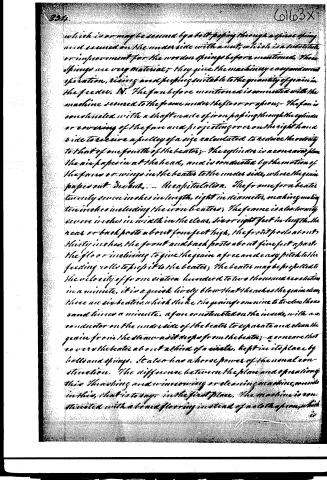
which is or may be secured by a bolt passing through a pin or key and secured on the under side with a nut, which is a substitute or improvement for the wooden springs before mentioned. These springs are very material; they give the machinery easy and smooth operation, rising and falling suitable to the quantity of grain in the feeder. N. The fan before mentioned is connected with the machine secured to the frame under the floor or apron; the fan is constructed with a shaft made of iron passing through the cylinder or covering of the fan and projecting over on the right hand side to receive a pulley of a size calculated to reduce the rotary to that of one fourth of the beater; the cylinder is a cone and has the air passed in at the head, and is conducted by the motion of the fans or wings in the beater to the under side, where the grain passes out.
Decapitation. The frame for a beater is only seven inches in length, eight in diameter, making making ten inches including the iron beater; the frame is also twenty seven inches in width in the clear, six or eight feet in length, the rear or back posts about four feet high, the front posts about thirty inches, the front and back posts about five feet apart, the floor inclining to give the grain a free and easy pitch to the feeding rolls to prop it to the beater; the beater may be propelled to the velocity of from sixteen hundred to two thousand revolutions in a minute, it is a quick lively blow that shakes the grain down, there are six beaters which strike the grain from nine to twelve thousand times a minute. A fan constructed on the inside, with a conductor on the under side of the beater to separate and clean the grain from the chaff and drops from the beater; a cone that covers the beater about a third of a circle, kept in its place by bolts and springs. It also has a horse power of the usual construction. The difference between the plan and operation of this threshing and winnowing or cleaning machine, consists in this, that is to say, in the first place, the machine is constructed with a broad flooring instead of a cloth of iron, which is
Page 6.
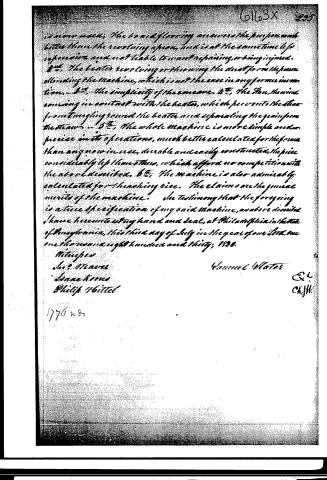
is now used; the board flooring answers the purpose much better than the revolving spoon, and is at the same time less expensive and not liable to want repairing, or being injured. 8th, The beater revolving or throwing the dust from the spoon alluding the machine, which is not the case in any former invention. 9th, The simplicity of the same. 10th, The fan, the wind coming in contact with the beater, which prevents the thread from tangling round the beater and separating the grain from the flour. 11th, The whole machine is more simple and inexpensive in its operations, much better calculated for the purpose than any now in use, durable and easily constructed, the price considerably less than others, which afford no competition with the above described. 12th, The machine is also admirably calculated for threshing rice. The claims are the genuine merits of the machine. In testimony that the foregoing is a true specification of my said machine, and above described, I have hereunto set my hand and seal, at Philadelphia in the state of Pennsylvania, this third day of July in the year of our Lord, one thousand eight hundred and thirty; 1830.
Witnesses
Jas. Weaver
Isaac Krons
Philip Whittel
Samuel Water
1776 n. 87
Published accounts: journal notice
Notice in the monthly list of patents, with remarks
Journal of the Franklin Institute, new ser., vol. 7 (1831), p. 7 · View the page
63. For a Thrashing and Winnowing Machine; Samuel Slater, Northern Liberties, Philadelphia county, Pennsylvania, October 1.
Remarks. We will let the patentee tell for himself the improvements which he has made. After describing his machine, which we should be in danger of confounding with some others, he says, "the difference between the plan and operation of this thrashing and winnowing, or cleaning machine, consists in this, that is to say; in the first place, the machine is constructed with a board flooring instead of a cloth apron, which is now used. The board flooring answers the purpose much better than the revolving apron, and is at the same time less expensive, and not liable to want repairing; or to being injured. 2nd. The beater revolving or throwing the dust from the person attending the machine, which is not the case in any former invention. 3d. The simplicity of the concave. 4th. The fan, the wind coming in contact with the beater, which prevents the straw from tangling. 5th. The whole machine is more simple, and precise in its operations, much better calculated for the farmer than any now in use, durable, and easily constructed, the price considerably less than others, which afford no competition with the above described. 6th. The machine is also admirably calculated for thrashing rice." The foregoing novelties, are some of them old, and others intangible. The board flooring has been long and frequently employed. The beater throwing the dust from the person has been used in former machines. With respect to the cheapness, and other desirable properties of that kind, we have nothing to say, and will only add a curious kind of claim, which also belongs to the intangibles, "the claims are the general merits of the machine."
About this record
- Patentee
- DATAMP
- Date
- the Name and Date index of patents, DATAMP, USPTO records
- Invention
- DATAMP
- Listed in
- the Name and Date index of patents, DATAMP, USPTO records, Jim Shaw's X-patent list, the Journal of the Franklin Institute, Burke's List of Patents (1847)
- Burke's 1847 Patent Office list gives the same patent.