

Drawings and documents
National Archives restored drawings: drawing
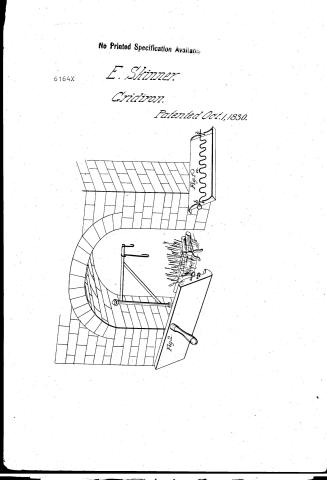
Elijah Skinner's Patent Drawing for a Baking Iron

National Archives, Restored Patent Drawings (Record Group 241) · Full-size scan at the National Archives · Catalog record
Show the text on the drawing Hide (76 words)
Words on the drawing as machine-read by the National Archives; not checked. Useful mainly for searching.
p2- / 126. STOVES &F RNACES / [154] Gridirons. / classification / 6164-+ X / ELIJAH SKINNER / DIV ISION. / Baking Iron. / Patented 1 October 1830 / Tig2 / References. / Fight / mint / / 2 Twnt Back view view a e the the wire. wooden bl the niohes handle. / colo / Patent office Aprilthe 20th 1839. / made under the direction of the Commifsioner of / Satents in inconformity with act of 3. march 1837 / sumich / Commitsioner of Patento
USPTO scan
The patent as scanned by the USPTO
-
 Page 1
-
 Page 2
-
 Page 3


U.S. Patent and Trademark Office · Google Patents
Show the transcription Hide (741 words)
Machine transcription (LightOnOCR) of the pages as scanned by the USPTO, most of them the handwritten copies made when the records were restored after the 1836 fire. Not checked; it can misread handwriting, so compare it with the scan.
Page 1.
No Printed Specification Available.
6164X
E. Skinner.
Gridiron.
Patented Oct. 1, 1830.
Fig. 1
Fig. 2
Page 2.
Oct. 1, 1890
Elijah Skinner, of Sandwich, N.H. 6164x
Letter Patent
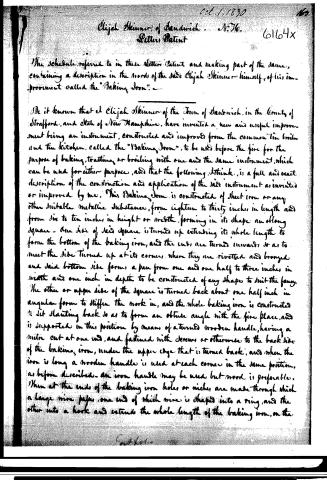
The schedule referred to in this Letter Patent and making part of the same, containing a description in the words of the said Elijah Skinner himself, of his improvement called the "Baking Iron".
Be it known that I Elijah Skinner of the Town of Sandwich, in the County of Strafford, and State of New Hampshire, have invented a new and useful improvement being an instrument, constructed and improved from the common Tin boiler and Tin Kitchen, called the "Baking Iron", to be used before the fire for the purpose of baking, toasting, or broiling with one and the same instrument, which can be used for either purpose, and that the following, I think, is a full and exact description of the construction and application of the said instrument as invented or improved by me. This Baking Iron is constructed of sheet iron or any other suitable metallic substance, from eighteen to thirty inches in length and from six to ten inches in height or width, forming in its shape an oblong square. One side of said square is turned up extending its whole length to form the bottom of the baking iron, and the ends are turned inwards so as to meet the side turned up at its corners, where they are rivetted and bronzed and said bottom side forms a pan from one and one half to three inches in width and one inch in depth to be constructed of any shape to suit the fancy. The other or upper side of the square is turned back about one half inch in angular form to stiffen the work in, and the whole baking iron is constructed to sit slanting back so as to form an obtuse angle with the fire place, and is supported in this position by means of a turned wooden handle, having a notch cut at one end, and fastened with screws or otherwise to the back side of the baking iron, under the upper edge that is turned back, and when the iron is long a wooden handle is used at each corner in the same position, as before described. An iron handle may be used but wood is preferable. Then at the ends of the baking iron holes or niches are made through which a large wire paper, one end of which wire is shaped into a ring, and the other into a hook and extends the whole length of the baking iron, on the
Cust. 1890
Page 3.
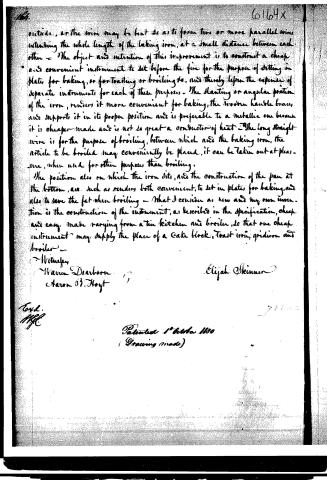
outside, or the wire may be bent so as to form two or more parallel wires extending the whole length of the baking iron, at a small distance between each other. The object and intention of this improvement is to construct a cheap and convenient instrument to set before the fire for the purpose of setting in plates for baking, or for toasting or broiling, and thereby lessen the expense of separate instruments for each of these purposes. The slanting or angular portion of the iron, renders it more convenient for baking, the wooden handle braces and supports it in its proper position and is preferable to a metallic one because it is cheaper made and is not so great a conductor of heat. The long straight wire is for the purpose of broiling, between which and the baking iron, the article to be broiled may conveniently be placed, it can be taken out at pleasure, when used for other purposes than broiling.
The position also on which the iron sits, and the construction of the pan at the bottom, are such as renders both convenient, to set in plates for baking, and also to save the fat when broiling. What I consider as new and my own invention is the construction of the instrument, as described in the specification, cheap and easy make ranging from a tin kitchen and broiler, so that one cheap instrument may supply the place of a Cake block, Toast iron, gridiron and broiler.
Witnesses
Warren Dearborn
Aaron B. Hoyt
Elijah Skinner
Patented 1st October 1850
(Drawing made)
Published accounts: journal notice
Notice in the monthly list of patents, with remarks
Journal of the Franklin Institute, new ser., vol. 7 (1831), p. 7 · View the page
62. For a Baking Iron, for the purpose of Baking, Toasting, or Boiling; Elijah Skinner, Sandwich, Strafford, county, New Hampshire, October 1.
Remarks. This is an affair made of sheet iron, and in form something like a cheese toaster. Its principal merit and novelty consists in its being more cheaply made than a tin kitchen. "What I consider as new," says the patentee, "and my own invention, is the construction of the instrument as described in the specification, cheap, and easy made, varying from a tin kitchen and boiler, so that one cheap instrument may supply the place of a cake block, toast iron, gridiron, and broiler."
About this record
- Patentee
- DATAMP
- Date
- the Name and Date index of patents, DATAMP, USPTO records
- Invention
- DATAMP
- Listed in
- the Name and Date index of patents, DATAMP, USPTO records, Jim Shaw's X-patent list, the Journal of the Franklin Institute, Burke's List of Patents (1847)
- Burke's 1847 Patent Office list gives the same patent.