

Drawings and documents
USPTO scan
The patent as scanned by the USPTO
-
 Page 1
-
 Page 2
-
 Page 3


U.S. Patent and Trademark Office · Google Patents
Show the transcription Hide (708 words)
Machine transcription (LightOnOCR) of the pages as scanned by the USPTO, most of them the handwritten copies made when the records were restored after the 1836 fire. Not checked; it can misread handwriting, so compare it with the scan.
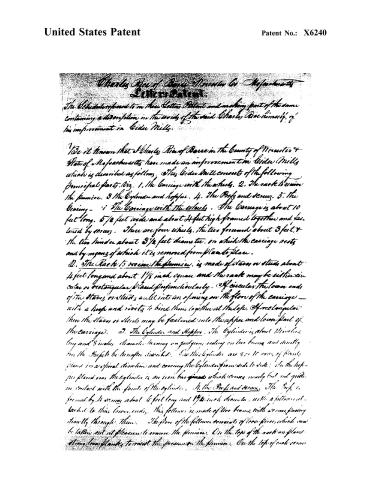
Page 2.
United States Patent
Patent No.: X6240
Charles Rice of Barre, Worcester Co. Massachusetts
Letters Patent.
The Subscriber proclaims to me these Letters Patent and making part of the same containing a description in the words of the said Charles Rice himself, of his improvement in Licker Mills.
Be it known that I Charles Rice of Barre in the County of Worcester & State of Massachusetts have made an improvement in Licker Mills which is described as follows. This Licker Mill consists of the following principal parts. Viz. 1. The Carriage with the wheels. 2. The rack to receive the fennice. 3. The Cylinder and Hopper. 4. The Prefs and Screws. 5. The Bearing.
1. The Carriage with the wheels. The Carriage is about 10 feet long, 5 1/2 feet wide and about 4 feet high framed together and fastened by screws. There are four wheels, the two forward about 3 feet, and the two hinder about 3 1/2 feet diameter, on which the carriage rests, and by means of which it is removed from place to place.
2. The Rack to receive the fennice. is made of staves or studs about 4 feet long and about 1 1/2 inch square and the rack may be either circular or rectangular placed perpendicularly. If circular the lower ends of the staves or studs are cut into an opening on the floor of the carriage — with a hook and rivets to bind them together at the top. If rectangular then the staves or studs may be fastened into the upper and lower part of the carriage.
3. The Cylinder and Hopper. The Cylinder is about 11 inches long and 8 inches diameter turning on gudgeons resting on two beams and directly over the Prefs to be hereafter described. On this Cylinder are 8 to 10 rows of flanks placed in a spiral direction and covering the Cylinder from side to side. In the hopper placed over the Cylinder is an iron bar which comes nearly but not quite in contact with the flanks of the Cylinder.
4. The Prefs and Screws. The Pref is formed by 4 screws about 6 feet long and 1 1/2 inch diameter with a follower attached to their lower ends. This follower is made of two beams with screws passing directly through them. The floor of the follower consists of loose pieces which can be taken out at pleasure to remove the fennice. On the top of the rack are placed strong iron flanks to resist the pressure on the fennice. On the top of each screw
Page 3.
United States Patent
Patent No.: X6240
is a nut working against another riding on the lower end of the lever, a sliding board is placed at the bottom of the hopper in which the cider falls and is collected.
3. The cleaning is similar to that in common use and is adapted to the purpose of the mill. This cider mill may be worked by animal, water, or steam power.
Operation. The apples are put into the hopper. The mill is set in motion. The apples are ground by the cylinder, the pomace descends into the frock, upon the bars of the follower. The blanks being placed over the tops of the cake, the cakes are turned by a worm which bring up the follower with the pomace against them, and thus the juice of the apples is pressed out. The juice falls down and is collected in the sliding board from whence it runs into a trough or tub, the pomace is taken out by removing the bars of the follower.
The Invention here claimed, and for which Letters Patent are desired is the Body, the Back, and the arrangement of the different parts of the mill as above described.
I further to illustrate my invention, I herewith the model and drawing of the same deposited in the Patent Office. I testify that the foregoing is a true description of my Invention. I have signed my name before two witnesses and made oath to the same at the City of Washington this 3rd day of November 1830.
Witnesses:
William P. Elliot
Charles A. Geller
Charles Rice
(720 words)
Published accounts: journal notice
Notice in the monthly list of patents, with remarks
Journal of the Franklin Institute, new ser., vol. 6 (1830), p. 387 · View the page
When the substance is not finely divided, the action of the heated water on the fecula being slower, the mucilage is partly liquefied as soon as formed, the mass not being thickened as in the first case, I add the whole of the substance at first; I also agitate it, but it is to divide, or the better to crush it; as the action of the heat and acidulated water soften it. I regulate the quantity of water to be used according to the state of concentration in which I wish to obtain the sirop, and, if the heating is effected by introducing steam into the mass, an equal quantity of water to that formed by its condensation should be deducted from the original quantity. When the largest proportion of acid is used, corn, unbroken, is saccharified in about twenty-four hours, and its meal in about six. Rice, either whole, or in a state of flour, is also saccharified in about six hours. When, on the contrary, the smallest proportion of acid is used, it may require more than four days for corn unbroken, and thirty-six hours for its meal. Twenty-four hours for rice, but, for its flour, about one-fourth of that time is sufficient. As the time given above may vary, I merely give it as a guide, for I always ascertain the termination of the operation, by the tincture of iodine no longer giving a blue or purple colour to the liquid, as is the case so long as any portion of the fecula remains unsaccharified. I then neutralize the acid with lime, or a carbonate of lime, and separate, (if required,) by filtering, or any other means, the sirop from the sediment. The sirop thus obtained may be afterwards evaporated, fermented, or applied in any way which may be found convenient. What I claim I claim as new, and as my invention and discovery, is the saccharification, by the combined action of heat, and water acidulated by sulphuric acid, of the fecula of rice and maize, without separating it from their other principles, by whatever variation of the within recited process the same may be effected. A. J. BRASIER. Specification of a patent for an improvement upon the Running Cap Spinner, which was patented on the 13th of June, 1829. Granted to JOHN THORP, Providence, Rhode Island, November 11, 1830.
Remarks. (WITH A COPPER-PLATE.) Be it known, that I, John Thorp, of Providence, in the county of Providence, and state of Rhode Island, &c. have invented, constructed, made, and applied to use, new and useful improvements in machinery for spinning, and in spinning cotton yarns, being improvements on my running cap spinner, patented on the 13th day of June, A. D. 1829, by which is produced a new mode of obstructing the revolving progress of the yarn, causing it to fall back of the cap, and wind upon the bobbin. The spindle used is the common throstle spindle. Two projecting lips are affixed to that part of it where the bobbin usually traverses. These lips are on opposite sides of the spindle, are parallel with it, and project about the sixteenth of an inch. They extend up no further than the base of the bobbin, when at its highest position, and there should be length enough to the spindle above them, to allow the bobbin to be raised above them, so as to turn on the spindle for the purpose of yielding the yarn for piecing, &c. The common throstle flyer is converted into what I call a cap, by affixing to the lower extremity of its arms, in a horizontal position, a ring called the connecting ring, sufficiently large to allow the bobbin to traverse up and down through it. This ring guides the yarn to, and distributes it on, the bobbin. The yarn is not connected with the cap, but is left to revolve around its surface. The bobbin used, is the common throstle bobbin, with a channel, or groove, formed on each side of its perforation, in which the above described lips of the spindle traverse, and by which the bobbin is made to turn with the spindle. Or, there may be to each spindle, a tube of the length of the bobbin, in which the said channels, or grooves, may be formed, having a large head, or collar, at the bottom, on which the bobbin will loosely set. This tube may be made of sheet iron, and not entirely closed, and brazed to a head, or collar, of the same. In this case, the opening in the side of the tube, will answer for one channel, or groove, and the other channel, or groove, and one of the lips on the spindle may be dispensed with. The friction of the base of the bobbin on this head, or collar, will be sufficient to give motion to the bobbin; and the bobbin being allowed to turn on said tube, will at any time yield the yarn when it is necessary that it should be drawn from it, as in piecing the ends, &c. Or, instead of said lips, on the spindle, grooves, or channels, may be made in it, and a collar used to give motion notion to the bobbin. This collar should be about the size of the base of the bobbin, and made to slide loosely on the spindle. From the sides of its perforation, two lips project inward, and into the channels, or grooves, in the spindle, causing the collar to turn with the spindle. But the principal improvement consists in a stationary spiral lip, or rim, that I call the check. The upper edge of the check is within the connecting ring. One end, or part of this check, is placed and remains above this ring, while the other end remains below it. The space between the inside of this ring and the outside of the check, should be large enough to allow the yarn to revolve freely in it.
Published accounts: journal notice
Notice in the monthly list of patents, with remarks
Journal of the Franklin Institute, new ser., vol. 7 (1831), p. 164 · View the page
34. For an improvement in Cider Mills; Charles Rice, Barre, Worcester county, Massachusetts, November 11.
Remarks. This cider mill and press are placed upon wheels, to move them from place to place. There is a sweep, attached to an upright shaft, to be turned by horse power. The apples are put into a hopper, at the lower part of which is a cylinder with teeth, by the revolution of which they are ground. The pommage falls into a square or circular rack, or cage, in which it is to be pressed. At the bottom of this cage there is a follower, which may be drawn up by two screws, the cider then runs down into a trough below. "The invention here claimed, and for which a patent is desired, is the press; the rack; and the arrangement of the different parts of the mill as before described." This claim we think much too indefinite, as there are other patented cider mills in which some of the arrangements are essentially the same with the present.
About this record
- Patentee
- DATAMP
- Date
- the Name and Date index of patents, DATAMP, USPTO records
- Invention
- DATAMP
- Listed in
- the Name and Date index of patents, DATAMP, USPTO records, Jim Shaw's X-patent list, the Journal of the Franklin Institute, Burke's List of Patents (1847)
- Burke's 1847 Patent Office list gives the same patent.