

Drawings and documents
National Archives restored drawings: drawing
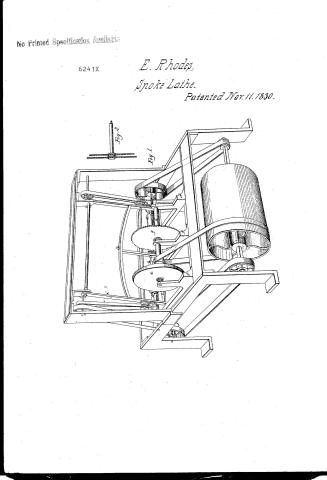
Elias Rhodes' Patent Drawing for an Improvement in the Lathe

National Archives, Restored Patent Drawings (Record Group 241) · Full-size scan at the National Archives · Catalog record
Show the text on the drawing Hide (108 words)
Words on the drawing as machine-read by the National Archives; not checked. Useful mainly for searching.
142. WOOD TURNING. / Turning Irregular Forms. / Elias Rhodes / $3- / Improvement in the Lathe / TLASSIFICATION / 6241-+ / Votio. Tio. pg. 383. / DIV ISION. / Patented Noo. H. 1830. / Tig. / Jis.2. / 1116 / Ontia the Inferences. rough pinceof wood. / b. the pattern a wagon spoke. / P d the pinions. / oikating frame. / e smooth east iron wheel. / fifthe frame mooing sideways. / g. circular saw. h the axis. / Sig 2. two Taws fixed upon the axish. / Patent office the Dear / made under the direction of the born mipioner / of Patents in conformity with Get of 3º march 183% / Ch. Hinhman froit. / ML Sumorth / Commissioner of Patents.
USPTO scan
The patent as scanned by the USPTO
-
 Page 1
-
 Page 2
-
 Page 3


U.S. Patent and Trademark Office · Google Patents
Show the transcription Hide (534 words)
Machine transcription (LightOnOCR) of the pages as scanned by the USPTO, most of them the handwritten copies made when the records were restored after the 1836 fire. Not checked; it can misread handwriting, so compare it with the scan.
Page 1.
No Printed Specification Available
6241X
E. Rhodes,
Spoke Lathe.
Patented Nov. 11, 1830.
Fig. 1
Fig. 2
Page 2.
Patent Drawing of Improvements on Saw Blade
Nov 11, 1830
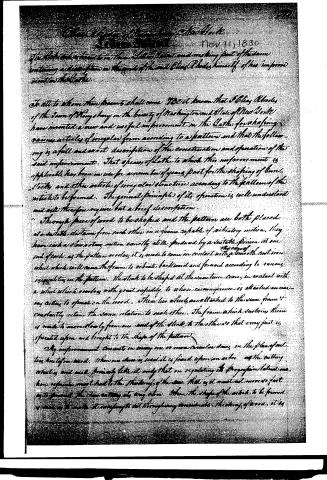
I, Elias Phelps, of the town of Washington, in the State of New York, do hereby declare that I have invented a new and useful improvement in the saws for shaping various articles of irregular form according to a pattern, and that the following is a full and exact description of the construction and operation of the said improvement. That species of saw to which this improvement is applicable has been in use for a considerable time past for the shaping of curved strokes, and other articles of irregular structure according to the pattern of the article to be formed. The general principle of its operation is well understood and will therefore require but a brief description.
Through pieces of wood to be shaped and the pattern are both placed at a suitable distance from each other in a frame capable of oscillatory motion. They have each a sliding motion exactly alike, produced by a suitable pinion at one end of each; as the pattern revolves, it is made to come in contact with a smooth cast iron wheel which will cause the frame to vibrate backward and forward according to various inequalities in the pattern. The stroke to be shaped at the same time comes in contact with a wheel which revolves with great rapidity, to whose circumference is attached numerous cutting to operate on the wood. These two wheels are attached to the same frame and constantly retain the same relation to each other. The frame which involves them is made to move slowly from one end of the stroke to the other so that every part is operated upon and brought to the shape of the pattern.
My improvement consists in using one or more circular saws in the place of cutting knives heretofore used. When one saw is used it is fixed upon an axis of the cutting wheel and must formerly take it only that in regulating its progressive lateral motion reference must had to the thickness of the saw. That is it must not move so fast as to prevent the saw cutting its way clear. When the shape of the article to be formed is such as to make it necessary to cut through any considerable thickness of wood, it is
Page 3.
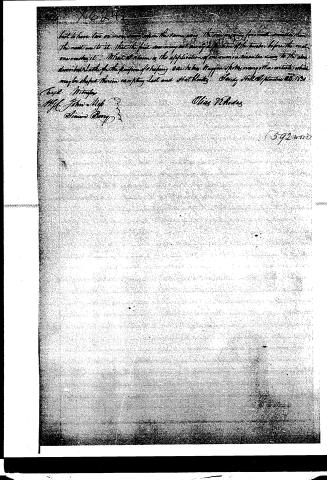
but to have two or more bars upon the same page. The one may for most words be the next one to it. That the first one may not carry all the tone before the next one reaches it. What I claim is the application of a new or peculiar way to the way described. I attach the figures of shaping each to his tray in which many other articles which may be shaped therein are placed. Last and Hot Blocks. Sandy Hill September 23, 1851
Eph. Mitryer
Wm. John Mfg
Simon Berry
Olas Whoses
(592 wro)
Published accounts: journal notice
Notice in the monthly list of patents, with remarks
Journal of the Franklin Institute, new ser., vol. 7 (1831), p. 164 · View the page
36. For an improvement in the Lathe for shaping various articles of irregular form, according to a pattern; Elias Rhodes, Kingsbury, Washington county, New York, November 11.
Remarks. The specification commences by informing us that the "species of lathe to which this improvement is applicable, has been in use for a number of years past, for the shaping of gun stocks, and other articles of irregular figure according to a pattern of the article to be formed. The general principle of its operation is well understood, and will therefore require but a brief description." After giving this brief description, it is said, "What I claim is the application of one or more circular saws to the above described lathe, for the purpose of shaping axe helves, wagon spokes, or any other article which may be shaped therein, excepting lasts and hat blocks." This is rather a curious kind of claim, and one which is based upon a common, but very mistaken notion. The patentee does not pretend to have invented the machine, and excepts lasts and hat blocks from his claim, because they are made in a similar lathe. It has been decided in court, and the decision rests upon the plain dictates of common sense, that to apply an old machine to a new purpose, is not an invention, or discovery, for which a patent can be sustained.
About this record
- Patentee
- the Journal of the Franklin Institute, Journal
- Date
- the Name and Date index of patents, USPTO records, Jim Shaw's X-patent list
- Invention
- the Name and Date index of patents
- Listed in
- the Name and Date index of patents, USPTO records, Jim Shaw's X-patent list, the Journal of the Franklin Institute, Burke's List of Patents (1847)
- The patentee's full name comes from the Franklin Institute's journal.
- The residence comes from the Franklin Institute's journal.
- Burke's 1847 Patent Office list gives the same patent.