

Drawings and documents
National Archives restored drawings: drawing
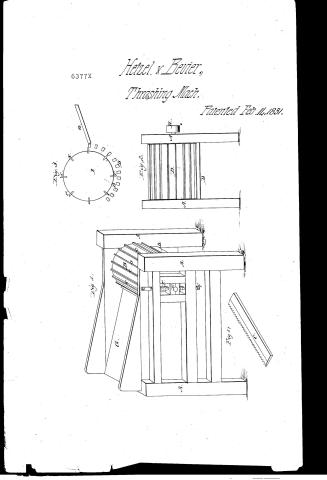
J. Hetzel and J. Bevier's Patent Drawing for a Threshing Machine and Corn Sheller

National Archives, Restored Patent Drawings (Record Group 241) · Full-size scan at the National Archives · Catalog record
Show the text on the drawing Hide (103 words)
Words on the drawing as machine-read by the National Archives; not checked. Useful mainly for searching.
Eintered / es. / chines. / J. Hitzel & f. Bevier / Tol.13.p.247. / Threshing & Machine / Patented 14 the! 1831, / CLASSIFICATION / born Sheller, / 6377+ / DIVISION. / from barn / Square bass of / from or flat / bars set up edge- / mys / Fid:1. References, threshind machine, / Fight end view. Fig. 3. cylender / and concave, Fid. bar detatched / from cylinder, A. frame. B. cylinder / C.barsof ditto. D.concave, Enfrictionbox. / Escrewsto regulate cylinder, G inclined box, / Hepulley. / Patent Office March 17 1842 / Made under the direction of the Commiprone of Patents / in conformity with act of Cougrep 3 March 1837, / Commisioner of Patents
USPTO scan
The patent as scanned by the USPTO
-
 Page 1
-
 Page 2
-
 Page 3


U.S. Patent and Trademark Office · Google Patents
Show the transcription Hide (646 words)
Machine transcription (LightOnOCR) of the pages as scanned by the USPTO, most of them the handwritten copies made when the records were restored after the 1836 fire. Not checked; it can misread handwriting, so compare it with the scan.
Page 1.
6377X
Hetzel & Bevier,
Thrashing Mach.
Patented Feb. 14, 1831.
Fig. 1.
Fig. 2.
Fig. 3.
Fig. 4.
Page 2.
6377X
Feb. 14, 1831
Jacob Hetzel & Jofac Bevier
Letters Patent
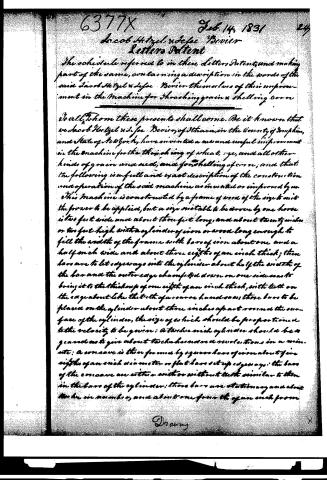
The schedule referred to in these Letters Patent, and making part of the same, containing a description in the words of the said Jacob Hetzel & Jofac Bevier themselves of their improvement in the Machine for threshing grain & shelling corn.
To all To whom these presents shall come. Be it known that we Jacob Hetzel & Jofac Bevier, of Stranin, in the County of Suffolk, and State of New York, have invented a new and useful improvement in the Machine for the threshing of wheat, rye, and all other kinds of grain and seed, and for shelling of corn; and that the following is a full and exact description of the construction and operation of the said machine as invented or improved by us.
This Machine is constructed by a frame of wood of the size to suit the power to be applied, but a size suitable to be drawn by one horse is two feet wide and about three feet long, and about twenty inches or two feet high with a cylinder of iron or wood long enough to fill the width of the frame with bars of iron about one and a half inch wide and about three eighths of an inch thick; then bars are to let edgewise into the cylinder about half the width of the bar and the outer edge chamfered down on one side so as to bring it to the thickness of one eighth of an inch thick, with teeth on the edge about like the teeth of a coarse hand saw; these bars to be placed on the cylinder about three inches apart round the surface of the cylinder, the size of which should be proportioned to the velocity to be given: A two-inch cylinder should be so geared as to give about two and a half revolutions in a minute: A concave is then formed by square bars of iron about five eighths of an inch diameter or flat bars set up edgewise: the bars of the concave are either with or without teeth similar to those in the bars of the cylinder; these bars are stationary and about twelve in number, and about one foot to span each from
Drawing
Page 3.
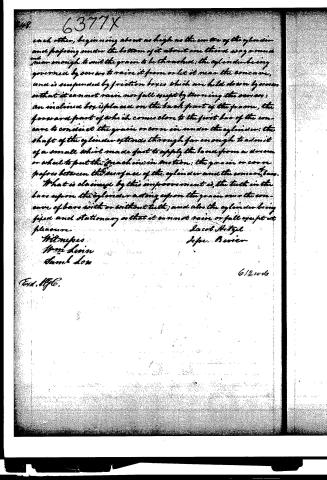
each other, beginning about as high as the centre of the cylinder and passing under the bottom of it about one third way round, near enough to suit the grain to be threshed; the cylinder being governed by corn to raise it from or let it near the concave, and is suspended by friction boxes which are held down by corn, so that it cannot raise nor fall except by turning the corn; an inclined box is placed on the back part of the frame, the forward part of which comes close to the first line of the concave to conduct the grain or corn in under the cylinder; the shaft of the cylinder extends through far enough to admit of a small wheel made fast to apply the hand from a drum or wheel to put the machine in motion; the grain or corn passes between the surface of the cylinder and the concave bar.
What is claimed by this improvement is, the teeth in the bars upon the cylinder acting upon the grain over the concave of bars with or without teeth; and also the cylinder being fixed and stationary so that it cannot raise or fall except at pleasure.
Jacob Astyl
Jesse Brewer
Witn:
Wm Levin
Saml Low
Exd. 11/6.
6/2 wks
Published accounts: journal notice
Notice in the monthly list of patents, with remarks
Journal of the Franklin Institute, new ser., vol. 7 (1831), p. 373 · View the page
22. For a Thrashing Machine; Jacob Ketzle, and Jesse Bevier, Ithaca, Tompkins county, New York, February 14.
Remarks. " What we claim is the teeth in the bars upon the cylinder acting upon the grain over the concave of bars, with or without teeth; and also the cylinder being fixed and stationary, so that it cannot raise or fall except at pleasure." These claims are no doubt as good as any that could be made to the machine described. The difference between the teeth of this machine and many others, is, that in this, they are made on plates of metal like saw teeth, and fixed along the cylinder. There has never been a dearth of newly patented thrashing machines, but of late they have sprung up with a rapidity quite unusual; this is to be attributed to the success of one or two patentees, who, if their machines are not of a superior order, have been indefatigably active in bringing them into use.
About this record
- Patentee
- DATAMP
- Date
- the Name and Date index of patents, DATAMP, USPTO records
- Invention
- DATAMP
- Listed in
- the Name and Date index of patents, DATAMP, USPTO records, Jim Shaw's X-patent list, the Journal of the Franklin Institute, Burke's List of Patents (1847)
- Burke's 1847 Patent Office list gives the same patent.