

Drawings and documents
USPTO scan
The patent as scanned by the USPTO
-
 Page 1
-
 Page 2
-
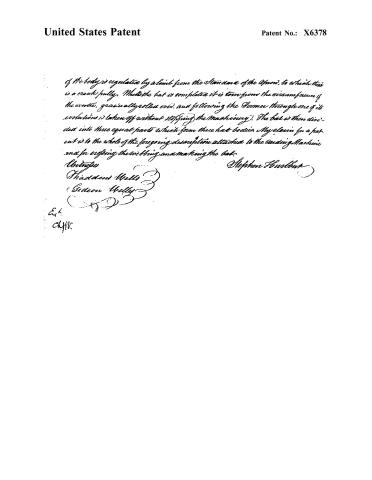 Page 3


U.S. Patent and Trademark Office · Google Patents
Show the transcription Hide (579 words)
Machine transcription (LightOnOCR) of the pages as scanned by the USPTO, most of them the handwritten copies made when the records were restored after the 1836 fire. Not checked; it can misread handwriting, so compare it with the scan.
Page 2.
United States Patent
Patent No.: X6378
Stephen Humbert
Letters Patent
The Schedule referred to in the Letters Patent and making part of, the same containing a description in the words of the said Stephen Humbert himself of his Improvement in making and constructing Bats for Hat Bodies.
Be it known that Stephen Humbert of Glastonbury in the County of Hartford and State of Connecticut have invented a new and useful improvement in making and constructing Bats for hat bodies and that the following is a full and exact description of the construction and operation of the said machine as invented or improved by me.
First an Apron (N° 3) attached to a common carding machine, which is made to vibrate by means of a Crank-pulley (N° 6) driven from the Doffer (N° 2). A Standard (N° 0) is affixed to a cross piece under the apron and by a limb (N° 12) from the standard to which limb the crank-pulley is attached. The size of the Bat is regulated it being necessary to lengthen the crank to increase the size and to shorten it to lessen the size.
The apron is made to move round the frame in order to carry the web from the Doffer to the Former (N° 4), by means of a belt ascending from a pulley on the end of the Doffer opposite the crank-pulley above to a double pulley (N° 13) thence descending to the pulley of the apron. The Former is a light wheel or table having a horizontal rotary motion and on the Former is a Roller (N° 5). The frame (N° 4) is moved by a belt running on a pulley attached to the under side of the Former, thence to another pulley on the frame of the carding machine which last pulley is carried by a belt on the shaft of the main cylinder.
The Roller is attached by a swivel in its centre to the under side of the Former, and its outer or extreme end is secured to the frame of the carding machine by means of a swivel and vice. The operation of the machine is as follows. The web is received from the Doffer of a common carding machine upon the Apron, it is carried by the Apron to the Former and by the vibrating motion of the apron the web is spread as it is received between the Former and the Roller. The variation in thickness of the bat for the formation of the body must be regulated by the feed of the carding machine. The size of the bat for the formation of
Page 3.
United States Patent
Patent No.: X6378
of the body is regulated by a limb from the Standard of the Apone, to which there is a crank pully. When the hat is completed it is torn from the circumference of the centre, gradually rolled over, and following the Stamer through one of its evolutions is taken off without stopping the Machinery). The hat is then divided into three equal parts which form three hat bodies. My claim for a patent is to the whole of the foregoing description attached to the Carding Machine and for ordering the working and making the hat.
Witnesses
Thaddeus Wells
Eudon Wells
Stephen Hurdle
Ex.
ClyW.
Published accounts: journal notice
Notice in the monthly list of patents, with remarks
Journal of the Franklin Institute, new ser., vol. 7 (1831), p. 373 · View the page
20. For machinery for making Bats for Hat Bodies; Stephen Hurlbut, Glastenbury, Hartford county, Connecticut, February 14.
Remarks. The wool is to be received from a common carding machine upon an endless apron, which apron receives a vibratory motion, that it may cross the wool as it delivers it upon the former. "The former is a light wheel, or table, having a horizontal rotary motion; and on the former is a roller; the roller is attached, by a swivel in its centre, to the apron on the former, and its outer or extreme end is secured to the frame of the carding machine, by means of a swivel and wire." "The operation of the machine is as follows:-The web is received from the doffer of a common carding machine upon the apron. It is carried by the apron to the former, and by the vibratory motion of the apron the web is crossed, as it is received between the former and the roller. The variation in thickness of the bat, for the formation of the body, must be regulated by the feed of the carding machine. The size of the bat for the formation of the body is regulated by a limb from the standard of the apron to which there is a crank pulley. When the bat is completed, it is torn from the circumference to the centre, gradually rolled over, and following the former through one of its revolutions, is taken off without stopping the machinery. The bat is then divided into three equal parts, which forms three hat bodies." "My claim for a patent is to the whole of the foregoing description attached to the carding machine, and for crossing the webbing, and making the bat." The drawing which accompanies this specification is a very imperfect one; and is not indeed worthy the name of a drawing, although it serves to give some general idea of the plan. The claim as it stands would seem to include the revolving apron; in this case it appears to be too broad.
About this record
- Patentee
- DATAMP
- Date
- the Name and Date index of patents, DATAMP, USPTO records
- Invention
- DATAMP
- Listed in
- the Name and Date index of patents, DATAMP, USPTO records, Jim Shaw's X-patent list, the Journal of the Franklin Institute, Burke's List of Patents (1847)
- Burke's 1847 Patent Office list gives the same patent.