

Drawings and documents
National Archives restored drawings: drawing
James Johnson's Patent Drawing for a Fire Ladder

National Archives, Restored Patent Drawings (Record Group 241) · Full-size scan at the National Archives · Catalog record
Show the text on the drawing Hide (70 words)
Words on the drawing as machine-read by the National Archives; not checked. Useful mainly for searching.
JAMES JOHNSON / FIRE LADDER / 6490-+ / Patented is April 1831. / to / to / References a. the ladders b.b. props C.C.C.C the wheels - d platform e. rops. / Lang / Patent office 1.Dec/1838 / Made Made under the direction of the Commiproner / of Patints in conformity with act 3 March 1837 / earf / Hungh Sumorth / & mipioner of Patents
USPTO scan
The patent as scanned by the USPTO
-
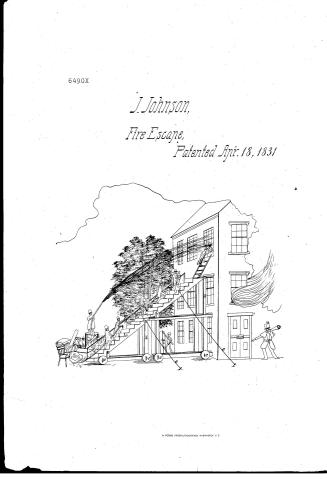 Page 1
-
 Page 2


U.S. Patent and Trademark Office · Google Patents
Show the transcription Hide (384 words)
Machine transcription (LightOnOCR) of the pages as scanned by the USPTO, most of them the handwritten copies made when the records were restored after the 1836 fire. Not checked; it can misread handwriting, so compare it with the scan.
Page 1.
6490X
J. Johnson,
Fire Escape,
Patented Apr. 18, 1831
N. PETERS, PHOTO-LITHOGRAPHER, WASHINGTON C. C.
Page 2.
James Johnson, of Baltimore, Md
Letters Patent -
The schedule referred to in these Letters Patent and making part of the same, containing a description in the words of the said James Johnson himself of his improvement called, "The Life Escape and fire ladder."
To all to whom these present shall come. Be it known that I James Johnson of the City of Baltimore in the County of Baltimore and State of Maryland have invented a new and useful improvement in the machine for facilitating the escape of persons from buildings on fire called the escape and fire ladder and that the following is a full and exact description of the construction and operation of the said machine as invented by me. This machine consists of a platform placed on wheels for moving it speedily from place to place on which are erected steps laying horizontally and from which it can be elevated in a moment to the height calculated and made stationary when arrived at the point desired by props resting on the platform and stays of ropes fastened to iron pins drove into the ground. A second platform is erected on a level with the top of the elevation of the first ladder or steps, has steps similar to the first, is raised and stayed in the same manner and on the top is placed or fixed a stand for one or more persons to occupy and direct the water poured from the hose in a horizontal or inclined line which will have the effect of saving three fourths or one half of the water in the manner now used and more speedily extinguishing the flames. In the case of rescuing persons from a house which has taken fire in the lower stories it can be run up so close to a window as to afford as much facility in descending as common stair steps.
Witnesses
Wm. P. Elliott
Chas. M. Miller
Jas. Johnson
(Patent Office 1881)
6490X
Published accounts: journal notice
Notice in the monthly list of patents, with remarks
Journal of the Franklin Institute, new ser., vol. 8 (1831), p. 125 · View the page
48. For a Life Escape, and Fire Ladder; James Johnson, city of Baltimore, April 18.
Remarks. A car is made to run upon wheels; this car has a considerable elevation, and is so constructed as to form two or more platforms, retiring like steps, one probably ten feet above the other. The ladder, in sections, is to reach from one angle of these platforms to the next above it, where it is to be secured. Firemen with hose may stand upon the platform, and play directly into a window. The apparatus is very indifferently described, and, as presented, appears liable to many objections. A carriage of this description requires too much space to admit of many of them being kept in large cities. Its elevation is such as to render it very liable to be upset in the hurry of repairing to fires, and when placed against a building which is on fire at the lower part, the machine will be in contact with it, whilst a common ladder would stand clear. There have been many contrivances made for a similar purpose, but they have not proved to be practically useful, being liable to the objections stated, or to others equally formidable.
About this record
- Patentee
- DATAMP
- Date
- the Name and Date index of patents, DATAMP, USPTO records
- Invention
- DATAMP
- Listed in
- the Name and Date index of patents, DATAMP, USPTO records, Jim Shaw's X-patent list, the Journal of the Franklin Institute, Burke's List of Patents (1847)
- Burke's 1847 Patent Office list gives the same patent.