

Drawings and documents
National Archives restored drawings: drawing
William Foster's Patent Drawing for a Method of Extracting Stumps

National Archives, Restored Patent Drawings (Record Group 241) · Full-size scan at the National Archives · Catalog record
Show the text on the drawing Hide (37 words)
Words on the drawing as machine-read by the National Archives; not checked. Useful mainly for searching.
t, / CLASSIFICATION / 6509.4 / DIVISION. / Willant Faster's / E HOISTING / [79] Stump Eleva Elev. / mode of / Extracting Stumps / Patented April 22 4831 / Fig.2 / his / Fig. 3 / old
USPTO scan
The patent as scanned by the USPTO
-
 Page 1
-
 Page 2
-
 Page 3


U.S. Patent and Trademark Office · Google Patents
Show the transcription Hide (718 words)
Machine transcription (LightOnOCR) of the pages as scanned by the USPTO, most of them the handwritten copies made when the records were restored after the 1836 fire. Not checked; it can misread handwriting, so compare it with the scan.
Page 1.
6509X
W. Foster,
Stump Elevator.
Patented Apr. 22, 1831.
Fig: 1.

Fig: 2.

Fig: 3.

AM. PHOTO-LITHO. CO. N.Y. (OSBORNE'S PROCESS)
Page 2.
6509X
Apr 22, 1831
Willard Foster, Onego, New-York.
Letters Patent.
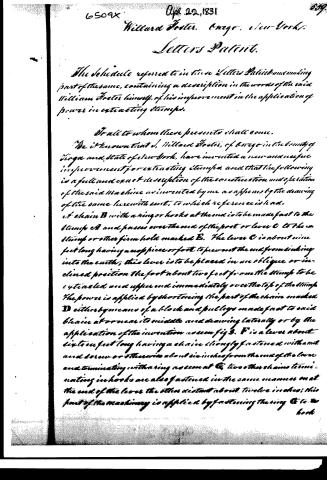
The Schedule referred to in these Letters Patent and making part of the same, containing a description in the words of the said William Foster himself, of his improvement in the application of power in extracting stamps.
To all to whom these presents shall come.
Be it known that I, Willard Foster, of Onego in the county of Tioga and State of New-York, have invented a new and useful improvement for extracting stamps, and that the following is a full and exact description of the construction and operation of the said machine as invented by me as appears by the drawing of the same herewith sent, to which reference is had.
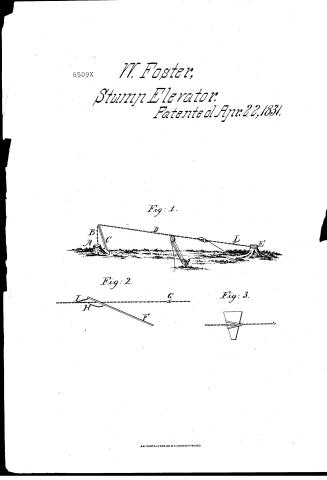
A chain B with a ring or hooks at the end is to be made fast to the stamp A and passes over the end of the post or lever C to the stamp or other firm hold marked D. The lever C is about nine feet long having a foot piece or foot to prevent the end from sinking into the earth; this lever is to be placed in an oblique or inclined position the foot about two feet from the stamp to be extracted and upper end immediately over the top of the stamp. The power is applied by shortening the part of the chain marked D either by means of a block and pulleys made fast to said chain at or near its middle and drawing laterally or by the application of the invention as seen fig 3. F is a lever about sixteen feet long having a chain strongly fastened with an and screw or otherwise about six inches from the end of the lever and terminating with a ring as seen at G; two other chains terminating in hooks are also fastened in the same manner on at the end of the lever the other distant about twelve inches; this part of the machinery is applied by fastening the ring G to a hook
Page 3.
hook on the chain D, as seen at L, the lever F, is laid parallel or nearly so with the chain D, and the chain having the hook I is drawn as far towards G as can be and made fast to the chain D the end of the lever is then carried forward towards the stumps A which shortens the chain D and makes the operator to hook the chain H in advance of I; the end of the lever is then carried back and the other hook made fast, and so alternately until the chain is drawn tight as possible by this means, or the stumps A is extracted; the lever F may be worked either by hand, horse power, pulleys or in otherwise as may be deemed best calculated to effect the object; after the chain has been made as tight by this means as possible, or the stumps started, a lateral draft on the chain by means of a block and pulleys, is to be made either with horses, cattle, or by hand or otherwise. One other part of the invention consists in having a chain containing hooks at the end with three long links or bands connected together by a wedge of iron or other hard material, which is to be applied to the chain D, immediately above or beneath where the lever F is applied the long links slip or pass by each other and the wedge on the slackening of the chain is pushed forward until the chain is again made taut—this part of the machinery is seen at fig 3. The power may be applied to extracting stumps, raising weights, drawing up vessels moving buildings or other ponderous bodies—and each part of the machinery or the whole applied as will be sufficient to effect the object.
Witnesses
Geo. Park
Christy Patterson
Willard Foster
(692 words)
Published accounts: journal notice
Notice in the monthly list of patents, with remarks
Journal of the Franklin Institute, new ser., vol. 8 (1831), p. 167 · View the page
68. For the application of power to the Extracting of Stumps of Trees; Willard Foster, Oswego, Tioga county, New York, April 22.
Remarks. A straight post of about nine feet in length, with a cross piece of timber morticed on to its lower end, to prevent it from sinking into the ground, is placed at the distance of about two feet from the stump to be raised; its upper end is to incline so as to stand over the stump. A chain, one end of which is firmly attached to the stump, passes over, and rests upon the upper end of the post first mentioned; the other end of the chain is to be fastened round another stump, or any convenient fixed object. If this chain be then shortened by any means, and all the attachments be secure, the stump will be raised. This shortening is proposed to be effected by means of a tackle attached to the chain, drawing it laterally; or by means of a long lever with chain and hooks near to one end of it, which hooks may be so attached to the main chain, that by twisting the lever it may draw forcibly upon them. There is no claim made, but we are told that "the power may be applied to extracting stumps, raising weights, drawing up vessels, moving buildings or other ponderous bodies, and such part of the machine, or the whole, applied, as will effect the object." As no new power, or machine, is brought into action, but means resorted to which have been heretofore applied in various ways, we presume it would have been best to have confined the description to the raising of stumps, because it is probable that such part as has been heretofore employed for other purposes, may still be freely used.
About this record
- Patentee
- DATAMP
- Date
- the Name and Date index of patents, DATAMP, USPTO records
- Invention
- DATAMP
- Listed in
- the Name and Date index of patents, DATAMP, USPTO records, Jim Shaw's X-patent list, the Journal of the Franklin Institute, Burke's List of Patents (1847)
- Burke's 1847 Patent Office list gives the same patent.