

Drawings and documents
National Archives restored drawings: drawing
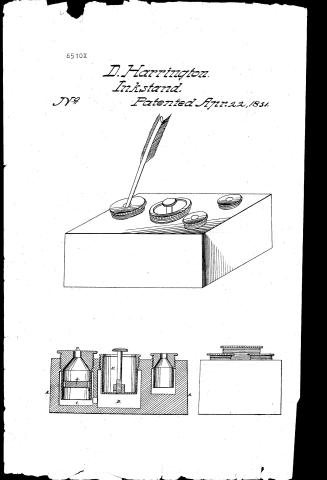
D. Harrington's Patent Drawing for an Ink Well

National Archives, Restored Patent Drawings (Record Group 241) · Full-size scan at the National Archives · Catalog record
Show the text on the drawing Hide (77 words)
Words on the drawing as machine-read by the National Archives; not checked. Useful mainly for searching.
STATIONERY. / Ink e Hol / [146] Inkstands. / Patented 22an'1531 / CLASSI / 6510-+ / DIVISION. / A. Body of Ink Holder / B. Chamber for supply of Ink / C. 2" Chamber / D. Cup. a. Cork ndo / E'. Metalio cup & Reservoir / mm / D. HARRINGTON. / Patent Office June 30th 1841 / Made under the direction of the Communions / of Patents in conformity with ach of 3 March 1837 / Strichland Del / Commissioner of Patents
USPTO scan
The patent as scanned by the USPTO
-
 Page 1
-
 Page 2
-
 Page 3
-
 Page 4
-
 Page 5
-
 Page 6


U.S. Patent and Trademark Office · Google Patents
Show the transcription Hide (1,544 words)
Machine transcription (LightOnOCR) of the pages as scanned by the USPTO, most of them the handwritten copies made when the records were restored after the 1836 fire. Not checked; it can misread handwriting, so compare it with the scan.
Page 1.
6510X
D. Harrington.
Inkstand.
No. Patented Apr. 22, 1831.


Page 2.
Daniel Harrington
The subscriber refers to his Letters Patent and making part of the same containing a description in the words of the said Daniel Harrington himself of his improvement in the Ink Holder. To all to whom these presents shall come.
Be it known that Daniel Harrington of Philadelphia in the County of Philadelphia and State of Pennsylvania have invented a new and useful improvement in the machine for supplying ink to the pen and that the following is a full and exact description of the construction and operation of the said machine as invented by me specified below and denominated the new Ink Holder. The main body of this ink holder is, at the top part, three inches wide and five inches long, and at its bottom one eighth of an inch larger at its ends and sides than it is at its top. In depth it is two inches. The body of ink holder may be made of wood with a leather top or a metallic top, or the whole body may be made of wood, metals or stone, as well as some other substances, as clay, plastic or Paris, or in fine it may be made of any substance that will hold common ink of different colours. About the centre of the top of this body is sunk down within one quarter of an inch of the bottom, a round chamber for holding a supply of ink (say black ink). This chamber communicates at its side next to one end of the body with another chamber between it (the supply chamber) and the ends of the body. This second chamber is in diameter, say only one and a quarter inch in diameter is sunk down to near the same depth as the larger one. Into this smaller chamber is screwed from the top of the body a metallic oblong cap, say in length one and three quarters of an inch and in diameter one and a quarter inch made funnel form at the inner part of its upper end with an opening in its outer bottom.
Page 3.
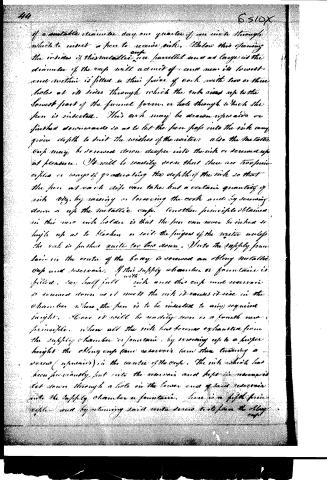
If a suitable chamber, say one quarter of an inch through which to insert a pen to receive ink. Below this opening the insides of this metallic cup are parallel and as large as the diameter of the cup will admit of, and near its lowest end within is fitted a thin piece of cork with two or three holes at its sides through which the ink rises up to the lowest part of the funnel form, or hole through which the pen is inserted. This cork may be drawn upwards or pushed downwards so as to let the pen pass into the ink any given depth to suit the wishes of the writer; also the metallic cup may be screwed down deeper into the ink or screwed up at pleasure. It will be readily seen that there are two principles or ways of graduating the depths of the ink so that the pen at each dip can take but a certain quantity of ink by raising or lowering the cork and by screwing down or up the metallic cup. Another principle obtained in this new ink holder is that the pen can never be inked so high up as to blacken or soil the fingers of the writer unless the ink is pushed quite too low down. Into the supply chamber in the centre of the body is screwed an oblong metallic cup and reservoir. If this supply chamber or fountain is filled, say half full with ink and this cup and reservoir is screwed down so it meets the ink it causes it rise in the chamber where the pen is to be inserted to any required height. Here it will be readily seen is a fourth new principle. When all the ink has become exhausted from the supply chamber or fountain, by screwing up to a proper height the oblong cup (and reservoir (and then turning a screw (opposite) in the centre of the cup. The ink which has been previously put into the reservoir and kept in reserve is let down through a hole in the lower end of said reservoir into the supply chamber or fountain. Here is a fifth principle and by returning said centre screw to its place the oblong
Page 4.
Cups and reservoirs may again be screwed down into the pleasure until all the ink has been forced into the other chamber or fountain and used; after which, of course, a new supply must be furnished both to the supply chamber or fountain and reservoir. The part that stands in the pipe of the cups, blackened with holes in it is merely to set pins in and may be retained and used or dispensed with as there are holes enough in the body of the ink holder for holding regular funds. The two smaller funnel forms metallic oblong cups at the other end of the body of the ink holder for red and blue inks, are the same in all respects as the one above described except that they are less in diameter, say only three quarters of an inch in diameter. They have their appropriate chambers or fountains, in point of size but have no supply fountains, they graduate to suit the wishes of the writer by screwing up or down, also by drawing up or pushing down the works in their lower ends. Their fountains when exhausted are supplied again with ink by pouring in at their tops. As relates to invention with reference to this new ink holder the undersigned is aware that the body of this ink holder though an oblong square on its top is not so far different from some square forms of the old fashioned ink stand long in use as to be denominated a discovery or invention; the same may be said of the chambers or fountains as relate to their form size &c. for all forms of hollow vessels from that of the half of an eggshell to the old fashioned common ink stand have been used from time immemorial to this date. But all of the other parts of the new ink holder as above specified the undersigned merely believes to be his own inventions exclusively and which inventions and combinations justify him in his claim to the invention of the new ink holder. There is no addition to the principles already above mentioned as belonging to the new ink holder or
Page 5.
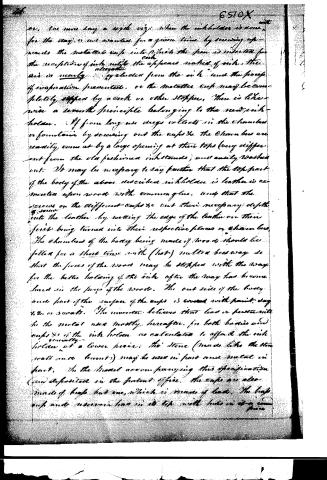
or, one more say a sixth viz: when the inhaler is done for the day, or not wanted for a given time by screwing upwards the metallic cup into which the pen is inserted for the reception of ink with the apparatus marked by ink, the air is nearly excluded from the ink and the process of evaporation prevented, or the metallic cup may be completely stopped by a cork or other stopper. There is likewise a seventh principle belonging to the new inhaler. If from long use usage collects in the chamber or fountain by screwing out the cups &c the chambers are readily removed by a large opening at their tops (very different from the old fashioned inhalers), and easily washed out. It may be necessary to say further that the top part of the body of the above described inhaler is leather is cemented upon wood with common glue, and that the screws on the different cups &c cut their necessary depths into the leather by setting the edge of the leather on their first being turned into their respective places or chambers. The chambers of the body being made of wood should be filled for a short time with (hot) melted beeswax so that the pores of the wood may be stopped with the wax for the better holding of the ink after the wax has become hard in the pores of the wood. The out side of the body and part of the surface of the cups is covered with paint, say yellow or scarlet. The inventor believes that lead or pewter will be the metal used mostly hereafter for both bodies and cups &c of the ink holder as calculated to afford the ink holder at a lower price; the stone (made like the iron walls once burnt) may be used in part and metal in part. In the Model accompanying this specification (now deposited in the patent office) the cups are also made of brass but one, which is made of lead. The brass cup and reservoir has in its top with holes in it a small pipe.
Page 6.
6510X 47.
1 piece made of tin standing on the cup, on three tin legs as above described for to stand from in. This piece as the said may dispense with.
Witness:
W. H. Dillingham
J. Dillingham
Daniel Harrington
1441 20-72
6510X 47.
Published accounts: journal notice
Notice in the monthly list of patents, with remarks
Journal of the Franklin Institute, new ser., vol. 8 (1831), p. 167 · View the page
69. For an Ink Holder; Daniel Harrington, Philadelphia, Pennsylvania, April 22.
Remarks. This is an ingenious contrivance for regulating the height at which the ink shall stand in the vessel containing it, and for securing certain other advantages; as this ink holder consists of several parts, tending to the attainment of the same ends, its structure cannot be fully explained without the aid of a drawing. The ink is contained in a cylindrical chamber, in the part which may be denominated the ink stand. A second chamber is provided into which the ink is to flow from the first, there being a lateral opening from one into the other. A cylindrical cup, or box, screws into the first chamber, and may be readily made to press upon the surface of the ink below it. When depressed, the ink rises in the second chamber, and when raised, the ink in this second chamber is depressed, and it is evident that its height may be thus regulated. Another cylindrical cup screws into the second chamber, which is also capable of being raised or lowered as desired. Into this cup the pen is to be dipped. A disk of cork is placed within it, against which the end of the pen is to touch, preserving it by its texture from any injury.
About this record
- Patentee
- DATAMP
- Date
- the Name and Date index of patents, DATAMP, USPTO records
- Invention
- DATAMP
- Listed in
- the Name and Date index of patents, DATAMP, USPTO records, Jim Shaw's X-patent list, the Journal of the Franklin Institute, Burke's List of Patents (1847)
- Burke's 1847 Patent Office list gives the same patent.