

Drawings and documents
National Archives restored drawings: drawing
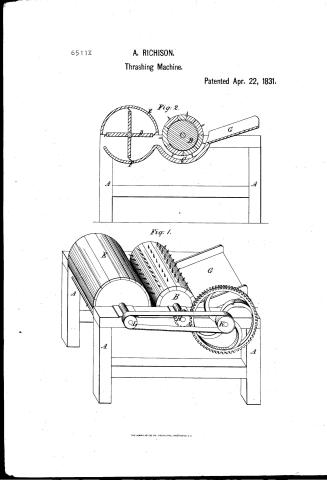
Andrew Richison's Patent Drawing for a Machine for Threshing Grain

National Archives, Restored Patent Drawings (Record Group 241) · Full-size scan at the National Archives · Catalog record
Show the text on the drawing Hide (105 words)
Words on the drawing as machine-read by the National Archives; not checked. Useful mainly for searching.
Eintered / 130. THRASHING. / Andrew Richison / Vol.13./- / Thrashing Machines. / A. Cylinder Machines. / $2. / Throshing Grain / Patented 22 April 1831, / cyr / Fif,2, / CLASSIFICATION / 6511-4 / DIVISION. / Fig.1. / KO / References, / Fig.1 Perspective view. / Fid,2. Section. / THE / A. frame. B. threshing machine. / C. concave, D. rake. E.Drum. Escreen. / G feeding board. H. pinion on the threshing cylinder / I. driving wheel. K. driving pulley. I. pulley on rake, / Patus Offin / C Made un der the Coum prom of Patents in conformity / direction of ther / Mar 17 1842 / with act of bon grep 3 Mar ch 1837 / ML ellmoth / Commipiner of Patents
USPTO scan
The patent as scanned by the USPTO
-
 Page 1
-
 Page 2
-
 Page 3


U.S. Patent and Trademark Office · Google Patents
Show the transcription Hide (710 words)
Machine transcription (LightOnOCR) of the pages as scanned by the USPTO, most of them the handwritten copies made when the records were restored after the 1836 fire. Not checked; it can misread handwriting, so compare it with the scan.
Page 1.
6511X
A. RICHISON.
Thrashing Machine.
Patented Apr. 22, 1831.
Fig. 2.
Fig. 1.
THE MORRIS PETERS CO., PHOTO-LITHO., WASHINGTON, D. C.
Page 2.
6511X. [From a Patent Copy]
Oct 22, 1881
Andrew Richison of New Carlisle, Ohio
Letters Patent.
The Schedule referred to in these Letters Patent and making part of same containing a description in the words of the said Andrew Richison himself of his improvement for the machine for Thrashing Grain.
Be it known that I, Andrew Richison, of New Carlisle, Clarke County, Ohio, have made an improvement in the machine for Thrashing Grain, which is described as follows:
This machine consists of the following parts: 1st The frame. 2nd The Thrashing Cylinder. 3rd The Concave. 4th The Rake Drum and Screen. 5th The feeding Board. 6th The Driving 1st The frame may be made of any convenient size and strength adapted to the machinery to be constructed thereon, by mortising and tenoning together four posts to the side and end pieces.
2nd The Thrashing Cylinder. This is constructed by first making an axle about 1½ inch in diameter, three wooden hearts, one for each end and one in the centre, the end ones to be plated with iron; the shaves are next grooved about four inches thick, and the length of the intended cylinder, these are fastened slightly on the hearts and turned true. The teeth about two inches long, made of wrought iron are then inserted at proper distances apart, so as to interlock reciprocally with those in the concave but to be hereafter described.
3. The concave. This is made of the same curvature as the cylinder, filled with teeth of the same size, and placed the same distance as apart as those in said Cylinder. It is placed on the lower side of it but rising a little in front, and is about one third its circumference.
4th The Rake and Screen. The Rake is formed by placing eight arms about 3 feet 4 inches long in a centre or axle; at the extremity of each arm is mortised and tenoned a piece of wood to raise the teeth, which are about 4 inches long inclining backwards to discharge the straw. A Drum or cone is made to surround the arms
Page 3.
6511x
April 22, 1831
of the rake which are cast so as to work tight to prevent the grain from escaping. On the lower part of the drum is a screen about one third its circumference, on which the grain and straw are thrown, the grain falling through and the straw being thrown out by the teeth of the Rake. The Rake is calculated to have about one revolution to fifteen revolutions of the Thrashing Cylinder.
5th. The feeding Board. This is an inclined plane placed in front of the Thrashing Cylinder, and even with the top of the concave.
6th. The gearing. On the axle of the Thrashing Cylinder is placed a pinion working into a cogwheel of about 2 feet 4 inches diameter, turning on an axle supported in the frame. On this axis is placed a pulley over which a band passes to a pulley on the axis of the Rake. This machine may be moved by any known power.
Operation. The Grain to be Thrashed is introduced into the machine along the feeding board, it is conveyed by the Thrashing cylinder to the Concave bed, where the grain is rubbed out by the teeth. The grain and straw are then carried up an inclined plane into the arms of the Rake and fall upon the screen; the Grain is then separated from the straw and falls through the screen and the straw is carried by the teeth of the Rake and thrown out at the hinder end of the machine.
The Invention here claimed is the construction and arrangement of the several parts of the machine, but particularly the mode herein described, whereby the grain is separated from the straw and the latter thrown out by the Revolving Rake.
Washington 22nd April 1831
And. Winthrop
W. P. Ellett
Charles M. Miller
Andrew Nicholson
700 words
Filed April 24, 1831
Published accounts: journal notice
Notice in the monthly list of patents, with remarks
Journal of the Franklin Institute, new ser., vol. 8 (1831), p. 166 · View the page
65. For a Thrashing Machine; Andrew Richison, New Carlisle, Clark county, Ohio, April 22.
Remarks. This thrashing machine has a cylinder and concave of the ordinary construction. As the straw passes from the concave, it is taken hold of by a revolving rake, with four arms, and teeth on cross pieces, the grain falling out underneath. "The invention here claimed, is the construction and arrangement of the several parts of the machine; but particularly the mode, before described, whereby the grain is separated from the straw, and the latter thrown out by the revolving rake." Should nothing be retained, either in general, or in particular, but what is new, the remaining part of this machine would occupy a very small space.
About this record
- Patentee
- DATAMP
- Date
- the Name and Date index of patents, DATAMP, USPTO records
- Invention
- DATAMP
- Listed in
- the Name and Date index of patents, DATAMP, USPTO records, Jim Shaw's X-patent list, the Journal of the Franklin Institute, Burke's List of Patents (1847)
- Burke's 1847 Patent Office list gives the same patent.