

Drawings and documents
National Archives restored drawings: drawing
Charles Evans' Patent Drawing for a Standing Press

National Archives, Restored Patent Drawings (Record Group 241) · Full-size scan at the National Archives · Catalog record
Show the text on the drawing Hide (259 words)
Words on the drawing as machine-read by the National Archives; not checked. Useful mainly for searching.
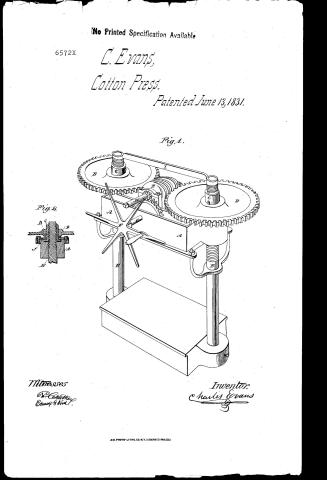
Fell / 1845. / 100. PRESSES. / Baling, Screw. Planger / bottan of Hay prefsed / $2.00 / Charles Evans / Itanding Prefs. / Patented June 13ᵗʰ1831. / CLASSIFICATION / 6572-+ / DIVISION / Es / Fly / References. / Fig:1. / A,A, Platen, or follower / B,B, Screw shafts / c,c, Screw nuto / D,D, Cog- wheels to which they are attached / Fig2. / E Endless Screw mashing into wheelsD,D. / F Grank, or hand wheel, which may / be placed on the shaft G for running / City of hiladetphia / the follower up; and on the shafth, / ss. / of Annsylvania / when great power is wanted. / I Brace in which the Screws ends swivel. / Second month ( February 1845, before the subscriber / On day of the / Fig:2. / sonally appeared Charles Evans, machinist, / an alderman in and for the said city,per / Section through one of the Screws / and made solemn affirmation that he is the / nuts C,C, showing the manner in / inventor of the improved Standing "Ress, / which they are attached to the / represented the in this United drawing, States for which letters / upper side of the platen. / patent of were granted to / A,A Part of the platen / him dated the 13th day of the sixth month / C,C Screw nut / 1831; and that said drawing is, as he verily / J, Plate that enters a ucess in the / believes, a true deliniation of the invention / screwnut and which is screwed to / described in said letters patent. / Fig. / to the platen, causing the nut to / raise it. / Comitting / aldermay / Witnesser / Charles Evans / Edward Chithar Wood
USPTO scan
The patent as scanned by the USPTO
-
 Page 1
-
 Page 2
-
 Page 3


U.S. Patent and Trademark Office · Google Patents
Show the transcription Hide (620 words)
Machine transcription (LightOnOCR) of the pages as scanned by the USPTO, most of them the handwritten copies made when the records were restored after the 1836 fire. Not checked; it can misread handwriting, so compare it with the scan.
Page 1.
No Printed Specification Available
6572X
C. Evans,
Cotton Press.
Patented June 13, 1831.
Fig. 1.
Fig. 2.
Witnesses
A. Churton
Edward Wood
Inventor
Charles Evans
A.M. PHOTO-LITHO. CO. N.Y. (OSBORNE'S PROCESS)
Page 2.
6572X June 13, 1831
Charles Evans, Philadelphia, Pa.
Letters Patent.
Dated June 13th 1831.
The Schedule referred to in these Letters Patent, and making part of the same, containing a description in the words of the said Charles Evans himself, of his Improvement in the mode of constructing the Standing Press.
To all whom it may concern be it known that I, Charles Evans of the City of Philadelphia, have invented an improved mode of constructing the Standing Press, for pressing paper, tobacco, or other articles requiring to be pressed, and that the following is a full and exact description of the same.
The bottom, or bed, and the top piece, which also answers as a platen, or follower, I usually make of cast iron, although, for certain purposes, wood, or other suitable material, may be employed. Instead of checks, two screws, of such length and thickness as may be required, rise vertically from the bed, one standing near each of its ends. A metal box or nut, is adapted to each of these screws, and these nuts are firmly fixed in the centre of cog wheels. These wheels are of such diameter that when the boxes are in their place the peripheries of the wheels will approach each other within the distance necessary.
Page 3.
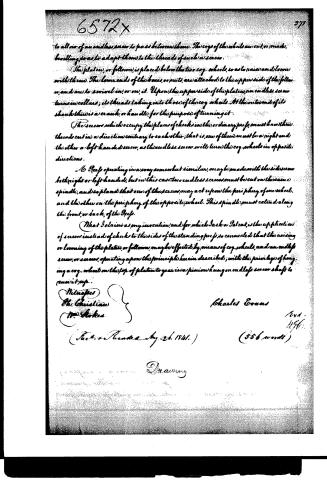
to all or of an endless screw to pass between them. The cogs of the wheels are cut, or made, beveling so as to adapt them to the threads of such a screw.
The plates, or followers, is placed below the two cog wheels, so as to raise and lower with them. The lower ends of the boxes, or suits, are attached to the upper side of the follower, and are to revolve in, or on, it. Upon the upper side of the plates, an endless screw turns in collars, its threads taking into those of the cog wheels. At the outer end of its shaft there is a crank, or handle, for the purpose of turning it.
The screws, which occupy the place of cheeks in the ordinary prefs, must have their threads cut in a direction contrary to each other; that is, one of them must be a right and the other a left handed screw, as the endless screw will turn the cog wheels in opposite directions.
A Press operating in a way somewhat similar, may be made with the side screws both right or left handed; but in this case two endless screws must be cut on the same spindle, and so placed that one of the screws may act upon the periphery of one wheel, and the other on the periphery of the opposite wheel. This spindle must extend along the front, or back, of the Press.
What I claim as my invention, and for which I ask a Patent, is the application of screws instead of cheeks to the sides of the standing prefs, so connected that the raising or lowering of the plates, or followers, may be effected by means of cog wheels, and an endless screw, or screws, operating upon the principle herein described; with the privilege of hanging a cog-wheel on the top of plates to gear into a pinion hung on endless screw shaft to run it up.
Witnesses
Ph. Christian
Wm. Stokes
Charles Evans
Filed 11/6
(356 words)
Drawing
Published accounts: journal notice
Notice in the monthly list of patents, with remarks
Journal of the Franklin Institute, new ser., vol. 8 (1831), p. 332 · View the page
14. For an improvement in the Mode of constructing the Standing Press; Charles Evans, Philadelphia, June 13.
Remarks. (See the specification.)
Published accounts: journal notice
Notice in the monthly list of patents, with remarks
Journal of the Franklin Institute, new ser., vol. 8 (1831), p. 345 · View the page
The principal improvements here claimed consist in a different arrangement of some parts of the English action from that heretofore pursued. These cannot be described without a drawing. The mode of hanging the wire on the hitch pins, is also new, and claimed by the patentees. Instead of the usual mode of forming an eye, or loop, by doubling the wire and twisting the two parts together, three or more turns are made by the wire round the hitch pin, and the short end is then to be turned several times round that part of the wire which is to be strained, which mode of procedure, it is said, pre vents the crippling of the wire. VOL. VIII. No. 5.- NOVEMBER, 1831. 44 SPECIFICATIONS OF AMERICAN PATENTS. Specification of a patent for an improved mode of constructing the Standing Press, for pressing paper, tobacco, or other articles, requiring to be pressed. Granted to CHARLES EVANS, city of Philadelphia, June 13, 1831.
Remarks. THE bottom, or bed, and the top piece, which also answers as a platten, or follower, I usually make of cast iron, although, for certain purposes, wood, or other suitable material, may be employed. Instead of cheeks, two screws, of such length and thickness as may be required, rise vertically from the bed, one standing near each of its ends. A metal box, or nut, is adapted to each of these screws, and these nuts are firmly fixed in the centres of cog wheels. These wheels are of such diameter that when the boxes are in their places, the peripheries of the wheels will approach each other within the distance necessary to allow of an endless screw to pass between them. The cogs of the wheels are cut, or made, bevelling, so as to adapt them to the threads of such a screw. The platten, or follower, is placed below the two cog wheels, so as to raise and lower with them. The lower ends of the boxes, or nuts, are attached to the upper side of the followers, and are to swivel in or on it. Upon the upper side of the platten, an endless screw turns in collars, its threads taking into those of the cog wheels. At the outer end of its shank, there is a crank, or handle, for the purpose of turning it. The screws which occupy the places of cheeks in the ordinary press, must have their threads cut in a direction contrary to each other; that is, one of them must be a right, and the other a left, handed screw; as the endless screw will turn the cog wheels in opposite directions. A press, operating in a way somewhat similar, may be made with the side screws both right or left handed, but in this case two endless screws must be cut on the same spindle, and so placed that one of the screws may act upon the periphery of one wheel, and the other on the periphery of the opposite wheel. This spindle must extend along the front or back of the press. What I claim as my invention, and for which I ask a patent, is the application of screws instead of cheeks to the sides of the standing press, so connected that the raising or lowering of the platten or follower must be effected by means of cog wheels, and an endless screw or screws, operating upon the principles herein described.
About this record
- Patentee
- DATAMP
- Date
- the Name and Date index of patents, DATAMP, USPTO records
- Invention
- DATAMP
- Listed in
- the Name and Date index of patents, DATAMP, USPTO records, Jim Shaw's X-patent list, the Journal of the Franklin Institute, Burke's List of Patents (1847)
- Burke's 1847 Patent Office list gives the same patent.