

Drawings and documents
National Archives restored drawings: drawing
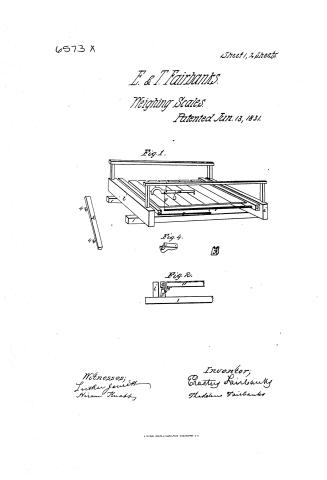
E. and T. Fairbanks' Patent Drawing for Weighing Scales


National Archives, Restored Patent Drawings (Record Group 241) · Full-size scan at the National Archives · Catalog record
Show the text on the drawing Hide (84 words)
Words on the drawing as machine-read by the National Archives; not checked. Useful mainly for searching.
Sheet 1. 02V RS90 / Sheet1, 2,Sheets / 6573X / СУКТОСКУБНІС бесоког / E. & T.Fairbanks. / RECORDS OE THE OLLICE / Weighing Scales. / SENIED / Patented Jun. 13, 1831. / IAS / RECORD esses / Fig.1 / 40 / 40 / Fig. 4. / wg / Fig. ?s. / Witnesses; / Inventor; / Luther Jewith / Crasting Fairbanky / Hiram Knappy / Thadelers Tairbanks / Berry
Sheet 2. Sheet 2, h sheets. / E. &T.Fairbanks. / 6573X / Weighing Scales. / Patented Jun. 13, 1831. / Fig.1. / 46 / 40 / 40 / Fig.4. 4. / Fig. 2. / 11 / ORGAN / 103 / суклоевуьніс БЕСО / OF / THIS / Nitnesses; / Luthingmith / Inventor; / Crasting Fairbanks / Hiram Keeph / AAD / Thadders Fairbanhs / Buy
USPTO scan
The patent as scanned by the USPTO
-
 Page 1
-
 Page 2
-
 Page 3


U.S. Patent and Trademark Office · Google Patents
Show the transcription Hide (780 words)
Machine transcription (LightOnOCR) of the pages as scanned by the USPTO, most of them the handwritten copies made when the records were restored after the 1836 fire. Not checked; it can misread handwriting, so compare it with the scan.
Page 1.
6573 X
Sheet 1, 2 Sheets
E. & T. Fairbanks.
Weighing Scales.
Patented Jun. 13, 1831.
Fig. 1.
Fig. 4.
Fig. 2.
Witnesses;
Luther Jewett
Hiram Thratt
Inventor;
Orastus Fairbanks
Theodore Fairbanks
A. PETERS, PHOTO-LITHOGRAPHER, WASHINGTON, D.C.
Page 2.
6573X
Sheet 2, 2 Sheets.
E. & T. Fairbanks.
Weighing Scales.
Patented Jun. 13, 1831.
Fig. 1.
Fig. 4.
Fig. 2.
Witnesses:
Luther Jewett
Hiram Knapp
Inventor:
Erastus Fairbanks
Thaddeus Fairbanks
R. PETER, PHOTO-LITHOGRAPHER, WASHINGTON, D.C.
Page 3.
6573 X
UNITED STATES PATENT OFFICE.
ERASTUS FAIRBANKS AND THADDEUS FAIRBANKS, OF ST. JOHNSBURY, VERMONT.
IMPROVEMENT IN THE MODE OF CONSTRUCTING STEELYARD-BALANCES.
Specification forming part of Letters Patent dated September 22, 1832.
To all whom it may concern:
Be it known that we, ERASTUS FAIRBANKS and THADDEUS FAIRBANKS, of St. Johnsbury, Caledonia county, and State of Vermont, have invented a new and Improved Method of Constructing and of Weighing by Means of the Steelyard-Balance; and we do hereby declare that the following is a full and exact description of our said improvement.
The main object had in view by us was to adapt the balance more perfectly than has heretofore been done to those machines which are constructed for the purpose of weighing loaded wagons and other articles of great weight; but our improved balance is also applied to such ordinary weighing as is effected by means of instruments constructed on the principle of what is called “Dearborn’s patent balance,” when the same is used for ponderous articles.
We construct a balance in the general form above indicated, dividing the arm of the balance by notches for using a movable poise indicating any number of pounds from one to one hundred, or from one to one thousand. In combination with the movable poise we use graduated weights suspended from the end of the balance, indicating even hundreds or thousands of pounds. For the double purpose of obtaining an exact counterpoise to the platform and of obtaining an equilibration of the beam itself, we affix to the beam a cylindrical or other formed weight, to be moved horizontally on a line elevated above the edge of the pivot, by which the balance is suspended, and which forms the axis of its motion.
It is a principle well understood in the construction of the Dearborn balance that the center of its gravity when suspended must be very little below the edge of the sustaining-pivot, that too great an amount of material above the horizontal range of that edge will occasion the beam to rise or fall indefinitely, while too great a weight of material below such horizontal range tends to settle the beam into an unyielding horizontal position, and to render it unsusceptible to the weight applied. The elevated position of the movable weight above described affords an opportunity by selecting one of proper gravity to correct any defect in the operation of the balance and to facilitate and perfect its equilibrium. Our usual method is to attach one end of a screw-rod to a standard rising from the end of the beam, which screw-rod extends along in the direction of the beam toward its fulcrum. Its inner end we usually turn down and curve, so that it may be fastened on one side of the beam, thus removing it out of the way of the hook of the movable poise. A cylindrical weight or ball is drilled through its center and tapped with a female screw fitting and placed upon the screw-rod. This, it will be seen, furnishes the means of regulating the balance with the utmost precision, and also of counteracting any variation in the weight of the platform. The rod and its weight stand a sufficient height above the beam to secure a horizontal equilibrium, and to allow the hook of the poise to pass under them. It is obvious to remark that the same effect may be produced by placing the weight at the other end of the beam at an equal elevation above the edge of the sustaining-pivot; or the beam may be so constructed as to place the weight on a horizontal line below the edge of the sustaining-pivot with the same effect.
We do not claim the movable weight attached to the beam for the purpose simply of obtaining an exact counterpoise to the platform, as heretofore used, but we do claim it in the positions above described for the double purpose of obtaining an exact counterpoise to the platform and of putting the beam into equilibrium.
ERASTUS FAIRBANKS.
THADDEUS FAIRBANKS.
Witnesses:
LUTHER JEWETT,
HIRAM KNAPP.
Published accounts: journal notice
Notice in the monthly list of patents, with remarks
Journal of the Franklin Institute, new ser., vol. 8 (1831), p. 342 · View the page
50. For a Weighing Machine; Thaddeus Fairbanks, and Erastus Fairbanks, St. Johnsbury, Caledonia county, Vermont, June 13.
Remarks. This is a machine intended for weighing loaded wagons and carts. The vehicle to be weighed is driven on to a platform, which is suspended upon proper fulcrums and levers, and these are to act upon a steelyard, by which the weight may be ascertained with considerable accuracy. Such machines are common on turnpike roads, and at coal yards; and the machine now patented is a mere variation of the general principle upon which these are made, without presenting any thing which can be fairly called an improvement. The patentee has described the whole machine without claiming any part.
Published accounts: journal notice
Notice in the monthly list of patents
Journal of the Franklin Institute, new ser., vol. 14 (1834), p. 235 · View the page
11. For a Machine for Weighing Heavy Bodies; Thaddeus and Erastus Fairbanks, St. Johnsbury, Caledonia county, Vermont. First patented June 13th, 1831.
About this record
- Patentee
- DATAMP
- Date
- the Name and Date index of patents, DATAMP, USPTO records
- Invention
- DATAMP
- Listed in
- the Name and Date index of patents, DATAMP, USPTO records, Jim Shaw's X-patent list, the Journal of the Franklin Institute, Burke's List of Patents (1847)
- Burke's 1847 Patent Office list gives the same patent.