

Drawings and documents
National Archives restored drawings: drawing
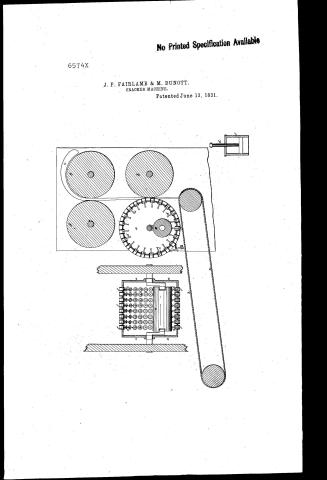
J. P. Fairlamb and M. Dunott's Patent Drawing for a Cracker Machine

National Archives, Restored Patent Drawings (Record Group 241) · Full-size scan at the National Archives · Catalog record
Show the text on the drawing Hide (100 words)
Words on the drawing as machine-read by the National Archives; not checked. Useful mainly for searching.
Hol. 12. page / Bread, Cracker and Lozenge Making! / UP 0 FAIRLAMB & M DUNOTT / Broad & Cracker Machines, / cracker Mac / Patented) 13 June 1831 / Stampers / Section / CLASSI FICATION / 65 74.4 / DIV ISION. / Section / Section / a. Cylinder containing moulds / b. Cylinder with nlain surface / C. Spring scraper / cl. Shanks or Studs / e. Inner cylinder / f. Cracker mould / Patent office Fuby22 1842 / I. Rollers to reduce the Dough to aproperthechnap / Made under the direction of the commysiour of / h. apron 07 conductor / Patents in comformity with achof 3 March 1837 / i Dough / Mmrk Sumorth / Strichland Del
USPTO scan
The patent as scanned by the USPTO
-
 Page 1
-
 Page 2
-
 Page 3


U.S. Patent and Trademark Office · Google Patents
Show the transcription Hide (707 words)
Machine transcription (LightOnOCR) of the pages as scanned by the USPTO, most of them the handwritten copies made when the records were restored after the 1836 fire. Not checked; it can misread handwriting, so compare it with the scan.
Page 1.
No Printed Specification Available
6574X
J. P. FAIRLAMB & M. DUNOTT.
CRACKER MACHINE.
Patented June 13, 1831.

Page 2.
June 13, 1831
Jonas P. Fairlamb & Miller Dunott
Letters Patent.
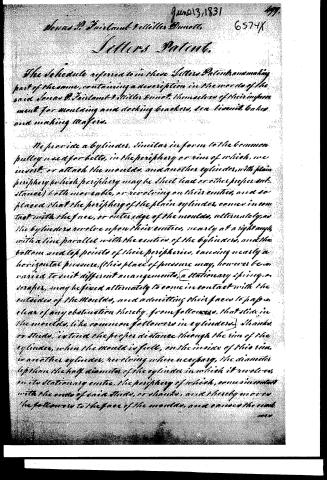
The schedule referred to in these Letters Patent, making part of the same, containing a description in the words of the said Jonas P. Fairlamb & Miller Dunott, themselves of their improvement for moulding and locking crackers, tea biscuit cakes and making wafers.
We provide a cylinder, similar in form to the common pulley used for belts, in the periphery or rim of which, we insert, or attach the moulds, and another cylinder, with plain periphery (which periphery may be sheet lead or other proper substance) both movable, or revolving on their centres, and so placed that the periphery of the plain cylinder comes in contact with the face, or outer edge of the moulds, alternately, as the cylinders revolve upon their centres, nearly at a right angle, with a line parallel with the centres of the cylinders, and the bottom and top points of their peripheries, causing nearly a horizontal pressure (this place of pressure may, however, be varied to suit different arrangements, a stationary spring or scraper, may be fixed alternately to come in contact with the outsides of the Moulds, and admitting their faces to pass clear of any obstruction thereby, from followers, that slide in the moulds, like common followers in cylinders) Shanks, or studs, extend the proper distance through the rim of the cylinder, when the mould is full, on the inside of this rim, in another cylinder, revolving when necessary, the diameter less than the half diameter of the cylinder in which it revolves, on its stationary centre, the periphery of which, comes in contact with the ends of said studs, or shanks, and thereby moves the followers to the face of the moulds, and causes the end
Page 3.
6574X
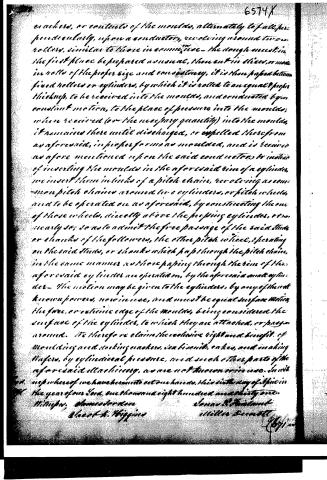
crackers, or contents of the moulds, alternately to fall perpendicularly, upon a conductor, revolving around two rollers, similar to those in comminice—the dough must in the first place be prepared as usual, then cut in slices, or made in rolls of the proper size and consistency, it is then passed between fixed rollers or cylinders, by which it is rolled to an equal & proper thickness, to be received into the moulds, and conducted by an constant motion, to the place of pressure into the moulds; when received (or the necessary quantity) into the moulds, it remains there until discharged, or expelled therefrom as aforesaid, in proper forms as moulded, and is received as aforesaid mentioned upon the said conductor, to instead of inserting the moulds in the aforesaid rim of a cylinder, we insert them in links of a pitch chain, revolving as common pitch chains around two cylinders, or pitch wheels, and to be operated on as aforesaid, by constructing the one of those wheels, directly above the pressing cylinders, or nearly so, so as to admit the free passage of the said studs or shanks of the followers, the other pitch wheel, operating on the said studs, or shanks which pass through the pitch chain, in the same manner as those passing through the rim of the aforesaid cylinders are operated on, by the aforesaid small cylinder—the motion may be given to the cylinders, by any of the well known powers, now in use, and must be equal surface motion the free, or exterior edge of the moulds, being considered the surface of the cylinders, to which they are attached, or pass around. We therefore claim the exclusive right and benefit of moulding and making crackers, or biscuits, cakes, and making wafers, by cylindrical pressure, and such other parts of the aforesaid machinery, as are not known or in use. In witness whereof we have hereunto set our hands, this 6th day of June in the year of our Lord, one thousand eight hundred and thirty one.
William, Thomas Gordon
Albert A. Higgins
James B. Hamilton
William Bennett
[Signature]
Published accounts: journal notice
Notice in the monthly list of patents, with remarks
Journal of the Franklin Institute, new ser., vol. 8 (1831), p. 343 · View the page
51. For machinery for Moulding and Docking Crackers, sea biscuit, cakes, &c., and for making wafers; Jonas P. Fairlamb and Miller Dunott, Wilmington, Newcastle county, Delaware, June 13.
Remarks. The dough from which crackers, &c. are to be made is passed be tween rollers which deliver it of the proper thickness; it then passes between another pair of rollers, one of which has a smooth surface, and upon the periphery of the other is placed a row of moulds which cut the crackers; from these moulds they are made to fall regularly upon an endless apron. The cylinders are hollow, and within that furnished with moulds, a smaller cylinder revolves, which acts upon the heads of followers or pistons, contained in each mould, and forces the cracker out. Another modification of the machine is described, but it operates upon the same principle. The claim is to mo moulding and docking by cylindrical pressure.
About this record
- Patentee
- DATAMP
- Date
- the Name and Date index of patents, DATAMP, USPTO records
- Invention
- DATAMP
- Listed in
- the Name and Date index of patents, DATAMP, USPTO records, Jim Shaw's X-patent list, the Journal of the Franklin Institute, Burke's List of Patents (1847)
- Burke's 1847 Patent Office list gives the same patent.