

Drawings and documents
National Archives restored drawings: drawing
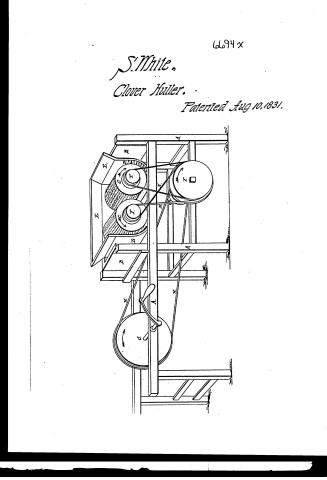
S. White's Patent Drawing for a Machine for Hulling and Cleaning Clover Seed

National Archives, Restored Patent Drawings (Record Group 241) · Full-size scan at the National Archives · Catalog record
Show the text on the drawing Hide (94 words)
Words on the drawing as machine-read by the National Archives; not checked. Useful mainly for searching.
S WHITE / 30. thrashing. / [159] Clover Hullers. / Hulling & Cleanino 2 Clorerseed Clorer seed / $2 / CLAISL TIATION / Patented 183/- / A Frame / 6694-X / B. Box / DIVISION. / C. Cytricter's / D. Concaves / E. Hopper / F. Pullics / Perspective showing the side ofBox of ox and Hopper removed / G. Wheel / cylmeters may be of woole / H. Bands / cacha with emery / F4 / for / Strickland Del / Patent office / Made under the direction of the commissioner of patents / in conformity with act of 3 March 1837 / Mengh Msworth / nefrormer of hatents
USPTO scan
The patent as scanned by the USPTO
-
 Page 1
-
 Page 2
-
 Page 3


U.S. Patent and Trademark Office · Google Patents
Show the transcription Hide (709 words)
Machine transcription (LightOnOCR) of the pages as scanned by the USPTO, most of them the handwritten copies made when the records were restored after the 1836 fire. Not checked; it can misread handwriting, so compare it with the scan.
Page 1.
6694 x
S. White.
Clover Huller.
Patented Aug 10, 1831.
Page 2.
X0006694 Aug 10, 1831 1/31.
Samuel White Adams County Pennsylvania.
Sellers Patent
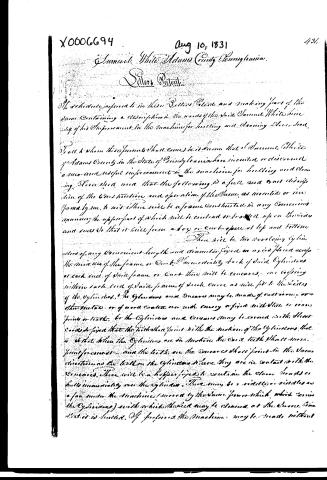
The schedule referred to in these Sellers Patent and making part of this same containing a description in the words of the said Samuel White here copy of his Improvement in the machine for hulling and cleaning Clover seed.
To all to whom this present shall come it known that I Samuel White of Adams County in the state of Pennsylvania have invented or discovered a new and useful improvement in the machine for hulling and cleaning Clover seed and that the following is a full and exact description of the construction and operation of the same as invented or improved by me. It will there will be a frame constructed in any convenient manner the upper part of which will be rounded or brought up on the sides and ends so that it will form a box or cistern space at top and bottom.
There will be two revolving cylinders of any convenient length and diameter fixed on axles placed across the middle of the frame or cistern immediately back of said cylinders at each end of said frame or cistern there will be concaves one opposing within each end of said frame of such curve as will fit to the sides of the cylinders. The cylinders and concaves may be made of cast iron or other metal or of wood coated over with canvas or fixed with iron or iron joints or teeth. So the cylinders and concaves may be covered with steel coats so fixed that the teeth shall joint with the motion of the cylinders that is to that when the cylinders are in motion the concave teeth shall move joint foremost and the teeth on the concaves shall joint in the same direction as the teeth on the cylinders have they are in contact with the concaves. There will be a hopper fixed to contain the clean seeds as falls immediately over the cylinders. There may be a riddle or riddles as a fan under the machine (moved by the same power which moves the cylinders) with which the seed may be cleaned at the same time that it is hulled. If preferred the machine may be made without
Page 3.
102.
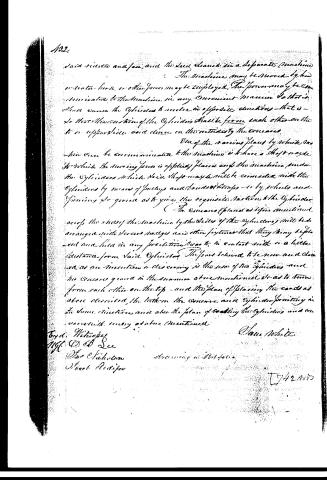
said ratchet and fan, and the said cleats in a separate machine. The machine may be moved by hand or water-horse, or other power may be employed. The power may be communicated to the machine in any convenient manner so that it shall cause the cylinders to revolve in opposite directions—that is, so that the motion of the cylinders shall be from each other on the top or opposite sides and down on the outside by the concaves.
One of the various plans by which motion can be communicated to the machine is to have a shaft maybe to which the moving force is applied, placed over the machine under the cylinders, which said shaft may be connected with the cylinders by means of pulleys and bands or strings—or by wheels and gearing so geared as to give the requisite motion to the cylinders.
The concaves (placed as before mentioned, except the sides of the machine by the sides of the cylinders) will be so arranged with screws swivels and other fixtures that they may be placed and held in any position near to, in contact with or a little distance from said cylinders. The part behind to be seen and described as an invention or discovery is the use of the cylinders and the concaves geared in the manner above mentioned, so as to turn from each other on the top—and the plan of placing the cords as above described, the latter on the concaves and cylinders forming in the same direction and also the plan of gearing the cylinders and concaves with every above mentioned.
Sam Nichols
By d. Wetzel
NHC D & B Lee
Thos Nicholson
Jacob Redifer
drawing a Boston
1742 and
Published accounts: journal notice
Notice in the monthly list of patents, with remarks
Journal of the Franklin Institute, new ser., vol. 9 (1832), p. 114 · View the page
13. For a Machine for hulling and cleaning Clover Seed; Lemuel White, Adams county, Pennsylvania, August 9.
Remarks. This clover machine is to be made pretty much like the ordinary cylinder thrashing machine, but it is to have two cylinders and two concaves adapted to them. The cylinders and concaves may be made of cast iron or of wood, and be covered with emery; or they may be covered with cards, so fixed that the teeth shall point with the motion of the cylinders, which is to be with their upper sides receding from each other. There must be a hopper for feeding, and a riddle and fan may be placed below, and moved with the machine. The claims are to the use of two cylinders and concaves, the cylinders revolving as described; the mode of gearing; the plan of placing the cards, and of coating the cylinders and concaves with emery.
About this record
- Patentee
- DATAMP
- Date
- the Name and Date index of patents, DATAMP, USPTO records
- Invention
- DATAMP
- Listed in
- the Name and Date index of patents, DATAMP, USPTO records, Jim Shaw's X-patent list, the Journal of the Franklin Institute, Burke's List of Patents (1847)
- The Franklin Institute's journal gives a different date.
- Burke's 1847 Patent Office list gives the same patent.