

Drawings and documents
National Archives restored drawings: drawing
H. Weed and S. Fellows' Patent Drawing for a Portable Smut Machine

National Archives, Restored Patent Drawings (Record Group 241) · Full-size scan at the National Archives · Catalog record
Show the text on the drawing Hide (121 words)
Words on the drawing as machine-read by the National Archives; not checked. Useful mainly for searching.
83. MILLS. / Grain Scourers. / Cylinder, Vertical. / 250 / Califial / Vol. 12 page / H .WEED & S .FELLOWS / CLASSIFICATION / Portable smut machine / 6720-+ / Patented 23 aug. aug.1831 183/- / DIV ISION / a. Box or chest / b. / Board covered with shoot. iron Supported / by blocks 6' / C. Melallic curve fitting in plank c / d. Shaft or spindle / e. Bridge e Free / f. / Whut or drum with driving hand orhelt / I. / Plumme 10. block / h. Whurs / k. Scives / l. / Regulating Regu lating Roller / in Hopper / 72. Smalleran 12 giving motion to Serves / a. F'an and curve / 11. Shout / Patud / Made un under the direction of the commyroner of Patents / in comformity with achof "March 1837 / Commingnoner of Patents
USPTO scan
The patent as scanned by the USPTO
-
 Page 1
-
 Page 2
-
 Page 3
-
 Page 4
-
 Page 5
-
 Page 6


U.S. Patent and Trademark Office · Google Patents
Show the transcription Hide (1,835 words)
Machine transcription (LightOnOCR) of the pages as scanned by the USPTO, most of them the handwritten copies made when the records were restored after the 1836 fire. Not checked; it can misread handwriting, so compare it with the scan.
Page 1.
6720X
Weed & Fellows.
Smart Mill.
Patented Aug. 23, 1831.
NO PRINTED SPECIFICATION AVAILABLE
Page 2.
Aug 23 1831 6720X 471
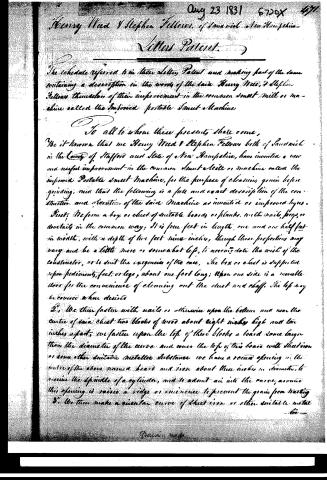
Henry Weed & Stephen Fellows, of Sandwich, New Hampshire
Letters Patent.
The schedule referred to in their Letters Patent and making part of the same containing a description in the words of the said Henry Weed, & Stephen Fellows themselves of their improvement in the common smut mill or machine called the Improved portable smut machine
To all to whom these presents shall come,
Be it known that we Henry Weed & Stephen Fellows both of Sandwich in the County of Stafford and State of New Hampshire, have invented a new and useful improvement in the common smut mill or machine called the improved Portable smut machine, for the purpose of cleansing grain before grinding, and that the following is a full and exact description of the construction and operation of the said machine as invented or improved by us.
First; We form a box or chest of suitable boards or planks, with nails, pegs, or dovetails in the common way; It is four feet in length, one and one half feet in width, with a depth of two feet nine inches, though these proportions may vary and be a little more or somewhat less, to accommodate the wish of the constructor, or to suit the exigencies of the case. The box or chest is supported upon pedestals, feet, or legs, about one foot long; Upon one side is a movable door for the convenience of cleaning out the dust and chaff. The top may be covered when desired.
2°, We then fasten with nails or otherwise upon the bottom and near the centre of said chest two blocks of wood about eight inches high and ten inches apart; we fasten upon the top of these blocks a board some larger than the diameter of the curve and cover the top of this board with sheet iron or some other suitable metallic substance we have a round opening in the centre of the above named board and iron about three inches in diameter, to receive the spindle of a cylinder, and to admit air into the curve, around this opening is raised a ridge or eminence to prevent the grain from starting.
3°, We then make a circular curve of sheet iron or other suitable metal
— to —
Patent granted
Page 3.
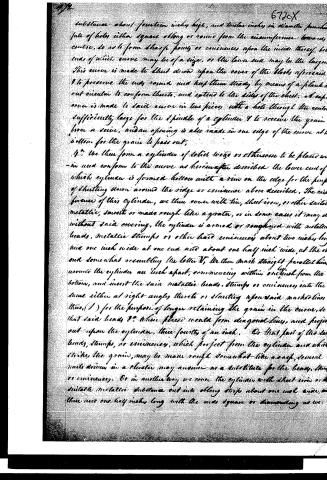
substance about fourteen inches high, and twelve inches in diameter, furnished with a full of holes either square oblong or round from the circumference towards the centre, so as to form sharp points or eminences upon the inside thereof, but the ends of which curve may be of a size, or the lower end may be the largest. This curve is made to shut down upon the cover of the block represented, and to preserve the coal round and keep them steady by means of a plank cut circular to conform thereto, and extend to the sides of the chest. An opening is made to admit air in two places, with a hole through the centre sufficiently large for the spindle of a cylinder to receive the grain from a sieve, and an opening is also made in one edge of the curve at the bottom for the grain to pass out.
4. The then form a cylinder of solid wood or otherwise to be placed within and conform to the curve as hereinafter described. The lower end of which cylinder is formed hollow with a rim on the edge for the purpose of shutting down around the ridge or eminence above described. The circumference of this cylinder, we then cover with tin, sheet iron, or other suitable metallic, smooth or made rough like a grate, or in some cases it may do without said covering. The cylinder is armed or roughened with metallic heads, metallic stumps or other hard eminences about two inches long and one inch wide at one end and about one half inch wide at the other end somewhat resembling the letter V. We then mark straight parallel lines around the cylinder an inch apart, commencing within one inch from the bottom, and insert the said metallic heads, stumps or eminences into the same either at right angles thereto or slanting upon said marked lines thus, (1) for the purpose of longer retaining the grain in the curve, so that said heads or when placed would form diagonal lines, and project out upon the cylinder, three fourths of an inch. Or that part of the said heads, stumps, or eminences, which project from the cylinder and which strike the grain, may be made rough somewhat like a rasp. Several nails driven in a cluster may answer as a substitute for the heads, stumps or eminences. Or in another way we can the cylinder with sheet iron or suitable metallic substance cut into oblong strips about one inch wide, and three and one half inches long with the ends square or diamonding as we
Page 4.
6720X 4773
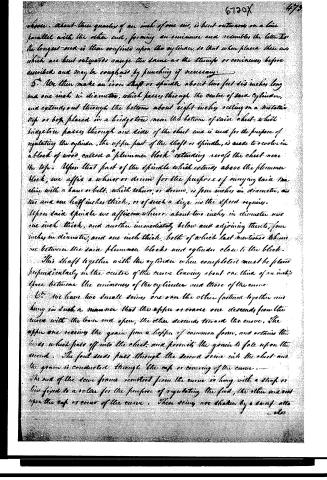
whose. About three quarters of an inch of one end, is bent outwards on a line parallel with the other end, forming an eminence and resembles the letter T. The longest end is then confined upon the cylinder, so that when placed there are which are bent outwards range the same as the stumps or eminences before described and may be roughened by punching if necessary.
5. We then make an iron shaft or spindle about two feet six inches long and one inch in diameter, which passes through the centre of said cylinder, and extends out through the bottom about eight inches, resting on a metallic step or box placed in a bridge tree near the bottom of said chest, which bridge tree passes through one side of the chest and is used for the purpose of regulating the cylinder. The upper part of the shaft or spindle, is made to cool in a block of wood, called a "plummer block" extending across the chest near the top. Upon that part of the spindle which extends above the plummer block, we affix a whorl or drum for the purpose of running said machine with a band or belt, which whorl or drum, is four inches in diameter, one two and one half inches thick, or of such a size as the speed requires. Upon said spindle we affix two whorls, about two inches in diameter and one inch thick, and another immediately below and adjoining thereto, four inches in diameter, and one inch thick, both of which last mentioned whorls are between the said plummer blocks and cylinder close to the block.
This shaft together with the cylinder when completed must be placed perpendicularly in the centre of the curve leaving about one third of an inch space between the eminences of the cylinder and those of the curve.
6. We have two small sieves, one over the other fastened together and hung in such a manner that the upper or coarse one descends from the curve with the lower end open, the other descends toward the curve, the upper one receiving the grain from a hopper of common form, and obtains the lands which pass off into the chest, and permits the grain to fall upon the second. The fine seeds pass through the second sieve into the chest and the grain is conducted through the cap or covering of the curve.
The end of the sieve frame remoter from the curve is hung with a strap or line fixed to a roller for the purpose of regulating the feed, the other end rests upon the cap or cover of the curve. These sieves are shaken by a lever also
Page 5.
attached to a small crank near the end of the chest opposite to the side, the arm of which crank is about one third of an inch long. About the end of this crank is a whorl four inches in diameter which receives and is driven by a band from a whorl on the said cylinder shaft two inches in diameter.
7th. We form a spout about three feet long which stands somewhat diagonally with the lower end placed so as to receive the wind from a fan with the under part shortest, to let the grain fall through the bottom of the chest or it may be conducted out at the side. The spout then passes up by the lower part of the curve, with a hole in one side opposite to the opening in the curve for the purpose of receiving the grain, it then continues about two feet through which the shaft is blown into the chest.
8th. We also make a curve for a fan about eight inches in diameter and four inches deep and place it perpendicularly upon the bottom of the chest at the end opposite the sieve, near the corner, through the bottom of the chest, in the centre of this curve is made a circular hole two inches in diameter to admit air into the curve. In this curve upon the edge near the top is made an opening corresponding with the spout. Also we have a fan as large as will operate in this curve made of wood or sheet iron attached to a wooden or iron shaft, which stands parallel with the spindle of the cylinder, and has a whorl near the upper end about four inches in diameter, and one inch thick to receive a belt that passes around a whorl on the spindle of the cylinder of the same size.
This shaft or spindle rests upon a bridge tree affixed to the bottom of the chest and revolves therein and at the top it is fastened similar to that of the cylinder. The curve of the fan is covered with a board in two pieces.
That we consider new in said machine for which we ask an exclusive privilege is, Firstly placing the machine in a chest, Secondly the shape of the beads, 9th, Thirdly in making them rough, Fourthly the manner of placing them in the cylinder, Fifthly the driving of the nails in clusters, Sixthly the cutting of the sheet iron into strips and making them rough like a rasp or grater.
Advantages. What we consider as advantages which this machine
Page 6.
6720X
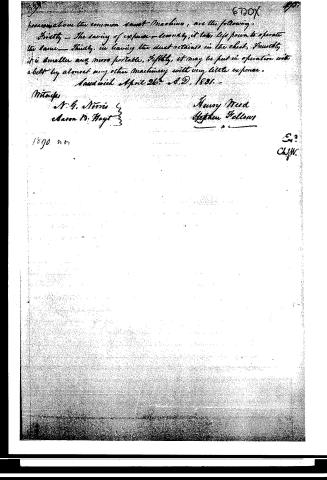
Innovations over the common dust Machine, are the following.
Firstly — The saving of expense — Secondly, it takes less power to operate the same — Thirdly, in leaving the dust contained in the chest, Fourthly, it is smaller and more portable, Fifthly, it may be put in operation with a belt by almost any other machinery with very little expense.
Sandwich April 26th A.D. 1831.
Witness
N. G. Norris
Baron D. Hoyt
Henry Wood
Stephen Hollow
1890
E?
CJHW.
Published accounts: journal notice
Notice in the monthly list of patents, with remarks
Journal of the Franklin Institute, new ser., vol. 9 (1832), p. 126 · View the page
42. For an improved portable Smut Machine; Henry Weed, and Stephen Fellows, Sandwich, Strafford county, New Hampshire, August 23.
Remarks. This smut machine is much like some others, and the improvements claimed to have been made by the patentees do not essentially alter it. A box or chest is to be made to contain the machine. A cylinder, about twelve inches in diameter, and four in height, is made to revolve vertically, by a strap passing round a whirl on its shaft. This cylinder may be left smooth, or it may be covered with sheet iron cutinto strips, or brads made rough, or nails in clusters, may be driven into it. A sheet iron cylinder, punched from the outside, so as to form a grater within, is to surround, and stand at a suitable distance from the revolving cylinder; between these, of course, the grain is to pass, the feed being from a hopper, the grain falling from it on a seive, and from that on to a second seive, kept in motion by a crank. A fan also is kept in motion, to blow away the chaff and dust. What is claimed as new, is "the placing the machine in a chest. The shape of the brads. The making them rough. The manner of placing them in the cylinder. The driving of the nails in clusters. The cutting sheet iron into strips, and making them rough like rasps."
About this record
- Patentee
- DATAMP
- Date
- the Name and Date index of patents, DATAMP, USPTO records
- Invention
- DATAMP
- Listed in
- the Name and Date index of patents, DATAMP, USPTO records, Jim Shaw's X-patent list, the Journal of the Franklin Institute, Burke's List of Patents (1847)
- Burke's 1847 Patent Office list gives the same patent.