

Drawings and documents
National Archives restored drawings: drawing
Josiah Fay's Patent Drawing for a Tenoning Machine

National Archives, Restored Patent Drawings (Record Group 241) · Full-size scan at the National Archives · Catalog record
Show the text on the drawing Hide (129 words)
Words on the drawing as machine-read by the National Archives; not checked. Useful mainly for searching.
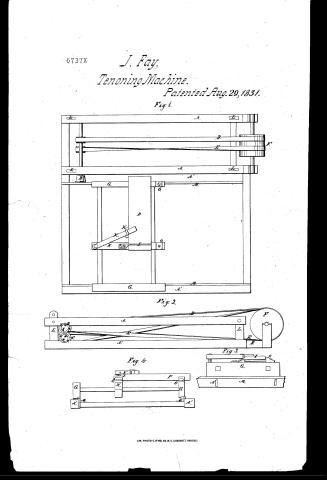
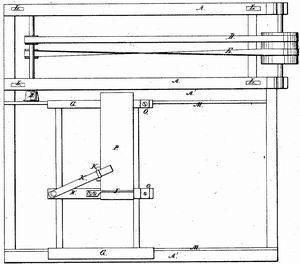
144. WOOD WORKING MACHINES. / fosiah Y. Fay / Vol. 8.70.17. / Vol, / $152 / Gaining. / Jenoning Machine. / Patented 29.Augt 1931: / CLASSIFICATION / 6737+ / DIVISION. / Fuf 1 / A' / DO / 4. / Fight / Fight / A' / A' / Fig.2. / OF / Is / A' / Fig.3. / References. / Fid.1. Top view. Fif.2. side view. / A.A'frames B. cutter in upper frame, Clower framescutter. / D. o/len belt. E. crops belt. Edriving drum, G. carriage / H. slide I,spring. K. sweep. & holdfast. Instuds. / Fig.3. endview, Fig. 4. side view. M.ways, V.Slots, / P. post to be termoned / for raising and lowering ways. O,moveable blocks. / Patent Office 31 Aug 1841 / Made under the direction of the Commip ioun of Patients / very difficult shin / in conformity with act of bougrep 3 March 183% / MemyLSumoth / Commiponn of Patints
USPTO scan
The patent as scanned by the USPTO
-
 Page 1
-
 Page 2
-
 Page 3
-
 Page 4


U.S. Patent and Trademark Office · Google Patents
Show the transcription Hide (968 words)
Machine transcription (LightOnOCR) of the pages as scanned by the USPTO, most of them the handwritten copies made when the records were restored after the 1836 fire. Not checked; it can misread handwriting, so compare it with the scan.
Page 1.
6737X
J. Fay,
Tenoning Machine.
Patented Aug. 29, 1831.
Fig. 1.
Fig. 2.
Fig. 3.
Fig. 4.
A.M. PHOTO-LITHO. CO. N.Y. (OSBORNE'S PROCESS)
Page 2.
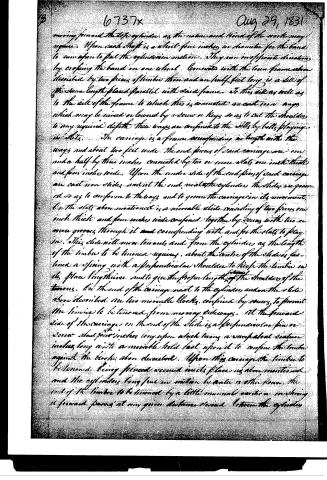
Aug 29 1831
Josiah Fry, Hollis, New Hampshire
Letters Patent
The Schedule referred to in these Letters Patent and making part of the same, containing a description in the words of the said Josiah Fry himself of his improvement in the art of cutting tenons by revolving cylinders.
To all to whom these presents shall come. Be it known that I Josiah Fry of Hollis in the County of Hillsborough and State of New Hampshire have invented a new and useful improvement in the art of cutting tenons by revolving cylinders and that the following is a full and exact description of the construction of my discovery or invention together with a frame necessary to contain the same. The machine consists of a frame forty-two inches long and twenty inches wide to contain the lower cylinder, directly over that is another frame the same size to contain the upper cylinder, and connected together at the ends by studs. The studs are made fast to the frame. The upper frame is confined to the said studs at one end by five and a half inches from the lower frame. The other end of the upper frame may be raised or lowered as the thickness of the tenons to be cut may require, and made fast by bolts that play in slots of said studs. The size of timber suitable for the frames is three by four inches and confined together by joint bolts. The cylinders are of cast iron seven inches in diameter at the far end and about one eighth of an inch less at the opposite end. They are three inches long and placed in the frames one directly over the other in nearly a horizontal position inclining a little towards each other at the wider end, so as to bring their surfaces at a parallel distance. They are supported in the frames by wrought iron shafts turning upon pivots or centres. An inch cylinder has a frame iron projecting through and set transversely with the surface of the cylinders and made fast by bolts and screws at the far end and upon the edge of each cylinder are two spurs fastened by iron keys to cut the shoulders of the tenons which may be cut directly opposite or be raised by
Page 3.
moving forward the top cylinder, as the nature and kind of the work may require. Upon each shaft is a wheel four inches in diameter for the band to run upon to put the cylinder in motion. They run in opposite directions by crossing the band on one wheel. Connected with the beam frame above described by two pieces of timber three and an half feet long is a sill of the same length placed parallel with said frame. To this sill as well as to the sill of the frame to which this is connected are cast iron ways which may be raised or lowered by a screw or keys so as to set the shoulders to any required depth. These ways are confined to the sills by bolts playing in slits. The carriage is a frame corresponding in length with the ways and about two feet wide. The end pieces of said carriage are one and a half by three inches, connected by two or more slats one inch thick and four inches wide. Upon the under side of the end pieces of said carriage are cast iron slides and at the end near the cylinders the slides are grooved so as to conform to the ways and to govern the carriage in its movement. In the slats above mentioned is a movable slide consisting of two pieces one inch thick and four inches wide confined together by screws with two or more grooves through it and corresponding with and for the slats to play in. This slide will move towards and from the cylinders as the length of the timber to be tenoned requires. About the centre of the slides is fastened a spring with a perpendicular shoulder to keep the timber in its place lengthwise and to give the proper length of the shoulders of the tenons. On the end of the carriage next to the cylinders and on the slide above described are two movable blocks confined by screws to prevent the timbers to be tenoned from moving sideways. At the forward side of the carriage on the end of the slide is a perpendicular pin or screw about four inches long upon which turns a scrap about sixteen inches long with a movable hold fast upon it to confine the timber against the blocks above described. Upon this carriage the timbers to be tenoned being placed around in its place as above mentioned and the cylinders being put in motion by water or other power, the end of the timber to be tenoned by a little manual exertion is moving it forward passing at any given distance forward between the cylinders.
Page 4.
Aug 29, 1831
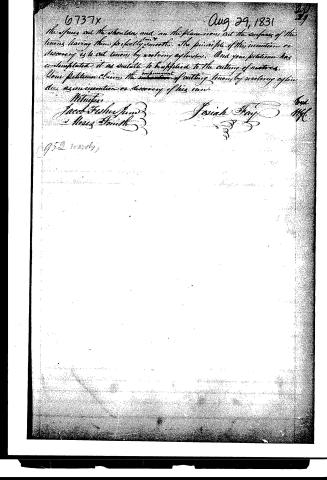
the edges out the shoulders and on the planar ones out the surfaces of the tenons leaving them perfectly smooth. The principle of this invention or discovery is to cut tenons by revolving cylinders. And your petitioner has contemplated it as suitable to be applied to the cutting of masts. Your petitioner claims the improvement of cutting tenons by revolving cylinders as an invention or discovery of his own.
Witness
Jacob Fishburne
Nasas Smith
Sariah Hay
(952 words)
Published accounts: journal notice
Notice in the monthly list of patents, with remarks
Journal of the Franklin Institute, new ser., vol. 9 (1832), p. 133 · View the page
(The specification was published in the last No.) 59. For Cutting Tenons by Revolving Cylinders; Josiah Fay, Hollis, Hillsborough county, New Hampshire, August 29.
Remarks. Two cylinders are made to revolve, one above the other, and are capable of being removed nearer together, or further apart. Upon their faces they carry cutters, in the form of plane irons set askew, and from their edges project small spurs, or cutters, which cut the shoulders of the tenons. The piece to be cut lies in the direction of the axes of the cylinders, upon a sliding frame prepared for the purpose. The machine, as drawn, appears to be unnecessarily complex; an error by no means uncommon in the first formation of instruments of this kind. The patentee claims "the cutting of tenons by revolving cylinders," as his own invention or discovery. The cylinders have their bearings behind that part upon which the cutters are placed, as these ends must stand out like a chuck in the mandril of a lathe, otherwise the piece to be tenoned could not pass between them.
DATAMP: illustration
Illustrations from DATAMP

DATAMP (Directory of American Tool and Machinery Patents), via the Internet Archive · Archived DATAMP page
About this record
- Patentee
- DATAMP
- Date
- the Name and Date index of patents, DATAMP, USPTO records
- Invention
- DATAMP
- Listed in
- the Name and Date index of patents, DATAMP, USPTO records, Jim Shaw's X-patent list, the Journal of the Franklin Institute, Burke's List of Patents (1847)
- Burke's 1847 Patent Office list gives the same patent.