

Drawings and documents
USPTO scan
The patent as scanned by the USPTO
-
 Page 1
-
 Page 2
-
 Page 3


U.S. Patent and Trademark Office · Google Patents
Show the transcription Hide (846 words)
Machine transcription (LightOnOCR) of the pages as scanned by the USPTO, most of them the handwritten copies made when the records were restored after the 1836 fire. Not checked; it can misread handwriting, so compare it with the scan.
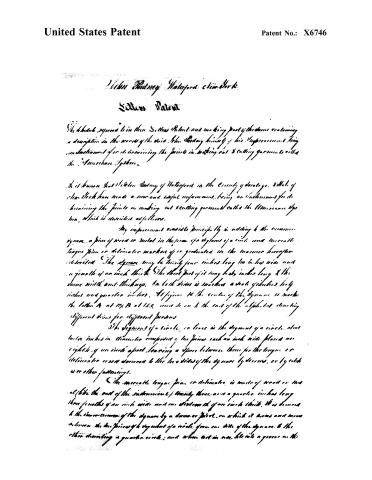
Page 2.
United States Patent
Patent No.: X6746
John Rodney Waterford, New York
Letters Patent
The above named John Rodney Waterford, of the County of Saratoga, State of New York, have made a new and useful improvement, being an instrument for determining the points in making out & cutting garments, called the American System.
It is known that John Rodney Waterford, of the County of Saratoga, State of New York, have made a new and useful improvement, being an instrument for determining the points in making out & cutting garments, called the American System, which is described as follows.
My improvement consists principally in adding to the common square, a piece of wood or metal, in the form of a segment of a circle, and movable tongue piece or delineator marked off or graduated in the manner hereafter described. The square may be twenty-four inches long, ten inches wide, and a quarter of an inch thick. The short part of it may be six inches long & the same width and thickness. On both sides is marked a scale graduated, half inches and quarter inches. At figure 12 the center of the square is marked the letter A at 12.5, B at 13.5, and so on to the end of the alphabet, denoting different sizes for different persons.
The segment of a circle, or base, is the segment of a circle, about twelve inches in diameter, composed of the pieces, each an inch wide, placed one eighth of an inch apart, leaving a space between them for the tongue or delineator to pass down to the two sides of the square by degrees, or by other means or other fastenings.
The movable tongue piece or delineator, is made of wood or metal, about the end of the instrument, twenty-three and a quarter inches long, three-eighths of an inch wide, and one-eighth of an inch thick. It is secured to the inner corner of the square by a screw or pivot, on which it turns and moves between the two pieces of a segment of a circle, from one side of the square to the other, describing a quarter circle; and when set in use, it cuts a groove on the
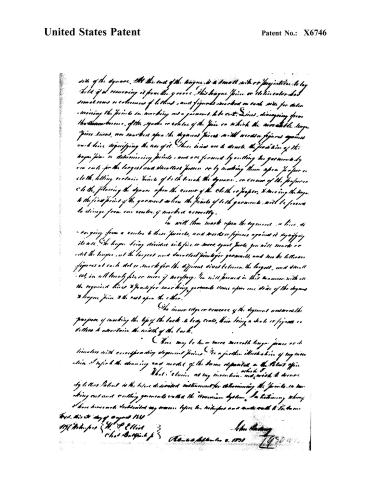
Page 3.
United States Patent
Patent No.: X6746
side of the square. At the end of the tongue is a small notch or projection to lay hold of in removing it from the groove. This tongue piece or the like color has several rows or columns of letters and figures marked on each side for determining the points in marking out a garment to be cut. Lines, diverging from the inner corners of the square or edges of the piece on which the movable tongue piece stands, are marked upon the segment pieces with words or figures against each line signifying the use of it. These lines are to denote the position of the tongue piece in determining points, and are formed by cutting the garments by one rule for the largest and smallest persons or by marking them upon a paper or cloth, letting exclusive lines of both touch the square, or corner of the paper or cloth, placing the square upon the corner of the cloth or paper, drawing the tongue to the first point of the garment when the points of both garments will be found to diverge from one centre if marked correctly.
You will then mark upon the segment a line diverging from a center to these points, and words or figures against it signifying its use. The tongue being divided into five or more equal parts, you will mark or cut the tongue at the largest and smallest points for garments, and use the letters or figures at each dot or mark for the different sizes between the largest and smallest, in all twenty-five or more if necessary. You will proceed in this manner with all the required lines of points for marking garments twice upon one side of the square and tongue piece to the rest upon the other.
The inner edge or concave of the segment answers the purpose of marking the top of the back to body coats, their being a scale or figures or letters to ascertain the width of the back.
There may be two or more movable tongue pieces or divisions with corresponding segment pieces. It is a further illustration of my invention I reject the drawing and model of the same deposited in the Patent office.
What I claim as my invention, and which I desire by letters Patent is the above described instrument for determining the points in marking out and cutting garments with the American system. In testimony whereof I have hereunto subscribed my name before the witnesses and made oath to the same.
This 20th day of August 1850
Wm. P. Elliot
Chas. Balgwin
John Haring
Filed September 6, 1850
7930 (1)
Published accounts: journal notice
Notice in the monthly list of patents, with remarks
Journal of the Franklin Institute, new ser., vol. 9 (1832), p. 160 · View the page
5. For an instrument for determining the points in Marking and Cutting Garments, called the "American System;" John Pudney, Waterford, Saratoga county, New York, September 3.
Remarks. Mr. Pudney's AMERICAN SYSTEM consists of a square like that of a carpenter, formed of wood or metal, one of the arms being about two feet in length, and the other about six inches. A segment of a circle unites the long and short arms, the angle of the square being its centre; a tongue, or secondary arm, works upon a joint at this centre, and opens like a rule. There are divisions, with letters and figures on the circular segment, and others on the arms, which serve as a scale to mark the points for cutting garments. The claim is to the before described instrument.
About this record
- Patentee
- DATAMP
- Date
- the Name and Date index of patents, DATAMP, USPTO records
- Invention
- DATAMP
- Listed in
- the Name and Date index of patents, DATAMP, USPTO records, Jim Shaw's X-patent list, the Journal of the Franklin Institute, Burke's List of Patents (1847)
- Burke's 1847 Patent Office list gives the same patent.