

Drawings and documents
National Archives restored drawings: drawing
W. P. Samples' Patent Drawing for a Scraper and Harrow

National Archives, Restored Patent Drawings (Record Group 241) · Full-size scan at the National Archives · Catalog record
Show the text on the drawing Hide (34 words)
Words on the drawing as machine-read by the National Archives; not checked. Useful mainly for searching.
Entered / 55 HARROWS & DIGGERS. / Harrows. / With Sampless / $250, Harrows-etgi. / Seraper I Harrow. / Potented 38 Sep 1831. / CLASSIFICATION / DIV 6747-1 ISION. / ep
USPTO scan
The patent as scanned by the USPTO
-
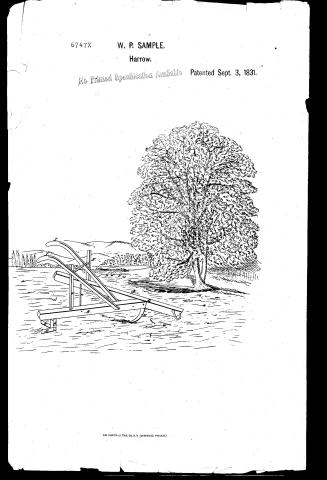 Page 1
-
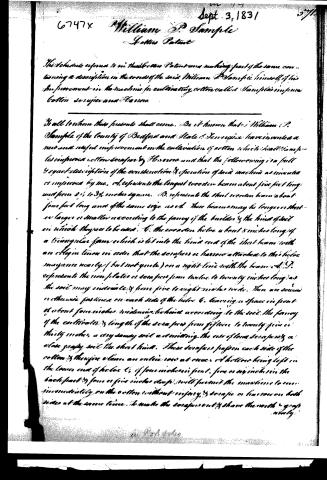 Page 2
-
 Page 3
-
 Page 4


U.S. Patent and Trademark Office · Google Patents
Show the transcription Hide (984 words)
Machine transcription (LightOnOCR) of the pages as scanned by the USPTO, most of them the handwritten copies made when the records were restored after the 1836 fire. Not checked; it can misread handwriting, so compare it with the scan.
Page 1.
6747X
W. P. SAMPLE.
Harrow.
No Printed Specification Available Patented Sept. 3, 1831.

AM. PHOTO-LITHO. CO. N.Y. (OSBORNE'S PROCESS)
Page 2.
Sept 3, 1831
6747x William P. Sample
Gottino Patent
The Schedule refers to in this Letter Patent and making part of the same containing a description in the words of the said William P. Sample himself of his Improvement in the machine for cultivating cotton called Sample's improved cotton scraper and Harrow.
To all to whom this presents shall come, Be it known that I William P. Sample of the County of Bedford and State of Tennessee have invented a new and useful improvement in the cultivation of cotton which I will hereafter improve cotton scraper & Harrow and that the following is a full & exact description of the construction & operation of said machine as invented & improved by me. A. represents the longest wooden beam about five feet long and from 2 1/2 to 3 1/2 inches square. B. represents the short wooden beam about four feet long and of the same size as A. These beams may be longer or shorter or larger or smaller according to the fancy of the builder & the kind of soil in which they are to be used. C. the scraper below about 8 inches long of a triangular form which is let into the hind end of the short beam with an oblique tenon in order that the scraper or harrow attached to this below may move nearly (but not quite) on a right line with the beam. A. D. represents the iron plates or scrapers from twelve to twenty inches long as the soil may indicate & from five to eight inches wide. These are secured with iron fasteners on each side of the below C. leaving a space in front of about four inches wide enough behind according to the soil, the fancy of the cultivator & length of the scraper from fifteen to twenty five or thirty inches, a very heavy iron and missing the use of long scrapers & a close grating soil the short kind. These scrapers pass on each side of the cotton & therefore leave an entire row at once of hollows being left in the lower end of below C. if four inches in front, four or six inches in the back part & four or five inches deep. will permit the machine to run immediately on the cotton without injury & scrape or harrow on both sides at the same time. To make the scraper cut & shave the earth & grass nearly.
Page 3.
SP. 6747x Sept 3, 1831
nearly the lower part must be sharp & from one to two inches of it bent forward. Likewise about one & half inch of the front part must be bent so as to come on a straight line with the cotton to prevent it from being injured by the beam. E represents the foot on which the long beam rests & may be about 12 or 14 inches long. F represents the uprights on which the handles are fastened by a pin passing through the uprights & handles by which the machine is governed. G represents the point where the two beams are mortised or joined together. H represents the brace or pin let into the beams A & B, near the hind end in order to keep them steady & firm & about 10 inches apart. I represents the handles. To convert the same frame or machine into a cotton harrow take off the scraper & insert into the foot of the same helve two bent iron teeth or small coulters about six inches apart. These teeth or coulters are likewise to come on each side of the cotton & are designed to break up the ground & sift in among the cotton a sufficient quantity of mould to cover young grass &c. And if it should be desired to use a complete harrow with two three or more teeth on each side take off the helve & attach this harrow in place of the helve & it will work on the same principle. I am aware that many cotton scrapers & harrows are in use & some of them so far as a single scraper is like a double scraper resembling mine, (that is the iron or steel plate separates from the machine) likewise I have seen harrows to act on both sides of the cotton at the same time, but in every such case the horse or mule was compelled to walk in mediately on the cotton. Therefore the claim made for a patent on my invention does not rest on the form of the plate of the scraper nor on the form of the iron teeth of the harrow separated from the machine, but mainly upon the wooden part. For by the mechanism & frame of the wooden part of my machine the horse or mule walks one foot from the cotton, when at the same time the instrument is directly on it. Two scrapers being fixed on the same helve double work is done & the machine runs more steadily. And in harrowing the same effect is produced on the same principle. Note. Although the mechanism of the wooden part is the main improvement yet the application of scrapers or harrows both
Page 4.
6747x
Sept 3, 1831
to such a machine being a new principle, at least so far as to do double work, I presume that the whole ought to be embraced in the patent
Witnesses
James F. Armstrong
Darling D. Arnold
W.D. Sample
Ex?
clyw
Published accounts: journal notice
Notice in the monthly list of patents, with remarks
Journal of the Franklin Institute, new ser., vol. 9 (1832), p. 160 · View the page
6. For an improved Scraper and Harrow, to be used in the cultivation of Cotton; William P. Sample, Bedford county, Tennessee, September 3.
Remarks. The frame work of this instrument resembles that of the well known triangular harrow, or cultivator. The patentee states that other scrapers have been made which nearly resemble his, but that their frame work was so constructed as to cause the horse employed to draw them, to trample upon the cotton, whilst by his construction, the animal is removed a foot from the rows. Scrapers, in the form of a V, are fixed upon helves so as to work upon each side of the row of cotton; these scrapers are so formed as to cut the surface, and cover low grass and weeds with earth. It is said that in consequence two scrapers being fixed on the same instrument, it executes double the work of any other. The patentee, however, relies principally on the form of the wooden part, as sustaining his claim to novelty.
About this record
- Patentee
- DATAMP
- Date
- the Name and Date index of patents, DATAMP, USPTO records
- Invention
- DATAMP
- Listed in
- the Name and Date index of patents, DATAMP, USPTO records, Jim Shaw's X-patent list, the Journal of the Franklin Institute, Burke's List of Patents (1847)
- Burke's 1847 Patent Office list gives the same patent.