

Drawings and documents
USPTO scan
The patent as scanned by the USPTO
-
 Page 1
-
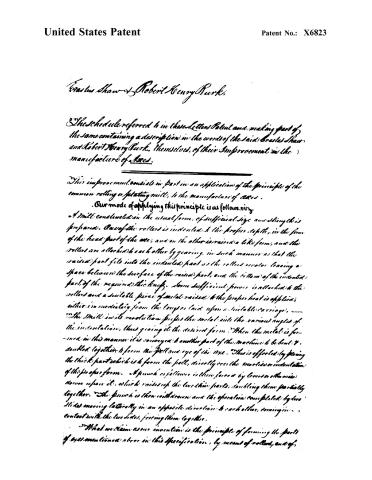 Page 2
-
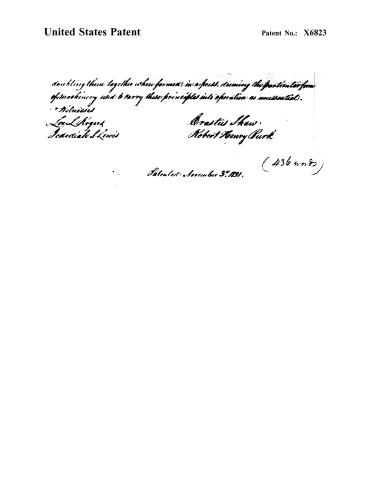 Page 3


U.S. Patent and Trademark Office · Google Patents
Show the transcription Hide (446 words)
Machine transcription (LightOnOCR) of the pages as scanned by the USPTO, most of them the handwritten copies made when the records were restored after the 1836 fire. Not checked; it can misread handwriting, so compare it with the scan.
Page 2.
United States Patent
Patent No.: X6823
Erastus Shaw & Robert Henry Burk.
This schedule referred to in these Letters Patent and making part of the same containing a description in the words of the said Erastus Shaw and Robert Henry Burk, themselves, of their Improvement in the manufacture of axes.
This improvement consists in part in an application of the principle of the common rolling or rotating mill, to the manufacture of axes.
Our mode of applying this principle is as follows:
A mill constructed in the usual form, of sufficient size and strength is prepared. One of the rollers is indented to the proper depth, in the form of the head part of the axe, and on the other is raised a like form, and the rollers are attached to each other by gearing, in such manner as that the raised part fits into the indented part as the rollers rotate, leaving a space between the surface of the raised part, and the bottom of the indented part, of the required thickness. Some sufficient power is attached to the rollers and a suitable piece of metal raised to the proper heat is applied, either immediately from the forge or laid upon a suitable carriage.
The mill in its revolution forces the metal into the various angles of the indentation, thus giving it the desired form. When the metal is formed in this manner it is conveyed to another part of the machine to be bent & doubled together to form the poll and eye of the axe. This is effected by placing the thick part which is to form the poll, directly over the mortise or indentation of the proper form. A punch or follower is then forced by levers or otherwise down upon it, which raises up the two thin parts, doubling them partially together. The punch is then withdrawn and the operation completed by two slides moving laterally in an opposite direction to each other, coming into contact with the two sides, forcing them together.
What we claim as our invention is the principle of forming the parts of axes mentioned above in this specification, by means of rollers, one of
Page 3.
United States Patent
Patent No.: X6823
doubling them together when formed; in a field, leaving the particular form of machinery used to carry these principles into operation as unessential.
Witnesses
Lucy Rogers
Jesediah Lewis
Horatio Shaw
Robert Henry Burk
(436 words)
Patented November 3, 1831.
Published accounts: journal notice
Notice in the monthly list of patents, with remarks
Journal of the Franklin Institute, new ser., vol. 9 (1832), p. 313 · View the page
5. For an improvement in the Manufacturing of Axes; Erastus Shaw, and Robert H. Burk, Canton, Hartford county, Connecticut, November 3.
Remarks. Rollers are to be prepared and geared in the manner of flatting mill rollers; one of these is to be indented; and the other is to have a raised part upon it, leaving, between the two, a proper space for the formation of the axe, so that when bent over, the eye and other parts will have their proper shape. The iron, properly heated, is to be passed between these rollers, and when delivered from them subjected to the action of a press, provided with a punch, or follower, for bending the parts together. The claim is to the forming the parts of axes by means of rollers, and of doubling them together in a press. The description is equally general with our notice of it, "the particular form of machinery used to carry these principles into operation being deemed unessential." We, however, do not concur with the patentee on this point, for the general principle of such a machine is well known, numerous articles having been manufactured of iron by means of rollers; we apprehend, therefore, that to sustain a patent for such a purpose, there ought to be something special in the construction of the apparatus, and that such special contrivance should be clearly exhibited.
About this record
- Patentee
- the Journal of the Franklin Institute, Journal
- Date
- the Name and Date index of patents, USPTO records, Jim Shaw's X-patent list
- Invention
- the Name and Date index of patents
- Listed in
- the Name and Date index of patents, USPTO records, Jim Shaw's X-patent list, the Journal of the Franklin Institute, Burke's List of Patents (1847)
- The patentee's full name comes from the Franklin Institute's journal.
- Burke's 1847 Patent Office list gives the same patent.