

Drawings and documents
National Archives restored drawings: drawing
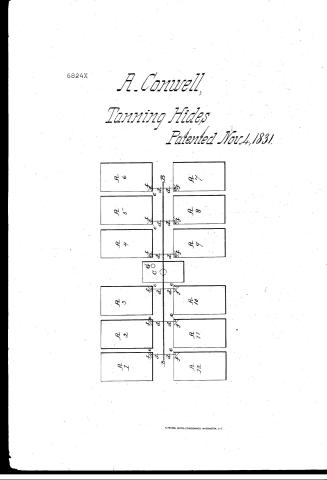
Abraham Conwells' Patent Drawing for an Improved Tan Yard and Reference

National Archives, Restored Patent Drawings (Record Group 241) · Full-size scan at the National Archives · Catalog record
Show the text on the drawing Hide (371 words)
Words on the drawing as machine-read by the National Archives; not checked. Useful mainly for searching.
CLASSE INATION / 149. Hides, Skins and Leather, / Apparatus, / 6824 / 9. Tanning. / DIVISION. / A drawing of Abraham Conwells improved Jan yord &πejerence / Patented 4" November. 1831 / is / A3 / 1/8 / 00/x / 12 / 11 / 10 / AM / Figures A. numbered 1, 2,3,4 H. represent vats of the ordinary size placed at the common distance apart. but / which may be placed at any distance anart to suit the convenience orpleasure of the constructor / Figure B. is a nipe or conductor placed on a level with the bottom of the vats equi distant between the / rows of bats chasing through the cistern or reservoir. 6. / Figure. G. represents a reservoir or cistern through which the conductor. B. hapses & should be located / at the centre of the conducter & be made so deep below the bottomy the vats as to be capable of receiving / at least the con tents of one vat upon the mere opening of the nines- the cistern or reservoir may however / be dispensed with by placing a nump in the centre of the conductor. B. & inserting the conductor into / the hump on each side as represented in the dotted line in the drawing / Figures. d. represent nipes which communicate with the bats & the conductor. B. & are inserted at the / bottom of the bat level with the con ductor / Figures e represent cochs or spigots which stop the nipes. d. and must be long enough so as to extend / from their insertion in the hipes to the top or near the top of the bats so as to he turned without des / cending into the bats / Figures. f. represent strainers or(as they are denominated by tanners letch eyes and are formed by / placing an inch plank twelve inches or lefs wide unright et tending from the bottom to the top of the / bats, in the angle and filled with small holes / Figure G. represents a hump which is necessary in case the cestern be used / Figure.h represents a cock in the centre of the condu ton B. and has a spigot extending to the ton of / the cestome & is used in drawing the liquors or ooze from the bats into the Cestern
USPTO scan
The patent as scanned by the USPTO
-
 Page 1
-
 Page 2
-
 Page 3


U.S. Patent and Trademark Office · Google Patents
Show the transcription Hide (881 words)
Machine transcription (LightOnOCR) of the pages as scanned by the USPTO, most of them the handwritten copies made when the records were restored after the 1836 fire. Not checked; it can misread handwriting, so compare it with the scan.
Page 1.
6824X
A. Conwell,
Tanning Hides
Patented Nov. 4, 1831.
<table>
<tr>
<td>
<table>
<tr><td> $A_6$ </td></tr>
<tr><td> $f$ </td></tr>
Page 2.
6824X Nov 4 1831 260
Abraham Conwell.
Letters Patent. Nov. 4, 1831.
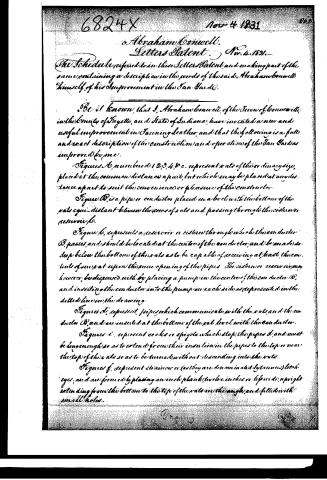
The Schedule referred to in these Letters Patent, and making part of this same, containing a description in the words of the said Abraham Conwell himself, of his Improvement in the Tan Yard.
Be it known, that I, Abraham Conwell, of the Town of Conwellville, in the County of Fayette, and State of Indiana, have invented a new and useful improvement in Tanning Leather, and that the following is a full and exact description of the construction and operation of the Tan Yard as improved by me.
Figures A, numbered 1, 2, 3, 4, &c. represent vats of the ordinary size, placed at the common distance apart, but which may be placed at any distance apart to suit the convenience or pleasure of the constructor.
Figure B, is a pipe or conductor placed on a level with the bottom of the vats equi-distant between the rows of vats and passing through the cistern or reservoir C.
Figure C, represents a reservoir or cistern through which the conductor B passes, and should be located at the centre of the conductor, and be made so deep below the bottom of the vats as to be capable of receiving at least three eights of water upon the mere opening of the pipes. The cistern or reservoir may, however, be dispensed with by placing a pump in the centre of the conductor B, and inserting the conductor into the pump on each side as represented in the dotted line in the drawing.
Figures D, represent pipes which communicate with the vats and the conductor B, and are inserted at the bottom of the vat level with the conductor.
Figures E, represent cocks or spigots which stop the pipes D, and must be long enough so as to extend from their insertion in the pipes to the top or near the top of the vats so as to be turned without descending into the vats.
Figures F, represent strainers or (as they are denominated by tanners) letch eyes, and are formed by placing an inch plank twelve inches or fifteen inches in length extending from the bottom to the top of the vats in the angle, and filled with small holes.
Drawing
Page 3.
68247
Figure A represents a pump which is necessary in case the cistern be used.
Figure B represents a cock in the centre of the conductor C, and has an spigot extending to the top of the cistern, and is used in drawing the liquor or oye from the vats into the cistern.
The advantages to be derived from this invention are first, the ease and facility by which oye or liquor can be changed from one vat to another, as for instance, should it be required to conduct the oye from vat at A-1, which is full, into vat at A-7, which is empty or simply filled with dry bark, it is only necessary to turn the spigot in each of these vats, and one half of the oye or liquor will be through the conductor conveyed into that at A-7, then by stopping the cock in A-7, and opening the cock b, in the conductor, the balance of the oye will be deposited in the cistern (if one be used) and can be raised by the pump and conveyed by phials or hose into A-7. Secondly, that at any time when oye in any vat becomes too weak to suit the hides, it can be drawn off and its place be supplied by stronger oye, without the labor now necessary in removing the hides. Thirdly, that weak oye can be drawn off and fresh and stronger applied in pumping in either without removing or disturbing the hides. Fourthly, that it leaves the bark in such a condition in the vats that all its strength can be exhausted, and the tan left perfectly drained and easy of removal. Fifthly, that the tanning of leather will be much facilitated because oye of any strength can be applied to hides to suit any stage in their tanning. Sixthly, that much labor and expense in tanning will be saved because the oye in part, accords itself to any vat merely in the yard and the balance to the cistern or pump from whence it can be easily raised and deposited in the vat required.
The inventor claims as new in the annexed drawing and description of his improved Tannyard: the application of the conductor and pipes to the vats as above shown and specified, by the means of which much labor and bark in the business of tanning is saved because the oye or liquor is changed and applied at pleasure without raising the hides or disturbing them.
Witnesses
Sam'l. K. Sample
Almer Fay
Abraham Cornwell
(1822)
Published accounts: journal notice
Notice in the monthly list of patents, with remarks
Journal of the Franklin Institute, new ser., vol. 9 (1832), p. 314 · View the page
8. For an improvement in the Tanning of Leather; Abraham Conwell, Connersville, Fayette county, Indiana, November 4.
Remarks. There are to be tubes of communication between each of the vats employed, which are opened or closed at pleasure by means of cocks fixed within the strainers, or leach eyes, and also with a cistern which forms a common reservoir from each of them. The claim is to "the application of the conductors and pipes to the vats, by means of which much labour and bark are saved in the business of tanning." Conductors and pipes have been repeatedly used; we have seen them many years since; not precisely as described by the present patentee, but operating upon the same principle, and answering the same end.
About this record
- Patentee
- Jim Shaw's X-patent list
- Date
- the Name and Date index of patents, USPTO records, Jim Shaw's X-patent list
- Invention
- the Name and Date index of patents
- Listed in
- the Name and Date index of patents, USPTO records, Jim Shaw's X-patent list, the Journal of the Franklin Institute, Burke's List of Patents (1847)
- The Franklin Institute's journal spells the name differently.
- Burke's 1847 Patent Office list gives the same patent.