

Drawings and documents
National Archives restored drawings: drawing
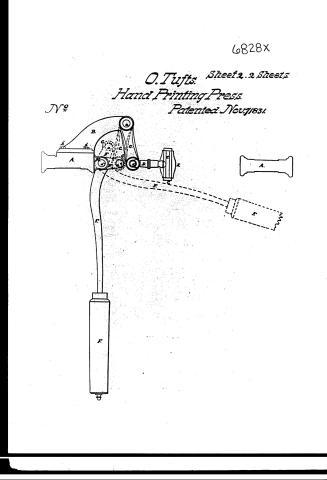
Otis Tuft's Patent Drawing for an In the Hand Printing Press


National Archives, Restored Patent Drawings (Record Group 241) · Full-size scan at the National Archives · Catalog record
Show the text on the drawing Hide (67 words)
Words on the drawing as machine-read by the National Archives; not checked. Useful mainly for searching.
Sheet 1. 111 / LOI. PRIN / Bed & Platen Machiness / 35 / Leven / OT'S TUFIS / In the Hand Printing Pross. / Patented Nov:7." 1831. / 6828 - X / 6828- X / EL" / a" / Li / Scale 1/4 of an inch to the Inch
Sheet 2. 101. PRINTING. / Bed & Platen Machines. / 6828-X / TON / 6828 - X / IBIO / IIII / d' / ia / a) / OlRy
USPTO scan
The patent as scanned by the USPTO
-
 Page 1
-
 Page 2
-
 Page 3
-
 Page 4


U.S. Patent and Trademark Office · Google Patents
Show the transcription Hide (770 words)
Machine transcription (LightOnOCR) of the pages as scanned by the USPTO, most of them the handwritten copies made when the records were restored after the 1836 fire. Not checked; it can misread handwriting, so compare it with the scan.
Page 1.
6828x
O. Tufts. Sheet 12 Sheets
Hand Printing Press.
Patented Nov. 7, 1831.
No.

Page 2.
6828X
O. Tufts. Sheet 2. 2 Sheets.
Hand Printing Press.
Patented Nov. 1831.
No.

Page 3.
X0006828 Nov 7, 1831 123.
Otis Swift
The schedule referred to in these Letters Patent and making part of the same containing a description in the words of the drafs Otis Swift himself of his improvement in the manner of straightening the toggle joints in the hand printing press. To all persons to whom these presents shall come. Otis Swift of Boston in the County of Suffolk and state of Massachusetts Machine and goods granting Be it known that I the said Otis Swift have invented constructed made and applied to use new and useful improvements in the manner of pressing up or straightening the toggle joints in the hand printing press which improvements are described in the following words and annexed drawings which taken together form my specification. First. I attach to the back of the arch of the press by screws or otherwise any arm B of the form represented in the drawing or otherwise made in any other convenient shape as the fancy or taste of the workman may direct. To this I connect a link C which turns on a pin or bolt a passing through the link an end of the arm B. In the other extremity of this link I place one end of a bent lever or handle F which pivots or turns to the right or left on a pin passing through it and the link as shown at a, at a point I in this lever or bar G of iron or other metal forked or split open so as to admit the lever through it is connected by a similar circular pin or bolt to stone as above described. The opposite extremity of this bar moving on a pin a" between two ears or projections on either side of the arch of the press towards the operator D is the fulcrum one end being cut out in a semicircular form and resting against the bolt or pin at the other having a ball turned on it to fit in a socket in the bar.
Page 4.
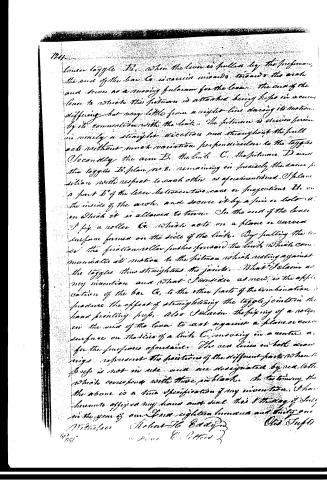
lower toggle T1, when the lever is pulled by the person, the end of the bar Ca is carried inward towards the arch and serves as a moving fulcrum for the lever. The end of the lever to which the piston is attached being kept in a curve differing but very little from a right line during its motion, by its connection with the link. The piston is driven between merely a straight direction and throughout the pull acts without much variation perpendicular to the toggles. Secondly, the arm B, the link C, the piston D and the toggles E, plan, no 2, remaining in precisely the same position with respect to each other as aforesaid. I place a part D' of the lever between two arcs or projections E1 on the inside of the arch, and secure it by a pin or bolt a' on which it is allowed to turn. In the end of the lever I fix a roller C1 which acts on a plane or curved surface formed on the side of the link. By pulling the lever the friction roller pushes forward the link which communicates its motion to the piston which resting against the toggles thus straightens the joints. What I claim as my invention and what I consider as new, is the application of the bar Ca to the other parts of the combination to produce the effect of straightening the toggle joints in the hand printing press. Also I claim the fixing of a roller in the end of the lever to act against a plane or curved surface on the side of a link C, moving in a center a, for the purposes aforesaid. The said lines in both drawings represent the positions of the different parts when the press is not in use, and are designated by red letters which correspond with those in black. In testimony that the above is a true specification of my invention, I have hereunto affixed my hand and seal this 8th day of July in the year of our Lord eighteen hundred and thirty one.
Witness
Robert H. Bady
Patentee
Date 8th Oct 31
Published accounts: journal notice
Notice in the monthly list of patents, with remarks
Journal of the Franklin Institute, new ser., vol. 9 (1832), p. 315 · View the page
10. For an improvement in the Manner of straightening the Toggle Joint in the Hand Printing Press; Otis Tufts, Boston, Massachusetts, November 7.
Remarks. The combination of levers and joints shown in the drawing which accompany this specification, constitutes the claim to a patent; a good idea of this cannot be given in words alone, and we therefore omit the form of the claim. We have had occasion, more than once, to describe variations in this particular apparatus; the relative merits of the different plans cannot be otherwise settled than by direct experience.
About this record
- Patentee
- the Journal of the Franklin Institute, Journal
- Date
- the Name and Date index of patents, USPTO records, Jim Shaw's X-patent list
- Invention
- the Name and Date index of patents
- Listed in
- the Name and Date index of patents, USPTO records, Jim Shaw's X-patent list, the Journal of the Franklin Institute, Burke's List of Patents (1847)
- The patentee's full name comes from the Franklin Institute's journal.
- Burke's 1847 Patent Office list gives the same patent.