

Drawings and documents
National Archives restored drawings: drawing
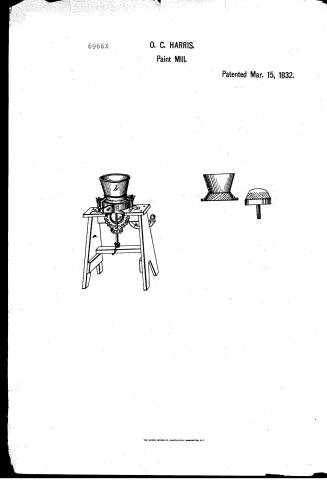
Oliver C. Harris' Patent Drawing for a Paint Mill

National Archives, Restored Patent Drawings (Record Group 241) · Full-size scan at the National Archives · Catalog record
Show the text on the drawing Hide (77 words)
Words on the drawing as machine-read by the National Archives; not checked. Useful mainly for searching.
83. MILLS. / Grinding Mills. / Paint. / Fise / CLASSIFICATION / 6966-X / DIVISION. / OLIVER C. HARRIS / PAINT MILL. / Patented March the 15. 1832 / Sectionofthe / curb / References. / Runner. / a the frame / b curb or hopper. / C nut or runner. / ol shaft / scraper. / f the step. / the bridge. / h crank. / Patent affir 10Nov 1839 / of / Made under the direction of the / of Patients in conformity with act 3 march 1837 / Commipioner of patents
USPTO scan
The patent as scanned by the USPTO
-
 Page 1
-
 Page 2
-
 Page 3


U.S. Patent and Trademark Office · Google Patents
Show the transcription Hide (547 words)
Machine transcription (LightOnOCR) of the pages as scanned by the USPTO, most of them the handwritten copies made when the records were restored after the 1836 fire. Not checked; it can misread handwriting, so compare it with the scan.
Page 1.
6966X
O. C. HARRIS.
Paint Mill.
Patented Mar. 15, 1832.
THE HARRIS PETERS CO., PHOTO-LITHO., WASHINGTON, D. C.
Page 2.
6966X Oliver C. Harris
Letters Patent
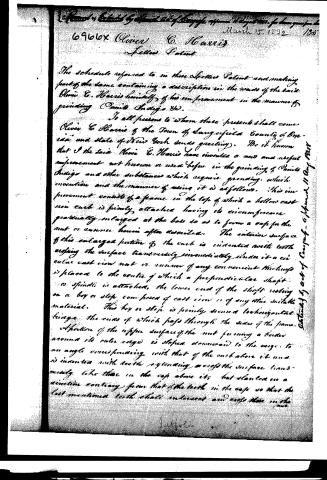
The schedule referred to in these Letters Patent and making part of the same containing a description in the words of the said Oliver C. Harris himself of his improvement in the manner of grinding Paints, Oils, &c.
To all persons to whom these presents shall come, Oliver C. Harris of the Town of Langolfen, County of Oneida and State of New York sends greeting. Be it known that I the said Oliver C. Harris have invented a new and useful improvement not known or used before in the grinding of Paints, Oils, and other substances which require grinding, which invention and the manner of using it is as follows. This improvement consists of a frame on the top of which a hollow cast iron curb is firmly attached having its circumference gradually enlarged at the base so as to form a cup for the nut or anvil herein after described. The interior surface of this enlarged portion of the curb is indented with teeth cutting the surface transversely immediately under it—a circular cast iron nut or anvil of any convenient thickness is placed to the center of which a perpendicular shaft or spindle is attached, the lower end of the shaft resting on a box or step composed of cast iron or of any other suitable material. This box or step is firmly secured to a horizontal bridge the axis of which passes through the sides of the frame. The upper surface of the nut forming a border around its outer edge is sloped downward to the verge to an angle corresponding with that of the curb above it and is indented with teeth extending across the surface transversely like those in the cup above it, but slanted in a direction contrary from that of the teeth in the cup so that the last mentioned teeth shall intersect and cross those in the
Page 3.
186 69106x Mar 15, 1832
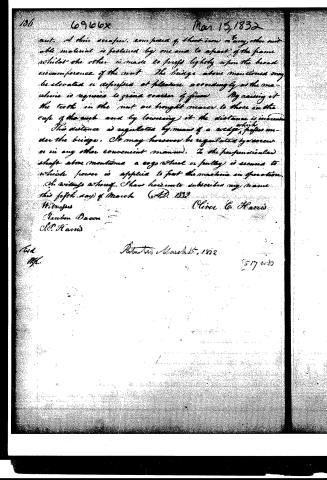
out. A thin scraper, composed of sheet iron or any other suitable material is fastened by one end to a part of the frame whilst the other is made to press lightly upon the broad circumference of the nut. The bridge above mentioned may be elevated or depressed at pleasure accordingly as the machine is required to grind coarser or finer. By raising it the teeth on the nut are brought nearer to those on the cup of the sink and by lowering it the distance is increased. This distance is regulated by means of a wedge, placed under the bridge. It may however be regulated by screws or in any other convenient manner. To the perpendicular shaft above mentioned a cog wheel or pulley is secured to which power is applied to put the machine in operation.
In witness whereof I have hereunto subscribed my name this fifth day of March A.D. 1832
Oliver C. Harris
Witnesses
Leuben Dacon
O.C. Harris
Patented March 15, 1832
517 w30
Published accounts: journal notice
Notice in the monthly list of patents, with remarks
Journal of the Franklin Institute, new ser., vol. 10 (1832), p. 161 · View the page
16. For a Mill for grinding Paints; Oliver C. Harris, Sangerfield, Oneida county, New York, March 15.
Remarks. On the upper part of a suitable frame a circular hopper, or curb, is placed; it is made of cast iron, and is to receive the paint to be ground. The lower part of this hopper is made conical to receive from below the runner, or nut, formed like that of the common coffee mill, this is also of cast iron, and has a shaft, or spindle, by which it VOL. X. No. 3.-SEPTEMBER, 1832. 21 is to be turned, extending down to a bridge tree. There is an elastic scraper bearing against the under rim of the runner to scrape off the paint. The edges of the runner and of the hollow cone are to have teeth on them; and the shaft, or spindle, is to be turned by a crank carrying a toothed wheel, taking into a pinion on the shaft. There is no claim made, which we think is just as it should be, obviating a great difficulty by saying nothing about novelty.
About this record
- Patentee
- DATAMP
- Date
- the Name and Date index of patents, DATAMP, USPTO records
- Invention
- DATAMP
- Listed in
- the Name and Date index of patents, DATAMP, USPTO records, Jim Shaw's X-patent list, the Journal of the Franklin Institute, Burke's List of Patents (1847)
- Burke's 1847 Patent Office list gives the same patent.