

Drawings and documents
USPTO scan
The patent as scanned by the USPTO
-
 Page 1
-
 Page 2
-
 Page 3
-
 Page 4


U.S. Patent and Trademark Office · Google Patents
Show the transcription Hide (925 words)
Machine transcription (LightOnOCR) of the pages as scanned by the USPTO, most of them the handwritten copies made when the records were restored after the 1836 fire. Not checked; it can misread handwriting, so compare it with the scan.
Page 2.
United States Patent
Patent No.: X6965
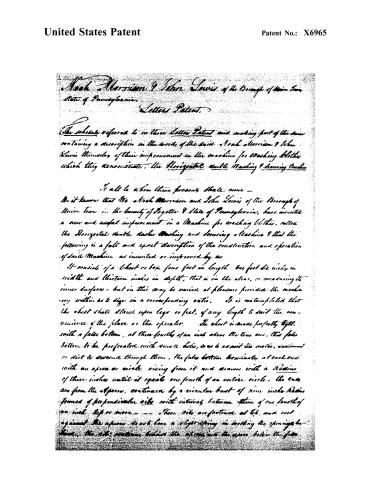
Noah Morrison & John Lewis of the Borough of Union Town State of Pennsylvania.
Letters Patent.
The schedule referred to in these Letters Patent and making part of the same containing a description in the words of the said Noah Morrison & John Lewis themselves of their improvement in the machine for washing clothes which they denominate, the Horizontal double Washing & scouring machine.
To all to whom these presents shall come —
Be it known that the said Noah Morrison and John Lewis of the Borough of Union Town in the county of Fayette & State of Pennsylvania, have invented a new and useful improvement in a Machine for washing clothes, called the Horizontal double washer Washing and scouring machine & that the following is a full and exact description of the construction and operation of said Machine as invented or improved by us.
It consists of a chest or box four feet in length one foot six inches in width and thirteen inches in depth, that is in the clear, or measuring its inner surfaces — but in this may be varied at pleasure provided the machine may within as to dig in a corresponding ratio. It is contemplated that the chest shall stand upon legs or feet, of any length to suit the convenience of the place or the operator. The chest is made perfectly tight, with a false bottom, at three fourths of an inch above the true one, this false bottom to be perforated with small holes, so as to admit the water, contained or dirt to descend through them, the false bottom terminates at each end with an apron or circle rising from it and around with a Radius of three inches until it equals one fourth of an entire circle, the ends are from the aprons, continued by a circular belt of nine inches Radius formed of perpendicular ribs with intervals between them of one fourth of an inch deep or more — These ribs are fastened at both ends against the aprons do not have a slight spring in working the apronsight behind. The ribs continue behind the aprons into the space below the false
Page 3.
United States Patent
Patent No.: X6965
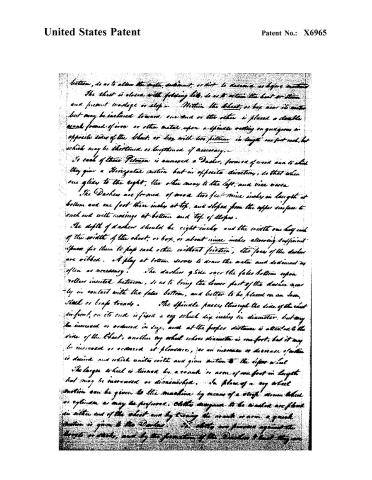
bottom, so as to allow the water, sediment, or dirt to become as before mentioned.
The chest is closed with folding lids, so as to retain the heat or steam and prevent leakage or slop. Within the chest, or box near its center, but may be inclined toward one end or the other, is placed a double rack formed of iron or other metal, upon a spindle resting on guides in opposite sides of the chest, or box with two pistons in length one foot each, but which may be shortened or lengthened if necessary.
To each of these Pistons is annexed a Dasher, formed of wood and to which they give a horizontal motion but in opposite directions, so that when one glides to the right, the other may to the left, and vice versa.
The Dashers are formed of wood two feet nine inches in length at bottom and one foot three inches at top, and slope from the upper surface to each end with grooves at bottom and top of slopes.
The depth of dashers should be eight inches and the width one half each of the width of the chest, or box, or about nine inches allowing sufficient space for them to pass each other without friction, the faces of the dashers are ribbed. A plug at bottom serves to draw the water and sediment as often as necessary. The dashers glide over the false bottom upon rollers inserted between, so as to bring the lower part of the dasher nearly in contact with the false bottom, and better to be placed on an iron, steel or brass tread. The spindle passes through the side of the chest in front, on its end is fixed a cog wheel six inches in diameter, but may be increased or reduced in size, and at the proper distance is attached to the side of the chest, another cog wheel whose diameter is one foot, but it may be increased or reduced at pleasure, for an increase or decrease of motion is desired and which unites with and gives motion to the larger wheel.
The larger wheel is turned by a crank or arm of one foot in length but may be increased or diminished. In place of a cog wheel motion can be given to the machine by means of a single steam wheel or cylinder as may be preferred. Other apparatus to be worked are placed in either end of the chest and by turning the crank or arm a quick motion is given to the Dashers. The wheels are formed against the chest or sides, and by the formation of the Dashers & chest they are
Page 4.
United States Patent
Patent No.: X6965
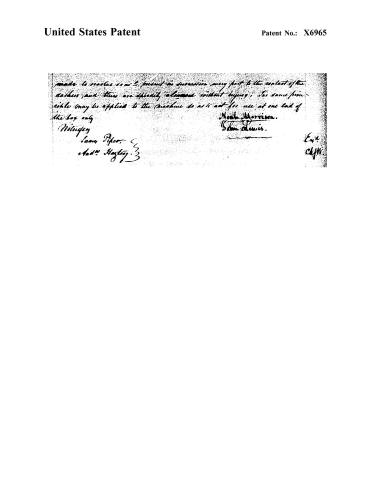
made to rotate so as to present in succession every part to the contact of the
rollers and thus are speedily cleaned without injury. The same principle
may be applied to the machine so as to act for use at one end of
the box only.
Witnesses
James Piper
Andrew Hasting
Neal Morrison
Sam Lewis
Ex. 1
Clynn
Published accounts: journal notice
Notice in the monthly list of patents, with remarks
Journal of the Franklin Institute, new ser., vol. 10 (1832), p. 161 · View the page
15. For a Washing Machine; Noah Morrison and John Lewis, Union Town, Fayette county, Pennsylvania, March 14.
Remarks. This is called the "horizontal, double dasher, washing and scouring machine. A trough has a shaft crossing it near its centre, and carrying two cranks; pitmen from these cranks cause two sliding dashers to traverse in the trough in opposite directions, and to squeeze between them and a breasting prepared for the purpose, the clothes put in at either end of the machine.
About this record
- Patentee
- DATAMP
- Date
- the Name and Date index of patents, DATAMP, Burke's List of Patents (1847)
- Invention
- DATAMP
- Listed in
- the Name and Date index of patents, DATAMP, USPTO records, Jim Shaw's X-patent list, the Journal of the Franklin Institute, Burke's List of Patents (1847)
- The sources give different dates; the date shown is the one most of them agree on.
- The Franklin Institute's journal confirms the date shown.
- Burke's 1847 Patent Office list gives the same patent.