

Drawings and documents
USPTO scan
The patent as scanned by the USPTO
-
 Page 1
-
 Page 2
-
 Page 3


U.S. Patent and Trademark Office · Google Patents
Show the transcription Hide (589 words)
Machine transcription (LightOnOCR) of the pages as scanned by the USPTO, most of them the handwritten copies made when the records were restored after the 1836 fire. Not checked; it can misread handwriting, so compare it with the scan.
Page 1.
7083X
W.B. Fahnestock,
Surgical Instrument,
Patented May 25, 1832.
No Printed Specification Available
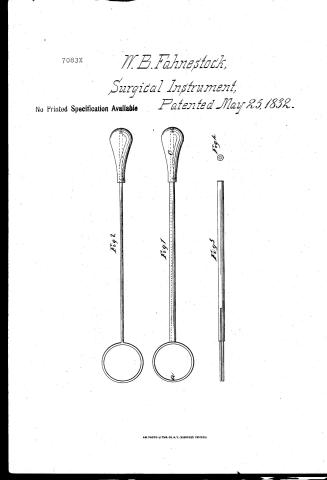
Fig. 1
Fig. 2
Fig. 3
Fig. 4
AM. PHOTO-LITHO. CO. N.Y. (OSBORNE'S PROCESS)
Page 2.
7083x
May 25, 1832
William D. Fahnestock of Lancaster ... Bm.
Letters Patent.
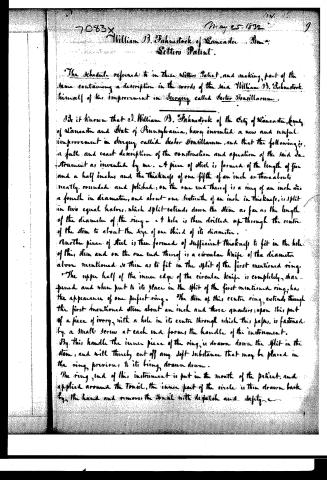
The Schedule referred to in these Letters Patent, and making part of the same containing a description in the words of the said William D. Fahnestock himself of his improvement in Surgery called Doctor Donillarium.
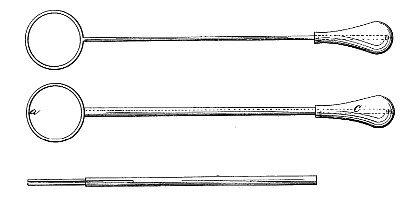
Be it known that W. William D. Fahnestock of the City of Lancaster, County of Lancaster and State of Pennsylvania, have invented a new and useful improvement in Surgery called Doctor Donillarium, and that the following is a full and exact description of the construction and operation of the said instrument as invented by me. A piece of steel is formed of the length of five and a half inches and the thickness of one fifth of an inch or thereabouts, nearly rounded and polished; on the one end thereof is a ring of an inch and a fourth in diameter, and about one sixteenth of an inch in thickness, is split in two equal halves, which split extends down the stem as far as the length of the diameter of the ring — a hole is then drilled up through the centre of the stem to about the size of one third of its diameter.
Another piece of steel is then formed of sufficient thickness to fit in the hole of this stem and on the one end thereof is a circular knife of the diameter above mentioned so thin as to fit in the split of the first mentioned ring. The upper half of the inner edge of the circular knife is completely sharpened and when put to its place in the split of the first mentioned ring, has the appearance of one perfect ring. The stem of this center ring extends through the first mentioned stem about an inch and three quarters; upon this part of a piece of ivory, with a hole in its centre through which this paper is fastened by a small screw at each end forms the handle of the instrument.
By this handle the inner piece of the ring is drawn down the split in the stem, and will thereby cut off any soft substance that may be placed in the ring previous to its being drawn down.
The ring end of this instrument is put in the mouth of the patient, and applied around the Tonsil, the inner part of the circle is then drawn back by the hand and removes the Tonsil with dispatch and safety.
Page 3.
May 25, 1832
The inventor has formed this instrument in a more simple manner but does not consider it quite as good as the one afore mentioned viz: The stem and ring may be split all the way down and kept together by rings, so that the one part will slide past the other, causing the two sections of the ring to pass each other, thereby performing the operation required.
In testimony that the above is a true specification of my said improvement as above described, I have hereunto set my hand this 28th day of April A.D. 1832.
Witnesses:
Sam G. Dale
Wm. L. G. Dale
William B. Fahnestock
(Patented 25 May 1832)
Drawings made from Specification.
Published accounts: journal notice
Notice in the monthly list of patents, with remarks
Journal of the Franklin Institute, new ser., vol. 10 (1832), p. 394 · View the page
48. For a Sector Tonsillarum, being an improvement in surgery; William B. Fahnestock, Lancaster, Lancaster county, Pennsylvania, May 25.
Remarks. The form of this instrument is that of a stem, or shank, of a fifth of an inch in diameter, with a ring on one end of about an inch and a quarter in diameter. The stem is perforated from end to end, to allow a rod, or wire, to pass through it, which rod, or wire, is furnished with an ivory handle at the end opposite to the ring. The ring is split through its plane, and the split, or kerf, extends up the shank a distance equal to the diameter of the ring. A piece of steel plate is made in the form of this ring, with a rod, or wire, projecting from it of sufficient length to pass through to the upper end of the shank, and receive the ivory handle. When these are all in their places, the three thicknesses of which the ring consists, coincide. The inner edge of the lower half of the steel ring is made sharp, and when it is desired to remove a tonsil, or other soft part, the ring is passed over it, and the ivory handle being drawn forward, it is separated by the cutting edge. The patentee states that the ring may be made to consist of two parts only, one sliding upon the other, but that he prefers the former method. 49. For Machinery for washing and cleaning Paper Makers'
DATAMP: illustration
Illustrations from DATAMP
DATAMP (Directory of American Tool and Machinery Patents), via the Internet Archive · Archived DATAMP page
About this record
- Patentee
- DATAMP
- Date
- the Name and Date index of patents, DATAMP, USPTO records
- Invention
- DATAMP
- Listed in
- the Name and Date index of patents, DATAMP, USPTO records, Jim Shaw's X-patent list, the Journal of the Franklin Institute, Burke's List of Patents (1847)
- Burke's 1847 Patent Office list gives the same patent.