

Drawings and documents
USPTO scan
The patent as scanned by the USPTO
-
 Page 1
-
 Page 2
-
 Page 3
-
 Page 4
-
 Page 5
-
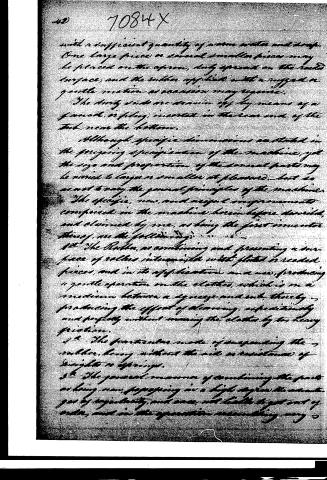 Page 6
-
 Page 7


U.S. Patent and Trademark Office · Google Patents
Show the transcription Hide (1,503 words)
Machine transcription (LightOnOCR) of the pages as scanned by the USPTO, most of them the handwritten copies made when the records were restored after the 1836 fire. Not checked; it can misread handwriting, so compare it with the scan.
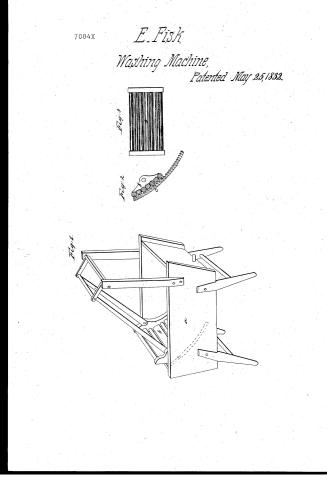
Page 1.
7084X
E. Fisk
Washing Machine,
Patented May 25, 1832.
Fig. 1
Fig. 2
Fig. 3
Page 2.
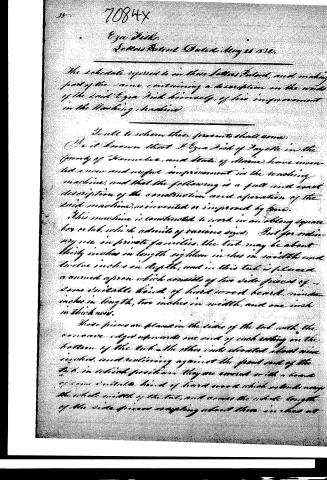
Ezra Stiles.
Letters Patent Dated May 25 1832.
The schedule referred to in these Letters Patent, and making part of the same, containing a description in the words of the said Ezra Stiles himself, of his improvement in the Washing Machine.
To all to whom these presents shall come:
Be it known that I Ezra Stiles of Fayette in the County of Hennelee, and State of Maine, have invented a new and useful improvement in the washing machine, and that the following is a full and exact description of the construction and operation of the said machine, as invented or improved by me.
This machine is constructed to work in an oblong square box or tub, which admits of various sizes. But for ordinary use in private families, the tub may be about thirty inches in length, eighteen inches in width and twelve inches in depth, and in this tub is placed a round apron which consists of two side pieces of some suitable kind of hard wood board, nineteen inches in length, two inches in width, and one inch in thickness.
These pieces are placed in the sides of the tub with the concave edge upwards, one end of each sitting on the bottom of the tub, the other ends elevated about nine inches, and resting against the front end of the tub, in which position they are covered with a board of some suitable kind of hard wood which extends across the whole width of the tub, and across the whole length of the side pieces excepting about three inches at
Page 3.
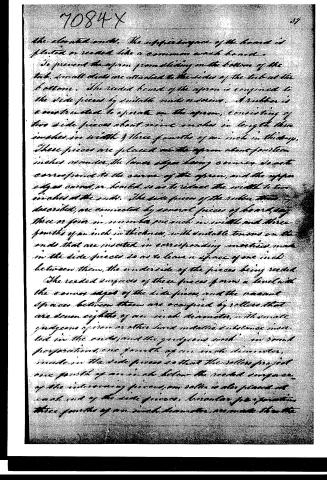
the elevated mouth. The upper surface of the board is planed or reeded like a common wash board.
To prevent the apron from sliding on the bottom of the tub, small cleats are attached to the sides of the tub at the bottom. The reeded board of the apron is confined to the side pieces by suitable nails or screws. A rubber is constructed to operate on the apron, consisting of two side pieces about nine inches in length, three inches in width, and three-fourths of an inch in thickness. These pieces are placed on the apron about fourteen inches from the lower edge, having a corner or notch correspond to the curve of the apron, and the upper edges curved or beveled, so as to reduce the width to two inches at the ends. The side pieces of the rubber, as described, are connected by several pieces of board, say three or four in number, one inch in width and three-fourths of an inch in thickness, with suitable tenons on the ends that are inserted in corresponding notches made in the side pieces so as to leave a space of one inch between them, the underside of the pieces being reeded.
The reeded surfaces of these pieces form a line with the corner edges of the side pieces, and the vacant spaces between them are occupied by rollers that are seven-eighths of an inch diameter, with small gudgeons of iron or other hard metallic substance inserted in the ends, and the gudgeons with an round perforations, one-fourth of an inch diameter, made in the side pieces so that the rollers project one-fourth of an inch below the reeded surface of the intervening pieces, one roller is also placed at each end of the side pieces. Similar perforations three-fourths of an inch diameter are made through
Page 4.
side pieces of the rubber, at the center (on opposite the length) about one inch below the upper edges.
The rubber thus constructed, is suspended by a kind of frame work that is supported by two posts which may be two inches in width and one inch in thickness. These posts are attached to the outsides of the tub, about seven inches from the rear end, extending in a vertical position, twenty-two inches above the tub; and the posts are confined in their position by sinking the lower ends in concrete, or into the sides of the tub, or they may be confined by any other suitable kind of fastening.
The upper ends of the posts are connected by a cross piece of wood which may be either square or round about one inch and a half through, with grooves made on the ends, fitted to work in round perforations, three fourths of an inch diameter, made thru the posts, one inch below the upper ends. Two perforations which may be either round or square, are made thru the above described cross piece, about two inches from the posts and in these perforations are inserted the ends of two pieces of wood that extend in the rear about seven inches, the outer ends being about one and a half deep and three fourths of an inch thick, and thru these, about an inch from the rear ends, are made horizontally, round perforations, three fourths of an inch diameter and these ends are connected by a cross piece that may be either square or round, about one inch and one fourth through, with grooves on the ends fitted to work in the last
Page 5.
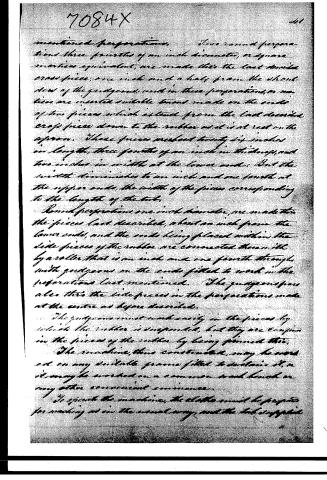
mentioned perforations. Three round perforations three-fourths of an inch diameter, or square markings equivalent, are made in the last described cross piece, one inch and a half from the shoulder of the gudgeons, and in these perforations, or markers are inserted suitable tongs made on the ends of two pieces which extend from the last described cross piece down to the rubber as it is at rest in the apron. These pieces measure twenty-six inches in length, three-fourths of an inch in thickness, and two inches in width at the lower end; but the width diminishes to one inch and one-fourth at the upper end, the width of the pieces corresponding to the length of the tub.
Round perforations one inch diameter, are made in the pieces last described, about an inch from the lower end, and the ends being placed within the side pieces of the rubber are connected therewith by a roller that is an inch and one-fourth through with gudgeons on the ends fitted to work in the perforations last mentioned. The gudgeons pass also through the side pieces in the perforations made at the centre as before described.
The gudgeons must work easily in the pieces by which the rubber is suspended, but they are confined in the pieces of the rubber by being pinned there.
The machine, thus constructed, may be mounted on any suitable frame fitted to sustain it, or it may be worked on a common road wheel or any other convenient convenience.
To operate the machine, the clothes must be prepared for washing as in the usual way, and the tub supplied
Page 6.
with a sufficient quantity of warm water and soap. One large piece or several smaller pieces may be placed on the apron, duly spread on the said surface, and the rubber applied with a rugged or gentle motion as occasion may require. The dirty water are drawn off by means of a faucet, or plug, inserted in the scar end of the tub, near the bottom.
Although specific dimensions are stated in the foregoing specification of the machine, yet the size and proportion of the several parts may be varied to larger or smaller as pleased, but so as not to vary the general principles of the machine. The specific, new, and useful improvements comprised in the machine hereinbefore described, and claimed by me, as being the first inventor thereof, are the following:
1st. The Rubber, as combining and presenting a surface of rollers interrupted with flats or raised pieces, and in its application and use, producing a gentle operation on the clothes, which is in a medium between a dry scye and one, thereby producing the effect of steaming, expeditiously and perfectly without moving the clothes by too heavy friction.
2d. The particular mode of suspending the rubber, being without the aid or resistance of weights or springs.
3d. The general manner of combining the parts as being new, progressing in a high degree the art, and yet of regularity, and ease, not liable to get out of order, and in the operation resembling any
Page 7.
nearly the common mode of working, consequently requiring but little practice to become acquainted with the mode of using the machine advantageously.
In testimony that the above is a true specification of my said improvement as above stated, I have hereunto set my hand and seal the twenty-first day of February in the year of our Lord, eighteen hundred and thirty-two.
Ezra Sisk.
Witnesses
Sam'l Blake
Francis A. Fiske
(Received and Recorded a new style 2d Sept 4)
Deposited by Al. 1841. Eas 1842
1770 words
Published accounts: journal notice
Notice in the monthly list of patents, with remarks
Journal of the Franklin Institute, new ser., vol. 10 (1832), p. 394 · View the page
The felt is to be made to pass round this cylinder, and is to be borne against it by smaller rollers of wood, and so secured by boxing that but little water shall escape from the perforated roller without passing through the felt. Two other wooden rollers serve to squeeze the superfluous water out of the felt, as it passes between them. Steam may be applied when requisite for the purpose of rendering the felt pliable. The water, or the steam, is to be introduced through hollow gudgeons at each end of the perforated roller. 50. For a Washing Machine; Ezra Fisk, Fayette, Kennebeck county, Maine, May 25.
Remarks. A vibrating rubber, composed of fluted pieces and of rollers, is to operate upon the clothes so nearly in the manner of many other washing machines, that we think a particular description of this, is unnecessary. The patentee considers it as a very superior article, and should the public concur with him in opinion, their praise will be of more value to him than any we are prepared to bestow.
About this record
- Patentee
- DATAMP
- Date
- the Name and Date index of patents, DATAMP, USPTO records
- Invention
- DATAMP
- Listed in
- the Name and Date index of patents, DATAMP, USPTO records, Jim Shaw's X-patent list, the Journal of the Franklin Institute, Burke's List of Patents (1847)
- Burke's 1847 Patent Office list gives the same patent.