

Drawings and documents
USPTO scan
The patent as scanned by the USPTO
-
 Page 1
-
 Page 2
-
 Page 3
-
 Page 4


U.S. Patent and Trademark Office · Google Patents
Show the transcription Hide (849 words)
Machine transcription (LightOnOCR) of the pages as scanned by the USPTO, most of them the handwritten copies made when the records were restored after the 1836 fire. Not checked; it can misread handwriting, so compare it with the scan.
Page 2.
United States Patent
Patent No.: X7154
Robert Wilson of Williamsport, State of Pennsylvania
Letters Patent
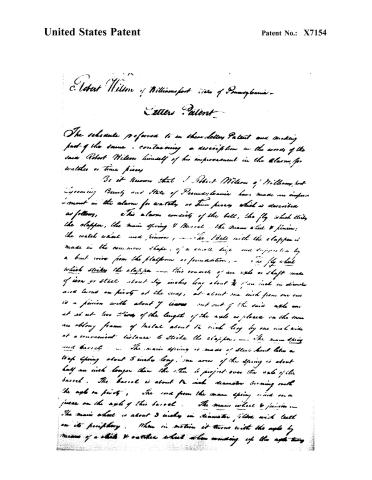
The schedule referred to in these Letters Patent and making part of the same, containing a description in the words of the said Robert Wilson himself of his improvement in the alarm for watches or time pieces.
Be it known that I Robert Wilson of Williamsport, Lycoming County and State of Pennsylvania have made an improvement in the alarm for watches or time pieces which is described as follows:
This alarm consists of the bell, the fly which strikes the clapper, the main spring & barrel, the main wheel & pinion; the watch wheel and pinion, — the Bell with the clapper is made in the common shape, of a small size and suspended by a bent wire from the platform or foundation. — The fly wheel which strikes the clapper — this consists of an axle or shaft made of iron or steel about 5½ inches long about ¾ of an inch in diameter and turns on pivots at the ends, at about one inch from one end is a pinion with about 7 leaves cut out of the said axle and at about two thirds of the length of the axle is placed on the same an oblong frame of metal about 1½ inch long by one inch wide at a convenient distance to strike the clapper. — The main spring and barrel — The main spring is made of steel bent like a trap spring about 5 inches long, one arm of the spring is about half an inch longer than the other to project over the axle of the barrel. The barrel is about 1½ inch diameter turning with the axle on pivots, the cord from the main spring winds on a groove on the axle of this barrel. The main wheel & pinion — The main wheel is about 3 inches in diameter fitted with teeth on its periphery. When in motion it turns with the axle by means of a shaft & watch wheel when winding up the axle turns
Page 3.
United States Patent
Patent No.: X7154
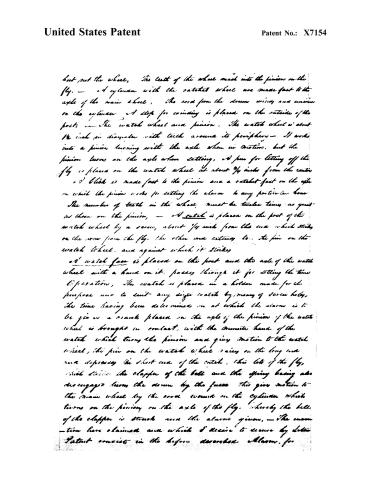
but put the wheel, The teeth of the wheel mesh into the pinion on the fly. — A cylinder with the ratchet wheel are made fast to the axle of the main wheel. The cord from the drum winding and unwin on the cylinder A stop for winding is placed on the outside of the post. — The watch wheel and pinion. The watch wheel is about 1½ inch in diameter with teeth around its periphery — It works into a pinion turning with the axle when in motion, but the pinion turns on the axle when setting, A pin for letting off the fly is placed on the watch wheel at about ¾ inch from the center. A click is made fast to the pinion and a ratchet fast on the axle on which the pinion works for setting the alarm to any particular hour. The number of teeth in the wheel must be twelve times as great as those on the pinion. — A catch is placed on the post of the watch wheel by a screw, about ⅞ inch from the end which strikes on the arm from the fly. The other end extending to the pin on the watch wheel, and against which it strikes.
A watch face is placed on the post and the axle of the watch wheel with a hand on it, passes through it for setting the time of operation. The watch is placed in a holder made for the purpose and to suit any size watch by means of screw holes, the time having been determined on at which the alarm is to be given a crank placed on the axle of the pinion of the watch wheel is brought in contact, with the minute hand of the watch which turns the pinion and gives motion to the watch wheel, the pin on the watch wheel raises on the long arm and depresses the short arm of the catch, this lets off the fly, which strikes the clapper of the bell and the spring being also disengaged turns the drum by the force this gives motion to the main wheel by the cord wound on the cylinder which turns on the pinion on the axle of the fly, whereby the bell of the clapper is struck and the alarm given. — The invention here claimed and which I desire to secure by letter Patent consists in the before described Alarm, for
Page 4.
United States Patent
Patent No.: X7154
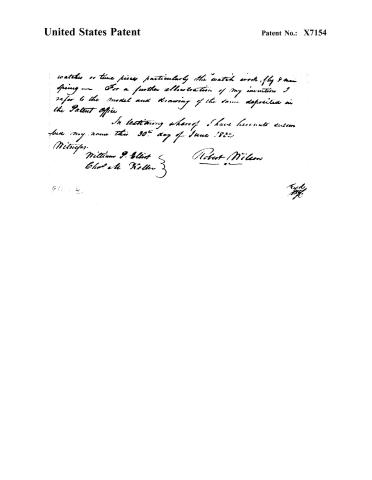
watch or time piece particularly the watch work, fly & main spring — For a further illustration of my invention I refer to the model and drawing of the same deposited in the Patent Office.
In testimony whereof I have hereunto set my name this 30th day of June 1832
Witnesses:
William P. Elliot
Charles Keller
Robert Wilson
Published accounts: journal notice
Notice in the monthly list of patents, with remarks
Journal of the Franklin Institute, new ser., vol. 11 (1833), p. 93 · View the page
3. For an Alarm for Watches or Time Pieces; Robert Wilson, Williamsport. Lycoming county, Pennsylvania, July 3.
Remarks. About six or seven years ago, numerous alarms were made and described in the journals of the day, or secured by letters patent, which alarms were to be operated upon by a common pocket watch. The arbor of the minute hand was made to pass into the end of an arbor attached to the alarm, and formed like a watch key. Provision being made for setting the alarm to ring at the appointed time, and the watch being left in its place, when the hour arrived a pin was made to disengage a spring, which was thus set at liberty, and, in its unwinding, caused a bell to ring. The present machine is one of this description, but as it does not recommend itself by greater simplicity than was possessed by several of its defunct predecessors, and only accomplishes the same end by a change in the arrangement of the wheel work, it does not require a particular description. The claim made is to "the before described alarm for watches, or time pieces, particularly the watch work, fly, and mainspring."
About this record
- Patentee
- DATAMP
- Date
- the Name and Date index of patents, DATAMP, USPTO records
- Invention
- DATAMP
- Listed in
- the Name and Date index of patents, DATAMP, USPTO records, Jim Shaw's X-patent list, the Journal of the Franklin Institute, Burke's List of Patents (1847)
- The X number was worked out from the patent’s place in the date sequence.
- Burke's 1847 Patent Office list gives the same patent.