

Drawings and documents
USPTO scan
The patent as scanned by the USPTO
-
 Page 1
-
 Page 2
-
 Page 3
-
 Page 4


U.S. Patent and Trademark Office · Google Patents
Show the transcription Hide (535 words)
Machine transcription (LightOnOCR) of the pages as scanned by the USPTO, most of them the handwritten copies made when the records were restored after the 1836 fire. Not checked; it can misread handwriting, so compare it with the scan.
Page 2.
United States Patent
Patent No.: X7155
Daniel Davis, of Cornish, N.H.
Letters Patent
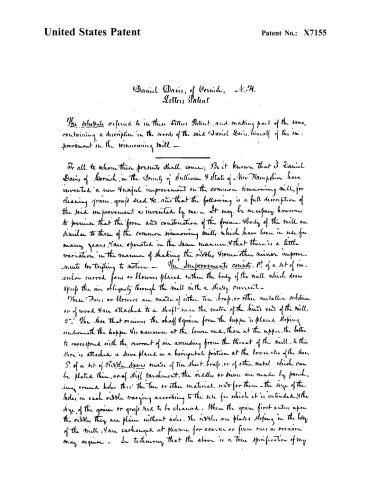
The schedule referred to in these Letters Patent, and making part of the same, containing a description in the words of the said Daniel Davis, himself of his improvement in the winnowing mill.
To all to whom these presents shall come; Be it known that I Daniel Davis of Cornish, in the County of Sullivan & State of New Hampshire have invented a new & useful improvement on the common winnowing mill, for cleaning grain, grass seed &c. and that the following is a full description of the said improvement as invented by me — It may be necessary however to premise that the form and construction of the frame & body of the mill are similar to those of the common winnowing mills which have been in use for many years, & are operated in the same manner, & that there is a little variation in the manner of shaking the riddles, & some other minor improvements too trifling to notice — The Improvement consists, 1st of a set of circular curved fans or blowers, placed within the body of the mill which draw & prop the air obliquely through the mill with a steady current — These Fans or blowers are made of either tin, brass, or other metallic substance, or of wood & are attached to a shaft near the centre of the hind end of the mill. 2nd The shoe that receives the chaff & grain from the hopper is placed sloping underneath the hopper & is narrower at the lower end, than at the upper, the better to correspond with the current of air ascending from the throat of the mill. to this shoe is attached a sieve placed in a horizontal position at the lower end of the shoe. 3rd of a set of Riddle Sieves made of tin sheet, brass, or of other metal which can be plated thin, or of stiff parchment. The riddles or sieves are made by punching round holes thro’ the tin or other material used for them — the size of the holes in each riddle varying according to the use for which it is intended & the size of the grain or grass seed to be cleaned. When the grain first enters upon the riddles, they are plain without holes. The riddles are placed sloping in the body of the mill, & are exchanged at pleasure for coarser or finer ones as occasion may require — In testimony that the above is a true specification of my
Page 3.
United States Patent
Patent No.: X7155
said improvement, as above described, I have hereunto set my hand this eighteenth day of June, in the year of our Lord one thousand eight hundred & thirty-two.
Witnesses
Sulamy Bryant Jr
Harry Chase
Daniel Davis
Page 4.
United States Patent
Patent No.: X7155
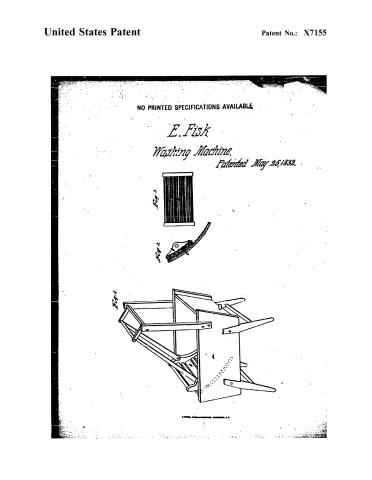
NO PRINTED SPECIFICATIONS AVAILABLE
E. Fisk
Washing Machine,
Patented May 25, 1832.

Fig. 1
Fig. 2
Fig. 3
Published accounts: journal notice
Notice in the monthly list of patents, with remarks
Journal of the Franklin Institute, new ser., vol. 11 (1833), p. 93 · View the page
4. For a Winnowing Mill; Daniel Davis, Cornish, Sullivan county, New Hampshire, July 5.
Remarks. • Reissued since on an amended specification. The principal improvement claimed on this machine is in the form given to the leaves of the fan, which stand spirally round their axis, like those of a smoke jack. These, it is said, draw and press the air obliquely through the mill with a steady current. Riddles, or sievės, are formed by punching holes of the size required, through thin sheet metal, or parchment. These, with the manner of forming the shoe, are the only novelties mentioned.
About this record
- Patentee
- DATAMP
- Date
- the Name and Date index of patents, DATAMP, USPTO records
- Invention
- DATAMP
- Listed in
- the Name and Date index of patents, DATAMP, USPTO records, Jim Shaw's X-patent list, the Journal of the Franklin Institute, Burke's List of Patents (1847)
- The X number was worked out from the patent’s place in the date sequence.
- Burke's 1847 Patent Office list gives the same patent.