

Drawings and documents
National Archives restored drawings: drawing
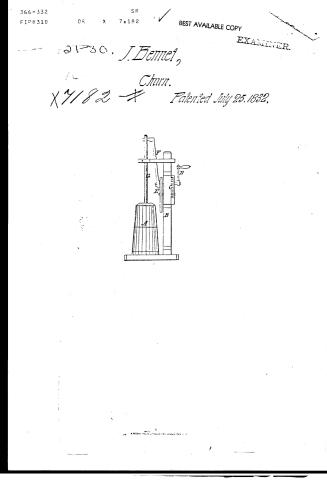
James Bennet's Patent Drawing for a Churn

National Archives, Restored Patent Drawings (Record Group 241) · Full-size scan at the National Archives · Catalog record
Show the text on the drawing Hide (58 words)
Words on the drawing as machine-read by the National Archives; not checked. Useful mainly for searching.
Entered. / Patented / +1 / 31 / Recipire Churn / 31 DAIRY / [** / Reciprocating-Churns. / Sames Pornet apr. products / CLASSIFICATION / Churn. / 7182-+ / Patented 25th July 1832. / DIV ISION / References. / A bhurn / B Jost. / c Pinion wheels / D brank. / E Balance wheel. / F Pitman / G Staff of the dasher. / H Dasher. / lp / Granmagh
USPTO scan
The patent as scanned by the USPTO
-
 Page 1
-
 Page 2
-
 Page 3


U.S. Patent and Trademark Office · Google Patents
Show the transcription Hide (413 words)
Machine transcription (LightOnOCR) of the pages as scanned by the USPTO, most of them the handwritten copies made when the records were restored after the 1836 fire. Not checked; it can misread handwriting, so compare it with the scan.
Page 1.
366-332
FIP8310
SR
OR X 7,182
BEST AVAILABLE COPY
EXAMINER.
21730. J. Bennet,
Churn.
X 7/82 Patented July 25, 1832.

Page 2.
7182x
July 25, 1832
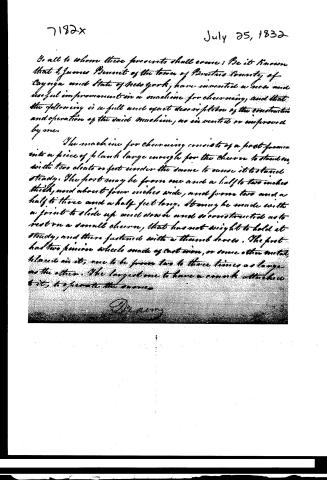
To all to whom these presents shall come: Be it known that I, James Bennett of the town of Pimhico, County of Cayuga and State of New York, have invented a new and useful improvement in a machine for churning, and that the following is a full and exact description of the construction and operation of the said machine, as invented or improved by me.
The machine for churning consists of a post, fixed into a piece of plank large enough for the churn to stand on, with two slats or feet under the same to cause it to stand steady. The post may be from one and a half to two inches thick, and about four inches wide, and from two and a half to three and a half feet long. It may be made with a joint to slide up and down and so constructed as to rest on a small churn, that has not weight to hold it steady, and there fastened with a thumb screw. The post had two pinion wheels made of cast iron, or some other metal, placed in it, one to be from two to three times as large as the other. The largest one to have a crank attached to it, to operate the same.
J. Bennett
Page 3.
July 25, 1832
The smallest one to have a balance wheel from two to eighteen inches in diameter, a piston from about nine to fourteen inches long, the upper end to be attached to one of the arms of the balance wheel, and the lower end to the staff of the dasher. The staff to contain from one to six dashers according to the quantity of cream. The dashers are to be placed on the staff in a moving position, so as to form two revolutions in the cream, a slow one round and a quick one up and down. The first has a mast arm formed into the post near the top through which the staff of the dasher passes in order to steady it.
Witnesses
Hoodore Phipple
H. B. Felley
James B. Beman
(357-40)
Exh. 1196. (Patented July 25, 1832.)
Published accounts: journal notice
Notice in the monthly list of patents, with remarks
Journal of the Franklin Institute, new ser., vol. 11 (1833), p. 104 · View the page
33. For a Machine for Churning; James Bennet, Brutus, Cayuga county, New York, July 25.
Remarks. This is the common dasher churn, the staff of which is to be worked up and down by machinery. An upright post is framed into a plank upon which the churn stands. Two iron cog wheels, one, two, or three times as large as the other, are to mash into each other, the larger being turned by a winch, or handle. A fly wheel, from ten to eighteen inches in diameter, is fixed upon the shaft of the smaller wheel, and a pin attached to one of the arms of this fly wheel forms a crank that carries a pitman, the other end of which works the dasher staff. All these parts are fully described, and properly delineated, but, as in the case of the "cooking machine" last noticed, we are not directed to the points of novelty, and, without a finger post, we cannot find our way to them.
About this record
- Patentee
- DATAMP
- Date
- the Name and Date index of patents, DATAMP, USPTO records
- Invention
- DATAMP
- Listed in
- the Name and Date index of patents, DATAMP, USPTO records, Jim Shaw's X-patent list, the Journal of the Franklin Institute, Burke's List of Patents (1847)
- The X number was worked out from the patent’s place in the date sequence.
- The Franklin Institute's journal spells the name differently.
- Burke's 1847 Patent Office list gives the same patent.