

Drawings and documents
National Archives restored drawings: drawing
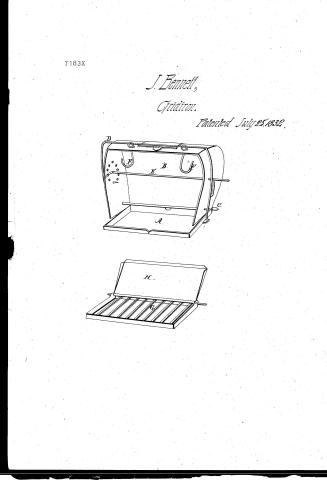
James Bennet's Patent Drawing for a Cooking Stove

National Archives, Restored Patent Drawings (Record Group 241) · Full-size scan at the National Archives · Catalog record
Show the text on the drawing Hide (56 words)
Words on the drawing as machine-read by the National Archives; not checked. Useful mainly for searching.
bal / $1.0 / 126. groves & FERNACES / [yee] Gridirons. / veris / $1 ANDON / 183 / Iames Bennet's / Cocking Here off / Patented: 25 July. 1832. / References. / A. Bottom / E. Spit / B. Oven. / F' Hooks / C. Wire on do. a. Gridiron. / O5 / D. Bale. / H. Tin Reflector. / cxlo / Ind: Greenowth
USPTO scan
The patent as scanned by the USPTO
-
 Page 1
-
 Page 2
-
 Page 3
-
 Page 4


U.S. Patent and Trademark Office · Google Patents
Show the transcription Hide (575 words)
Machine transcription (LightOnOCR) of the pages as scanned by the USPTO, most of them the handwritten copies made when the records were restored after the 1836 fire. Not checked; it can misread handwriting, so compare it with the scan.
Page 1.
7183X
J. Bennett,
Grindiron.
Patented July 25, 1832.

Page 2.
7183x
Jul 25, 1832
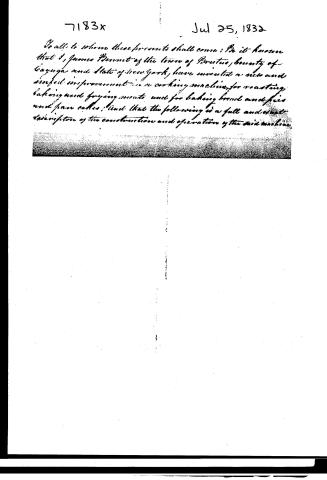
To all to whom these presents shall come: Be it known that I, James Bennett of the town of Rensselaer, county of Cayuga and State of New York, have invented a new and useful improvement in a cooking machine, for roasting, baking and frying meats and for baking bread and pies and pan cakes; and that the following is a full and exact description of the construction and operation of the said machine.
Page 3.
July 25, 1832
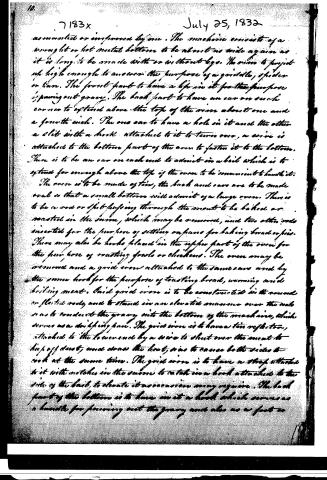
as mounted or improved by me. The machine consists of a wrought or hot metal bottom to be about as wide again as it is long to be made with or without legs. The oven to project up high enough to answer the purpose of a gridelle, spider or pan. The front part to have a lip in it for the purpose of pouring out gravy. The back part to have an ear on each corner to extend above the top of the oven about one and a fourth inch. The one ear to have a hole in it and the other a slit with a hook attached to it to turn over, a wire is attached to the bottom part of the oven to fasten it to the bottom. There is to be an ear on each end to admit in a bail which is to extend far enough above the top of the oven to be convenient to handle it.
The oven is to be made of tin, the back and ears are to be made oval so that a small bottom will admit of a large oven. There is to be a rod or spit passing through the mouth to be baked or roasted in the oven, which may be removed, and two other rods inserted for the purpose of setting on pans for baking bread or pies. There may also be hooks placed in the upper part of the oven for the purpose of roasting fowls or chickens. The oven may be removed and a grid iron attached to the same ears and by the same hook for the purpose of toasting bread, warming and boiling meat. Said grid iron is to be constructed in the round or flatly roly and to stand in an elevated manner over the oven so as to conduct the gravy into the bottom of the machine, which serves as a dripping pan. The grid iron is to have a tin reflector, attached to the lower end by a wire to shut over the meat to keep off dust, and draw the heat, so as to cause both sides to cook at the same time. The grid iron is to have a strap attached to it with notches in the same to catch in a hook attached to the side of the bail, to elevate it as occasion may require. The back part of the bottom is to have in it a hook which serves as a handle for pouring out the gravy and also as a foot or
Page 4.
7183x
July 25, 1832
House where the girl was employed.
Witnesses:
A. R. Riley
Theodore Phipps
James Bennett
500 acres
(500 acres)
(Patent July 25, 1832)
About this record
- Patentee
- DATAMP
- Date
- the Name and Date index of patents, DATAMP, USPTO records
- Invention
- DATAMP
- Listed in
- the Name and Date index of patents, DATAMP, USPTO records, Jim Shaw's X-patent list, Burke's List of Patents (1847)
- The X number was worked out from the patent’s place in the date sequence.
- Burke's 1847 Patent Office list gives the same patent.