

Drawings and documents
National Archives restored drawings: drawing
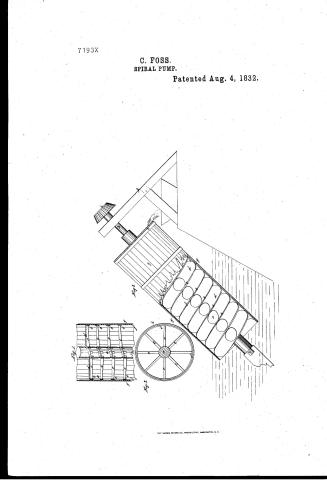
Cotton Foss' Patent Drawing for a Spiral Pump

National Archives, Restored Patent Drawings (Record Group 241) · Full-size scan at the National Archives · Catalog record
Show the text on the drawing Hide (99 words)
Words on the drawing as machine-read by the National Archives; not checked. Useful mainly for searching.
103. PUMPS. / [118] Centrifogal. / $250 / Sy.1. Section / Cotton Foss / CLASSIFICATION / Vol. in ps. 605 / 7193- X / DIVISION. / Spiral Pump. / Patented aug 4. 1832. / 4.2.2. / g-- / Top view / the floor. / Preferences. / fp / a shaft. b.b. pivats. C. ckspoks. / fide view. ofy.3. / d d floor board. e hoop. f.first / layer of Cover.g outside Coon. / hheiron hoop i. bevel whul. / K the beam. / Patentaffie Dear 7.1541. / mark under the direction of the / of Patents in can formity with act of s march 1837. / HL Ellmorth / ch. L. Minhiman feeit / Comminiow of Patents.
USPTO scan
The patent as scanned by the USPTO
-
 Page 1
-
 Page 2
-
 Page 3
-
 Page 4


U.S. Patent and Trademark Office · Google Patents
Show the transcription Hide (890 words)
Machine transcription (LightOnOCR) of the pages as scanned by the USPTO, most of them the handwritten copies made when the records were restored after the 1836 fire. Not checked; it can misread handwriting, so compare it with the scan.
Page 1.
7193X
C. FOSS.
SPIRAL PUMP.
Patented Aug. 4, 1832.

THE NORRIS PETERS CO., PHOTO-LITHO., WASHINGTON, D.C.
Page 2.
X 7193 Aug. 4, 1892 605
Cotton Tops of Perry, County of Geauga, Ohio,
Letters Patent
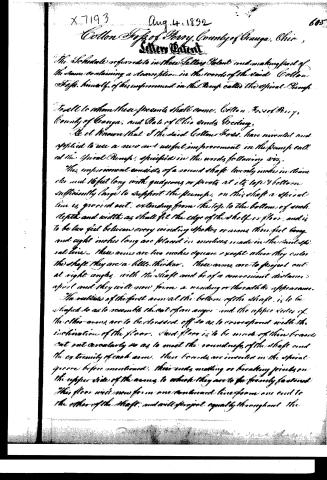
The Schedule referred to in these Letters Patent and making part of the same containing a description in the words of the said Cotton Tops, himself, of his improvement in the Pump called the Spiral Pump.
To all to whom these presents shall come, Cotton Tops of Perry, County of Geauga, and State of Ohio sends Greeting.
Be it known that I the said Cotton Tops, have invented and applied to use a new and useful improvement in the pump called the Spiral Pump; specified in the words following viz.
This improvement consists of a round shaft, twenty inches in diameter and 16 feet long with quadrants or pivots at its top & bottom sufficiently large to support the pump, on this shaft a spiral line is grooved out, extending from the top to the bottom of such depth and width as shall fit the edge of the shelf or floor, and is to be two feet between every winding spokes or arms, three feet long and eight inches long are placed in notches made in the said spiral line. These arms are two inches square except where they enter the shaft they are a little thicker. These arms are to project out at right angles with the shaft and be of a convenient distance apart and they will now form a winding or thread like appearance.
The outside of the first arm at the bottom of the shaft, is to be shaped so as to resemble the seat of an auger and the upper sides of the other arms are to be lowered off so as to correspond with the inclination of the floor. Said floor is to be made of thin boards cut out circularly so as to meet the roundness of the shaft and the extremity of each arm. These boards are inserted in the spiral groove before mentioned. Their ends making or breaking joints on the upper side of the arms to which they are to be firmly fastened. This floor will now form one continued line from one end to the other of the shaft, and will project equally throughout the
Page 3.
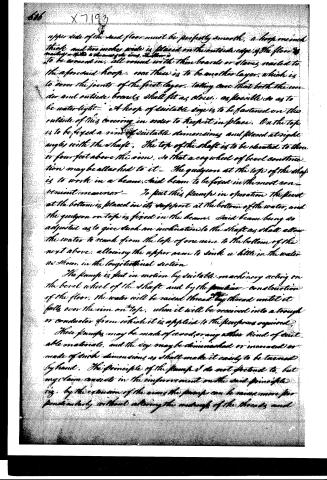
upper side of the said floor must be perfectly smooth, a hoop one inch thick and two inches wide is placed on the outside edge of the floor making a rim to the water. To be covered in, all round with thin boards or slats, nailed to the said hoop. over this is to be another layer, which is to cover the joints of the first layer, taking care that both the under and outside boards shall fit as close as possible so as to be water-tight. A hoop of suitable size is to be fastened on the outside of this covering in order to keep it in place. On the top is to be fixed a rim of suitable dimensions and placed at right angles with the shaft. The top of the shaft is to be elevated to three or four feet above the rim, so that a cog wheel of bevel construction may be attached to it. The guigeon at the top of the shaft is to work in a beam, said beam to be fixed in the most convenient manner. To put this pump in operation the pivot at the bottom is placed in its support at the bottom of the water, and the guigeon on top is fixed in the beam. Said beam being so adjusted as to give such an inclination to the shaft as shall allow the water to reach from the top of one rim to the bottom of the next above, allowing the upper rim to sink a little in the water as shown in the longitudinal section.
The pump is put in motion by suitable machinery acting on the bevel wheel of the shaft and by the peculiar construction of the floor, the water will be raised thread by thread until it falls over the rim on top, when it will be received into a trough or conductor from which it is applied to the purposes required.
These pumps may be made of wood, or any other kind of suitable materials, and the eye may be diminished or increased or made of such dimensions as shall make it easily to be turned by hand. The principle of the pump I do not pretend to, but my claim consists in the improvement on the said principle viz. by the extension of the rims the pump can be raised more perpendicularly without altering the nature of the threads and
Page 4.
will save time the quantity of water without the necessity of doubling the power. In testimony that the above is a true specification of my said improvement as above described I have hereunto set my hand the first day of June one thousand eight hundred and thirty two.
Witnesses
Benja'n. Crofoot
Will'm Graham
Patented 1 August 1832
Published accounts: journal notice
Notice in the monthly list of patents, with remarks
Journal of the Franklin Institute, new ser., vol. 11 (1833), p. 158 · View the page
3. For a Spiral Pump; Cotton Foss, Perry, Geauga county, Ohio, August 4.
Remarks. This "spiral pump" is the well known screw of Archimedes; the patentee, it is true, does not pretend to claim the principle of this pump, but merely an improvement thereon; "by the extension of the arms the pump can be raised more perpendicularly without altering the wideness of the threads, and will raise twice the quantity of water, without the necessity of doubling the power." The arms are pieces framed into the centre shaft in the manner of spokes, and are to serve as supports to the boards forming the spiral thread. The dimensions given, are, a shaft twenty inches in diameter, and sixteen feet long. The spiral groove formed round this, is to have a space of two feet between each turn. The arms or spokes supporting the spiral, are to be three feet eight inches long. The inclination to be given to the screw is to be such that the horizontal surface of the water will extend from the top of one spiral, next the shaft, to the bottom of that next above it, on the rim. The screw is to be made to revolve by a bevel geared wheel at the upper end of the shaft. Something will be gained in point of friction by enlarging the dimensions, but not much; to raise double the quantity of water, must therefore require, very nearly, double power to be applied. We do not perceive the novelty upon which the claim is founded, as, according to our understanding of the thing, it simply amounts to saying that "I make the screw of Archimedes larger in diameter than usual, and place it more vertical than it is ordinarily placed." Now we are not acquainted with any rule limiting the diameter, or the inclination of this instrument, the relationship which one must necessarily bear to the other having been well understood from the epoch of its invention to the present day.
About this record
- Patentee
- DATAMP
- Date
- the Name and Date index of patents, DATAMP, USPTO records
- Invention
- DATAMP
- Listed in
- the Name and Date index of patents, DATAMP, USPTO records, Jim Shaw's X-patent list, the Journal of the Franklin Institute, Burke's List of Patents (1847)
- The X number was worked out from the patent’s place in the date sequence.
- Burke's 1847 Patent Office list gives the same patent.