

Drawings and documents
National Archives restored drawings: drawing
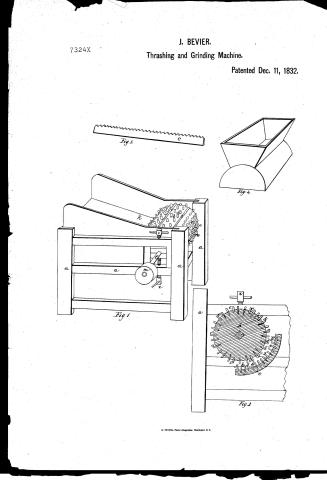
Jesse Bevier's Patent Drawing for a Machine for Thrashing Grain, Shelling Corn, and Grinding Apples


National Archives, Restored Patent Drawings (Record Group 241) · Full-size scan at the National Archives · Catalog record
Show the text on the drawing Hide (284 words)
Words on the drawing as machine-read by the National Archives; not checked. Useful mainly for searching.
Sheet 1. Entered / 130. THRASHING. / 130. / Corn Shellers. / is born Shellers / [59] / Breast and Cylinder. / Jesse Bevier / Dupheate Machine for thrashing Irain, shelling Corn Volin.637. / in The mehs". / and grinding apples. / Patenter Decem. 11.1832. / CLASSIFICATION / 7324-X / DIVISION. / sty.3. Theiron bar.c. / Jigh. / gare 'bars' / Jig.1 / Tig.2. / Puferines. a.a.a.a. frame. B. cylinder of iron out wood / E. concave. 933 He. bars. h. h.h. spikes. i.i verews toregulate Made under the direction of the / C.C.C.C.C. bars smooth 02 teethed. d.d d al &. iron spikes. / Patent affice Mar17 1842. / the cylinder. h inclined plane l the shaft. m whirl. Commifioner of Patents in conformity / Lig.1. Fig.2 Lectionof cylindar and concave. / with act of 3rd march 1837 / Ay.3 Theiron bar C. Jig Happer when the Machine is used / for grinding apples. / M.L.Sunoth / ch... Mishman freit. / Commissioner of Patents
Sheet 2. 130. THRASHING / Get ThrashingMachin / $250 CLASSIFICATION cylo Jesse Pevier Shreshing grain, Shelling Corn and / Guiding Applex. / Patented Dec: 11 1832.. / 7324 + / DIVISION. / Dr pleate / Jj. The irow Bar C. / J.g.h. / a. / OF / Jij.1. / J.y.2. / a.a.a.a. The frame, b, Cylinder of irow or mood. / C.C.C.C.C. bars smooth or toothed d d.d.d. Dro on opike / e. Concard ESSS. barohh.h. fulker i Sereurs to / regulate the Cylinder - K' inclined plane l the shaft. / in whire / I'g I-Dide view Heg 2.Section of Cy linder / rig 3. 3.He Iron Bar C. / Sig. apples. the Hopper when the machine is used for grinding / Made under che direction of the Commission / Salout Office Mar 17 1842 / er of Patents in Conformity with the adops / of March 1837. / (Rigued) / Courm
USPTO scan
The patent as scanned by the USPTO
-
 Page 1
-
 Page 2
-
 Page 3
-
 Page 4


U.S. Patent and Trademark Office · Google Patents
Show the transcription Hide (980 words)
Machine transcription (LightOnOCR) of the pages as scanned by the USPTO, most of them the handwritten copies made when the records were restored after the 1836 fire. Not checked; it can misread handwriting, so compare it with the scan.
Page 1.
7324X
J. BEVIER.
Thrashing and Grinding Machine.
Patented Dec. 11, 1832.
Fig. 3.
Fig. 4.
Fig. 1.
Fig. 2.
N. PETERS, Photo-Lithographer, Washington, D. C.
Page 2.
369 7324x Jeffe Brewer December 11, 1832 637
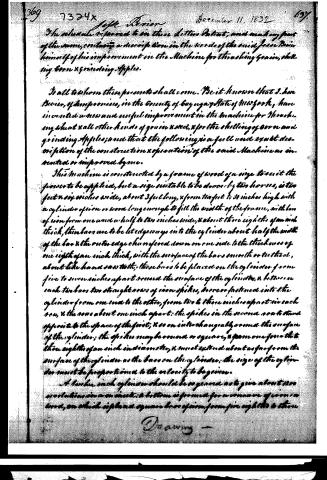
I herewith annexed to this Letter Patent, and make my part of the same, containing a description in the words of the said Jesse Brewer himself of his improvement in the Machine for threshing grain, shelling corn & grinding Apples.
To all to whom this presents shall come. Be it known that I, Jesse Brewer, of the province, in the County of Cayuga State of New York, have invented a new and useful improvement in the Machine for threshing wheat & all other kinds of grain & seed, & for the shelling of corn and grinding Apples; and that the following is a full and exact description of the construction & operation of the said Machine as invented or improved by me.
This Machine is constructed by a frame of wood of a size to suit the power to be applied, but a size suitable to be drawn by two horses, is two feet & six inches wide, about 3 feet long, & from ten feet to 20 inches high with a cylinder of iron or wood long enough to fill the width of the frame, with bars of iron from one and a half to two inches wide, & about three eighths of an inch thick, these bars are to be let edge ways into the cylinder about half the width of the bar & the outer edge channeled down on one side to the thickness of one eighth of an inch thick, with the surface of the bars smooth or textured, about like hand saw teeth, these bars to be placed on the cylinder from five to seven inches apart around the surface of the cylinder, & between each two bars two straight rows of iron spikes, & so fastened into the cylinder from one end to the other, from two to three inches apart in each row, & the rows about one inch apart: the spikes in the second row to stand opposite to the space of the first, & so on interchangeably around the surface of the cylinder; the spikes may be round or square, & from one fourth to three eighths of an inch in diameter, & must extend about as far from the surface of the cylinder as the bars on the cylinder: the size of the cylinder must be proportioned to the velocity to be given.
A twelve inch cylinder should be so given as to give about 200 revolutions in a minute. A bottom is formed for a concave grain board, on which is placed square bars of iron from five eighths to three
Drawing —
Page 3.
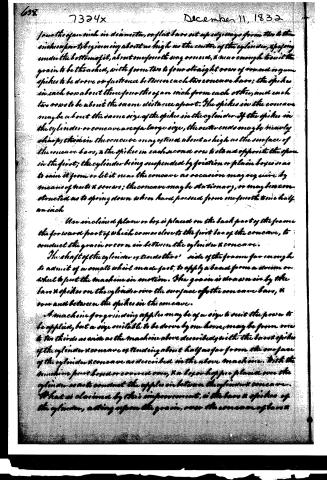
for the open inch in diameter, or flat bars set up edge ways from this to the inch on parts beginning about as high as the center of the cylinder, spiking under the bottom of it, about one foot to the row or row, & near enough to suit the grain to be thrashed, with from two to four straight rows of round or gum spikes to be drove or justice between each two concave bars; the spikes in each row about three-fourths of an inch from each other, and each two rows to be about the same distance apart. The spikes in the concave may be about the same size of the spikes in the cylinder. If the spikes in the cylinder or concave are of a large size, the outer ends may be nearly sharp; those in the concave may extend about as high as the surface of the concave bars, & the spikes in each second row to stand opposite the space in the first; the cylinder being suspended by friction or plain boxes so as to spin it from or let it run the concave as occasion may require by means of belts & screws; the concave may be stationary, or may be constructed so to spring down when hand passed from one foot to one half an inch.
An inclined plane or box is placed on the back part of the frame the forward part of which comes close to the first bar of the concave, to conduct the grain or corn in between the cylinder & concave.
The shaft of the cylinder extends to the side of the frame far enough to admit of a small wheel made fast, to apply a band from a drum or wheel to put the machine in motion. The grain is drawn in by the bars & spikes on the cylinder over the surface of the concave bars, & over and between the spikes in the concave.
A machine for grinding apples may be of a size to suit the power to be applied, but a size suitable to be drove by one horse, may be from one to two thirds as wide as the machine above described, with the bars & spikes of the cylinder & concave extending about half as far from the surface of the cylinder & concave as described in the above machine. With the machine front board or covered over, & a hopper for placing on the cylinder so as to conduct the apples in between the cylinder & concave. What is claimed by this improvement, is the bars & spikes of the cylinder, acting upon the grain, over the concave of bars &
Page 4.
7324x
Dec 11, 1832
639.
over a between the spokes in the concave at the same time, & also the application of the machine in grinding apples.
Witnesses
John Shams Jr.
Morgan Shams
(1000 words)
Patented October 11, 1832.
Filed. 11/96.
Published accounts: journal notice
Notice in the monthly list of patents
Journal of the Franklin Institute, new ser., vol. 11 (1833), p. 377 · View the page
15. For a Thrashing Machine; Jesse Bevier, Sempronius, Cayuga county, New York, December 11.
About this record
- Patentee
- DATAMP
- Date
- the Name and Date index of patents, DATAMP, USPTO records
- Invention
- DATAMP
- Listed in
- the Name and Date index of patents, DATAMP, USPTO records, Jim Shaw's X-patent list, the Journal of the Franklin Institute, Burke's List of Patents (1847)
- Burke's 1847 Patent Office list gives the same patent.