

Drawings and documents
National Archives restored drawings: drawing
Henry Higley's Patent Drawing for a Plough and Harrow

National Archives, Restored Patent Drawings (Record Group 241) · Full-size scan at the National Archives · Catalog record
Show the text on the drawing Hide (32 words)
Words on the drawing as machine-read by the National Archives; not checked. Useful mainly for searching.
97. PLOWS. / Entered / [43] Cultivators. / ULASSIFICATION / 7325-+ / DIVISION. / HENRY HIGLEY'S / PLOUGH and HARROW. / Patented 71 Dec 1832. / E' / F'
USPTO scan
The patent as scanned by the USPTO
-
 Page 1
-
 Page 2
-
 Page 3
-
 Page 4


U.S. Patent and Trademark Office · Google Patents
Show the transcription Hide (1,087 words)
Machine transcription (LightOnOCR) of the pages as scanned by the USPTO, most of them the handwritten copies made when the records were restored after the 1836 fire. Not checked; it can misread handwriting, so compare it with the scan.
Page 1.
7325X
H. Higley,
Cultivator.
Patented Dec. 11, 1832.

Page 2.
7325x
Dec 11, 1832
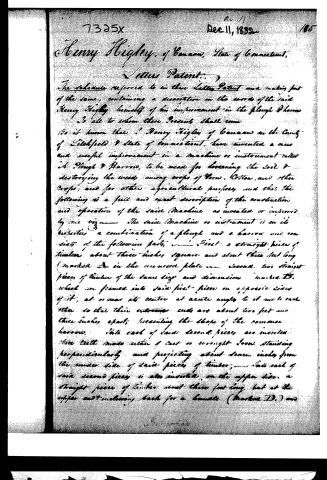
Henry Higley, of Canaan, State of Connecticut,
Letters Patent.
The subject referred to in these Letters Patent and making part of the same, containing a description in the words of the said Henry Higley himself of his improvement in the Plough Harrow.
To all to whom these Presents shall come
Be it known that I Henry Higley of Canaan in the County of Litchfield & State of Connecticut, have invented a new and useful improvement in a machine or instrument called "A Plough & Harrow," to be used for loosening the soil & destroying the weeds among crops of Corn, Cotton, and other crops, and for other agricultural purposes, and that the following is a full and exact description of the construction and operation of the said Machine as invented or improved by me viz:— The said Machine or instrument is in its properties a combination of a plough and a harrow and consists of the following parts, — First a straight piece of timber about three inches square and about three feet long (marked A in the annexed plate) — Second two straight pieces of timber of the same size and dimensions marked B, which are framed into said first piece on opposite sides of it, at or near its centre at acute angles to it and to each other so that their extreme ends are about two feet and three inches apart, presenting the shape of the common harrow. Into each of said second pieces are inserted three teeth made either of cast or wrought Iron standing perpendicularly and projecting about seven inches from the under side of said pieces of timber; — Into each of said second pieces is also inserted, on the upper side, a straight piece of timber about three feet long but at the upper end inclining back for a handle (marked D) and
Page 3.
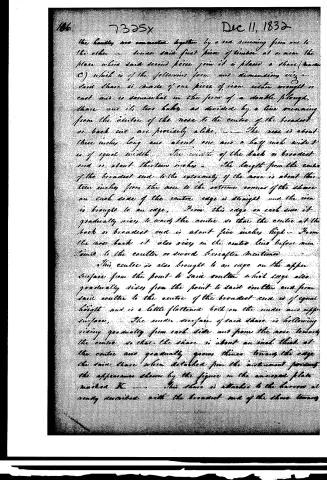
the bands are connected together by a rod running from one to the other — upon said first piece of timber at or near the place where said second piece joins it is placed a share (marked C) which is of the following form and dimensions viz — said share is made of one piece of iron either wrought or cast and is somewhat in the form of a double plough share and its two halves as divided by a line running from the centre of the nose to the centre of the broadest or back end are precisely alike. — The nose is about three inches long and about one and a half inch wide and is of equal width. The width of the back or broadest end is about thirteen inches. The length from the centre of the broadest end to the extremity of the nose is about thirteen inches from the nose to the extreme corner of the share on each side of the centre edge is straight and the iron is brought to an edge. From this edge on each side it gradually rises to reach the centre so that the centre at the back or broadest end is about five inches high. From the nose back it also rises in the centre line before mentioned to the centre or sword hereafter mentioned.
This centre is also brought to an edge on the upper surface from the point to said centre which edge also gradually rises from the point to said centre and from said centre to the centre of the broadest end is of equal height and is a little flattened both on the under and upper surfaces. The under surface of said share is following rising gradually from each side and from the nose towards the centre, so that the share is about an inch thick at the centre and gradually grows thinner towards the edge the same share when detached from the instrument presents the appearance shown by the figure in the annexed plate marked K. — This share is attached to the harrow at ready inserted with the broadest end of the share turning
Page 4.
7325x Dec 11, 1832
the broadest end of the harrow, and the center line of the share in a line with said first piece of timber and in the following manner, a bolt of wrought iron (marked G) passes through said first piece of timber just back of where said second pieces are joined to it and about four inches below the under side of it is bent forward, at a right angle and fast under the center of the share about five inches and a small bolt passes through the share and through this bolt & is fastened with a nut. A brace to this bolt (marked H,) made also of wrought iron passes through said first piece of timber about eight inches back of said main bolt, and is joined to it at the place where it is bent, to pass under the share, about four inches forward of said main bolt is a coulter or sword (marked E,) the upper end of which passes through said first piece of timber and is fastened on the top of it with a nut, and the lower end passes through the share and through the end of said main bolt, and is fastened on the under side with a nut. On the forward end of said first piece of timber is placed a common, clevis (marked E,) by which it is to be drawn.
This Machine is to be drawn by one or more horses or other beasts and to be used for ploughing, and harrowing among Corn, Cotton and any other crop planted in rows and for ploughing, and harrowing in, wheat and other kinds of grain and for any other agricultural purpose for which it can be profitably used. What I claim as new and as my own invention or discovery in the machine herein before described and for the use of which I ask an exclusive privilege, is the share herein before described and the combination of the properties of the plough and the harrow, in the same instrument and performing the work of both by the same operation.
Signed at Canaan the 24th day of October A.D. 1832.
Witness: William P. Barrell
Henry Higby
1045 n. 5
Published accounts: journal notice
Notice in the monthly list of patents, with remarks
Journal of the Franklin Institute, new ser., vol. 11 (1833), p. 374 · View the page
The improvement claimed consists in making a perfectly true and smooth core of iron to form the box. Upon this the hub is to be cast, and removed from the mould whilst hot, when the core may be driven out by striking it on the small end. The patentee says that he is aware that metallic cores have been used in small castings, and that he claims as new only the application and use of them in casting wheel hubs; ought we not to be informed at what size his patent begins to take effect? 7. For a Plough and Harrow; Henry Higley, Canaan, Litchfield county, Connecticut, December 4.
Remarks. This plough and harrow is made in the usual form of the instrument sometimes called a cultivator; it has a coulter at its front angle, formed much like the teeth of some of these instruments, with a ridge along its centre, to turn the earth on either side. The teeth on the two side bars of the V are straight, like those of common harrow teeth. The claim to the foregoing machine is "in the using this share as described, and the combination of the whole as uniting the properties of the plough and harrow.
About this record
- Patentee
- DATAMP
- Date
- the Name and Date index of patents, DATAMP, USPTO records
- Invention
- DATAMP
- Listed in
- the Name and Date index of patents, DATAMP, USPTO records, Jim Shaw's X-patent list, the Journal of the Franklin Institute, Burke's List of Patents (1847)
- The Franklin Institute's journal gives a different date.
- Burke's 1847 Patent Office list gives the same patent.