

Drawings and documents
National Archives restored drawings: drawing
D. Steinhauer's Patent Drawing for the Improvement in the Abstraction of Heat from Smoke Air Heaters and in the Mode of Applying Basket Grates to such Heaters

National Archives, Restored Patent Drawings (Record Group 241) · Full-size scan at the National Archives · Catalog record
Show the text on the drawing Hide (103 words)
Words on the drawing as machine-read by the National Archives; not checked. Useful mainly for searching.
3. STOVES &FURNACER / [154] Grates. / 152 / D.STEINHAUER'S / Improvement in the abstraction of heat from smoke of airhealers S in the mode of applying basket gratesto such healers. / CLASSIFICATION / Patented Dec. 13th 1832 / 7327x / DIVISION. / a. The Basket Grate / h.h. The double cased cylindrie drums. / b.b. Cylindex / in. Partition -rall / C. Ash pit / J.J. Pipes to convey the air into the / d. Ring or flanch. / interior of the drums / e. a rangrof firebricks / k. Bottom of the cylender / f. Sinoke pipe / 5.5. Walls of the air chamber
USPTO scan
The patent as scanned by the USPTO
-
 Page 1
-
 Page 2
-
 Page 3
-
 Page 4


U.S. Patent and Trademark Office · Google Patents
Show the transcription Hide (870 words)
Machine transcription (LightOnOCR) of the pages as scanned by the USPTO, most of them the handwritten copies made when the records were restored after the 1836 fire. Not checked; it can misread handwriting, so compare it with the scan.
Page 1.
7327X
J. Steinhauer.
Grate.
Patented Dec. 13, 1832.

Page 2.
7327x Dec. 13, 1832 425
Daniel Steinhauer, & Resident in the United States
Letters Patent.
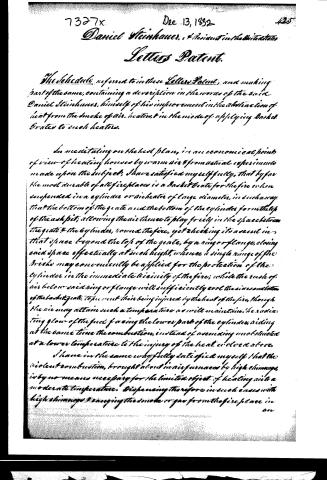
The Schedule referred to in these Letters Patent, and making part of the same, containing a description in the words of the said Daniel Steinhauer, himself of his improvement in the abstraction of heat from the smoke of air-heaters, & in the mode of applying Basket Grates to such heaters.
In meditating on the best plan, in an economical point of view of heating houses by warm air & from actual experiments made upon the subject, I have satisfied myself fully, that by far the most desirable of all fireplaces is a Basket Grate for the fire when suspended in a cylinder or air heater of large diameter, in such a way that the bottom of the grate and the bottom of the cylinder form the top of the ash-pit; allowing the air thence to play freely in the space between the grate & the cylinder, round the fire, yet checking its ascent in that space beyond the top of the grate, by a ring or flange, closing said space effectively at such height, whence a single range of fire bricks may conveniently be applied for the protection of the cylinder in the immediate vicinity of the fire; while the rush of air below said ring or flange will sufficiently cool the air and bottom of the basket grate, to prevent their being injured by the heat of the fire, though the air may attain such a temperature as will maintain the radiating glow of the fuel facing the lower part of the cylinder, aiding at the same time the combustion, instead of ascending unobstructed at a lower temperature to the injury of the heat evolved above.
I have in the same way fully satisfied myself that the violent combustion, brought about in air furnaces by high chimneys, is by no means necessary for the limited object of heating air to a moderate temperature. Dispensing therefore in such cases with high chimneys & ranging the smoke or gas from the fireplace in an
Page 3.
an horizontal direction, by the original impulse from the combustion, kept up by a continuation of its operation. I find that the heat of the smoke or gas may be abstracted to any desirable extent by a system of double oased cylindrical smoke domes, placed sideways in succession as gas retorts, inclosed in a walled air chamber, the one dome receiving the smoke from the other & each having a separate draft of cold air from without washing thro' the interior, while a draft from below is provided for taking up the heat from the exterior of the domes, which various currents of variously heated air will mix together and form a medium temperature, either by themselves, if the air chamber containing them be entirely separate, or with the air heated by the main body of the stove. If the separation be made by a lower partition only, the whole to be distributed then in the house by pipes or flues from the air chamber. But the entire heat of the smoke may in this way be rendered available yet local circumstances, & more particularly the height of the chimney by which the smoke is to escape, must necessarily be taken into consideration in determining the extent to which it may be advisable, & even practicable to carry the saving of heat above alluded to. I thus claim no new invention for the heating of houses by warm air, the abstraction of heat to any desirable extent from the smoke of air heaters, by a system of double oased cylindrical domes, placed horizontally and in succession as gas retorts inclosed in a walled air chamber, either entirely separate from the air chamber of the main body of the air heater, or forming part of it by a partition only, not raised higher than the domes, each dome having a separate collar flue thro' its entire & a separate or common draft from below to strike the outer casing of each, so as to produce a separate rush of air thro' & from around each dome, differently heated of course, according to the different temperature of the smoke in the respective domes, but mixing above into one body of
Page 4.
7327x
Dec 13, 1832
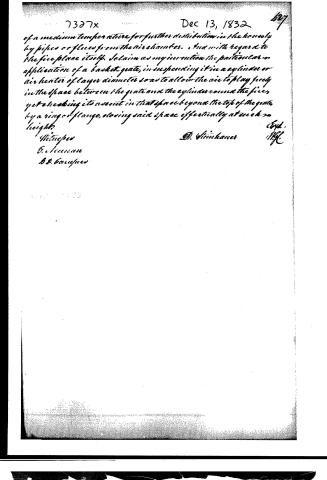
of a medium temperature for further distribution in the house by pipes or flues from the air chamber. And with regard to the fireplace itself, I claim as my invention the particular application of a basket-gate, in suspending it in a cylinder or air heater of larger diameter so as to allow the air to play freely in the space between the gate and the cylinder round the fire, yet checking its ascent in that space beyond the top of the gate, by a ring or flange, closing said space effectively at such a height.
Witnesses
G. Looman
B. E. Barufus
D. Vinkhauer
End.
1832
Published accounts: specification
Specification printed in the Journal of the Franklin Institute
Journal of the Franklin Institute, new ser., vol. 11 (1833), p. 394 · View the page
Text of the specification as printed in the Journal, from OCR; not proofread.
Specification of a patent for abstracting the heat from the smoke and gas of air heaters, and for applying basket grates to such heaters. Granted to DAVID STEINHAUER, city of Philadelphia; an alien who has resided two years in the United States, December 13, 1832. In meditating on the best plan, in an economical point of view, of heating houses by warm air, and from actual experiments made upon the subject, I have satisfied myself fully that by far the most durable of all fireplaces is a basket grate for the fire, when suspended in a cylinder, or air heater, of larger diameter, in such a way that the bottom of the grate and the bottom of the cylinder form the top of the ash pit; allowing the air thence to play freely in the space between the grate and the cylinder, round the fire, yet checking its ascent in that space STEINHAUER'S Heating Apparatus. beyond the top of the grate, by a ring, or flanch, closing the said space effectually at such height, where a single range of fire brick may be conveniently applied, for the protection of the cylinder, in the immediate vicinity of the fire; while the rush of air below said ring, or flanch, will sufficiently cool the sides and bottom of the basket grate to prevent their being injured by the heat of the fire, though the air may attain such a temperature as will maintain the radiating glow of the fuel, facing the lower part of the cylinder, aiding at the same time the combustion, instead of ascending, unobstructed, at a lower temperature, to the injury of the heat evolved above. I have in the same way fully satisfied myself that the violent combustion brought about in air furnaces, by high chimneys, is by no means necessary for the limited object of heating air to a moderate temperature. Dispensing, therefore, in such case with high chimneys, and carrying the smoke and gas from the fireplace in a horizontal direction, by the original impulse from the combustion, kept up by a continuation of its operation, I find that the heat of the smoke, and gas, may be abstracted to any desirable extent, by a system of double cased cylindrical smoke drums, placed sideways in succession, as gas retorts, inclosed in a walled air chamber, the one drum receiving the smoke from the other, and each having a separate draft of cold air from without rushing through the interior, while a draft from below is provided for taking up the heat from the exterior of the drums; which various currents of variously heated air, will mix together above, and form a medium temperature, either by themselves, if the air chamber containing them be entirely separate, or with the air heated by the main body of the stove, if the separation be made by a lower partition only; the whole to be distributed thence in the house, by pipes or flues from the air chamber. But though the entire heat of the gas and smoke may in this way be rendered available, yet local circumstances, and more particularly the height of the chimney by which the smoke is to escape, must necessarily be taken into consideration in determining the extent to which it may be adviseable, and even practicable, to carry the saving of heat above alluded to. I thus claim, as my invention for the heating of houses by warm air, the abstraction of heat to any desirable extent, from the gas and smoke of air heaters, by a system of double cased cylindrical drums, placed horizontally, and in succession, as gas retorts, inclosed in a walled air chamber, either entirely separate from the air chamber of the main body of the air-heater, or forming part of it, by a partition not carried higher than the drums, each drum having a separate, cold air flue through its centre, and a separate or common draft from below to strike the outer casing of each, so as to produce a separate rush of air through and from around each drum, differently heated, of course, according to the different temperatures of the gas and smoke in the respective drums, but mixing above into one body of a medium temperature for further distribution in the house by pipes, or flues, from the air chamber. And with regard to the fireplace itself, I claim as my invention the STEINHAUER'S Heating Apparatus. particular application of a basket grate, by suspending it in a cylinder or air-heater, of larger diameter, so as to allow the air to play freely in the space between the grate and the cylinder, round the fire, yet checking its ascent in that space, beyond the top of the grate, by a ring or flanch, closing said space effectually at such height. h h J h f 9 Ъ e 9 C 9 K bb, The cylinder. a, The basket grate. c, The ash pit. d, The ring or flanch. e, A range of fire bricks. b 9 f, The smoke pipe. gg, The walls of the air chamber. hh, The double cased cylindric drums. i i, The partition wall. jj, The pipes to convey the air into the interior of the drums. k, The bottom of the cylinder.
Editor's remarks. In the absence of personal observation upon the effects of the apparatus patented by Mr. Steinhauer, we have availed ourselves not only of a correspondence with the patentee, but also of the information derived from a gentleman, residing in Philadelphia, who has witnessed the experiments with, and the actual operation of, the apparatus described in the foregoing specification. He is a man of practical science; his testimony may therefore be relied on, and it confirms, in all respects, the statements of the patentee, which we will give in his own words. WALKER'S mode of Boring Wheels. "The trials made subsequently to those which were witnessed by our mutual friend, have all tended to confirm my opinion of its excellence. The double cased drums exceed my expectation in their power of abstracting the heat from the smoke and gas; and the basket grate, when properly hung, burns the anthracite admirably, and well deserves to be called indistructible. I have had one in constant use during the winter in my own house, which shows no trace of the intense fire which has been kept up in it; indeed I am well convinced that it would last twenty seasons as well as one, while I have never known the solid iron cylinder, used for the same purpose, however strong, last more than two seasons, and frequently not even one. The bars of the grate, when the fire is at the hottest, barely attain a cherry red, and consequently do not waste from scaling, while the sheet iron casing is scarcely incandescent in the dark, and therefore never produces that unpleasant smell so much complained of when the air comes in contact with red hot iron: "In one of my basket cylinders I had, by way of experiment, two bushels of good anthracite put, and well ignited. It was then left untouched for three days and three nights, at the expiration of which time I had the ashes stirred out, and was surprised to find still some glowing embers in the centre, and from the whole quantity of coal not more than one quarter of a peck of unconsumed material." The patentee is a manufacturer of stoves, and other articles of that description, and is familiar with the various plans of warming public and private buildings with heated air, as practiced in Philadelphia, where much has been done in this way; in many cases with considerable success, but in others, expectation has been entirely disappointed, after the expenditure of much money. In a heated air stove in a private house, it is stated that a quarter of a ton of coal was sometimes burnt in a day, without deriving sufficient heat from it to warm the building. On examination it was found that the heated air, after ascending five stories, escaped at a temperature of no less than $70° Fah. This, no doubt, was an extreme case of waste, but, in general, the quantity of heat, and consequently of fuel, lost, is very great. With Mr. Steinhauer's apparatus, the temperature of the smoke and gas escaping from the chimney, has been found to be but a few degrees above that of the surrounding atmosphere. Hot air chambers, on the ordinary construction, have been altered upon the plan of Mr. S., and the effect of the furnace in many instances doubled, without disturbing the original fixtures.
Published accounts: journal notice
Notice in the monthly list of patents, with remarks
Journal of the Franklin Institute, new ser., vol. 11 (1833), p. 378 · View the page
17. For improvements in Abstracting heat from the smoke of air heaters, and of applying basket grates to such heaters; Daniel Steinhauer, city of Philadelphia, an alien, who has resided two years in the United States. December 13.
Remarks. (See the specification.)
Published accounts: journal notice
Notice in the monthly list of patents, with remarks
Journal of the Franklin Institute, new ser., vol. 11 (1833), p. 394 · View the page
Granted to DAVID STEINHAUER, city of Philadelphia; an alien who has resided two years in the United States, December 13, 1832.
Remarks. In meditating on the best plan, in an economical point of view, of heating houses by warm air, and from actual experiments made upon the subject, I have satisfied myself fully that by far the most durable of all fireplaces is a basket grate for the fire, when suspended in a cylinder, or air heater, of larger diameter, in such a way that the bottom of the grate and the bottom of the cylinder form the top of the ash pit; allowing the air thence to play freely in the space between the grate and the cylinder, round the fire, yet checking its ascent in that space STEINHAUER'S Heating Apparatus. beyond the top of the grate, by a ring, or flanch, closing the said space effectually at such height, where a single range of fire brick may be conveniently applied, for the protection of the cylinder, in the immediate vicinity of the fire; while the rush of air below said ring, or flanch, will sufficiently cool the sides and bottom of the basket grate to prevent their being injured by the heat of the fire, though the air may attain such a temperature as will maintain the radiating glow of the fuel, facing the lower part of the cylinder, aiding at the same time the combustion, instead of ascending, unobstructed, at a lower temperature, to the injury of the heat evolved above. I have in the same way fully satisfied myself that the violent combustion brought about in air furnaces, by high chimneys, is by no means necessary for the limited object of heating air to a moderate temperature. Dispensing, therefore, in such case with high chimneys, and carrying the smoke and gas from the fireplace in a horizontal direction, by the original impulse from the combustion, kept up by a continuation of its operation, I find that the heat of the smoke, and gas, may be abstracted to any desirable extent, by a system of double cased cylindrical smoke drums, placed sideways in succession, as gas retorts, inclosed in a walled air chamber, the one drum receiving the smoke from the other, and each having a separate draft of cold air from without rushing through the interior, while a draft from below is provided for taking up the heat from the exterior of the drums; which various currents of variously heated air, will mix together above, and form a medium temperature, either by themselves, if the air chamber containing them be entirely separate, or with the air heated by the main body of the stove, if the separation be made by a lower partition only; the whole to be distributed thence in the house, by pipes or flues from the air chamber. But though the entire heat of the gas and smoke may in this way be rendered available, yet local circumstances, and more particularly the height of the chimney by which the smoke is to escape, must necessarily be taken into consideration in determining the extent to which it may be adviseable, and even practicable, to carry the saving of heat above alluded to. I thus claim, as my invention for the heating of houses by warm air, the abstraction of heat to any desirable extent, from the gas and smoke of air heaters, by a system of double cased cylindrical drums, placed horizontally, and in succession, as gas retorts, inclosed in a walled air chamber, either entirely separate from the air chamber of the main body of the air-heater, or forming part of it, by a partition not carried higher than the drums, each drum having a separate, cold air flue through its centre, and a separate or common draft from below to strike the outer casing of each, so as to produce a separate rush of air through and from around each drum, differently heated, of course, according to the different temperatures of the gas and smoke in the respective drums, but mixing above into one body of a medium temperature for further distribution in the house by pipes, or flues, from the air chamber. And with regard to the fireplace itself, I claim as my invention the STEINHAUER'S Heating Apparatus. particular application of a basket grate, by suspending it in a cylinder or air-heater, of larger diameter, so as to allow the air to play freely in the space between the grate and the cylinder, round the fire, yet checking its ascent in that space, beyond the top of the grate, by a ring or flanch, closing said space effectually at such height. h h J h f 9 Ъ e 9 C 9 K bb, The cylinder. a, The basket grate. c, The ash pit. d, The ring or flanch. e, A range of fire bricks. b 9 f, The smoke pipe. gg, The walls of the air chamber. hh, The double cased cylindric drums. i i, The partition wall. jj, The pipes to convey the air into the interior of the drums. k, The bottom of the cylinder. Remarks by the Editor. In the absence of personal observation upon the effects of the apparatus patented by Mr. Steinhauer, we have availed ourselves not only of a correspondence with the patentee, but also of the information derived from a gentleman, residing in Philadelphia, who has witnessed the experiments with, and the actual operation of, the apparatus described in the foregoing specification. He is a man of practical science; his testimony may therefore be relied on, and it confirms, in all respects, the statements of the patentee, which we will give in his own words. WALKER'S mode of Boring Wheels. "The trials made subsequently to those which were witnessed by our mutual friend, have all tended to confirm my opinion of its excellence. The double cased drums exceed my expectation in their power of abstracting the heat from the smoke and gas; and the basket grate, when properly hung, burns the anthracite admirably, and well deserves to be called indistructible. I have had one in constant use during the winter in my own house, which shows no trace of the intense fire which has been kept up in it; indeed I am well convinced that it would last twenty seasons as well as one, while I have never known the solid iron cylinder, used for the same purpose, however strong, last more than two seasons, and frequently not even one. The bars of the grate, when the fire is at the hottest, barely attain a cherry red, and consequently do not waste from scaling, while the sheet iron casing is scarcely incandescent in the dark, and therefore never produces that unpleasant smell so much complained of when the air comes in contact with red hot iron: "In one of my basket cylinders I had, by way of experiment, two bushels of good anthracite put, and well ignited. It was then left untouched for three days and three nights, at the expiration of which time I had the ashes stirred out, and was surprised to find still some glowing embers in the centre, and from the whole quantity of coal not more than one quarter of a peck of unconsumed material."
About this record
- Patentee
- DATAMP
- Date
- the Name and Date index of patents, DATAMP, USPTO records
- Invention
- DATAMP
- Listed in
- the Name and Date index of patents, DATAMP, USPTO records, Jim Shaw's X-patent list, the Journal of the Franklin Institute, Burke's List of Patents (1847)
- Burke's 1847 Patent Office list gives the same patent.