

Drawings and documents
National Archives restored drawings: drawing
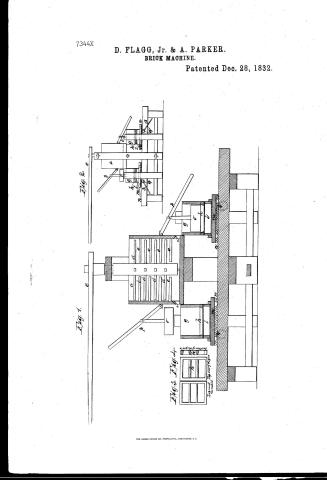
David Flagg and Amos Parker's Patent Drawing for a Machine for Stock, Brick, and Tile

National Archives, Restored Patent Drawings (Record Group 241) · Full-size scan at the National Archives · Catalog record
Show the text on the drawing Hide (116 words)
Words on the drawing as machine-read by the National Archives; not checked. Useful mainly for searching.
25. Clas / Briok / table / Mold / Renn / $4 / wid Hagg 7344-X Imand Amer Parker / figh. / Vol.14 485 / Patented Dec. 28. 1832. / Machine for manufacturing stocks brick tile / b. / sty.). / ences. / perpendicular shaft. c sweepear baci. / K. spacker armson the shaft. / LL Her spoe in the tub. / openings for the clay 18 pass / shambers. h. h. grates see big 4 and seation Jig.5. Fig. / C.C. moulds. m. carriages. n n. racks.. 0. o pistons. / levers. g .g. cozwhels and lears J. / the Machine. Ty.2. Fig.3 Topoins / of the nate. of Jy h. / Jisch. / Vep / made / under / Patent the fffice / of Patents in conformity th / swarch 18.17 / ML / of Pothe / frait
USPTO scan
The patent as scanned by the USPTO
-
 Page 1
-
 Page 2
-
 Page 3
-
 Page 4


U.S. Patent and Trademark Office · Google Patents
Show the transcription Hide (1,020 words)
Machine transcription (LightOnOCR) of the pages as scanned by the USPTO, most of them the handwritten copies made when the records were restored after the 1836 fire. Not checked; it can misread handwriting, so compare it with the scan.
Page 1.
7344X
D. FLAGG, Jr. & A. PARKER.
BRICK MACHINE.
Patented Dec. 28, 1832.

THE NORRIS PETERS CO., PHOTO-LITHO., WASHINGTON, D.C.
Page 2.
7344x Dec 28, 1832 4
David Hagg & Amos Parker.
Letters Patent.
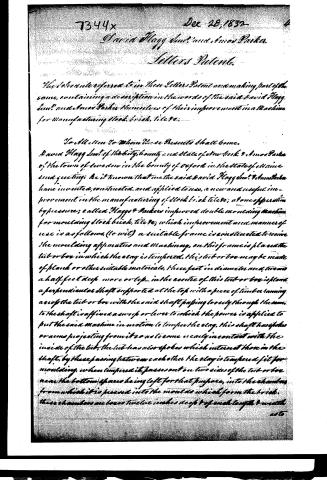
The declaration referred to in these Letters Patent and making part of the same, containing a description in the words of the said David Hagg & Amos Parker themselves of their improvement in a Machine for manufacturing block brick, tile &c.
To All Men To Whom These Presents Shall Come.
David Hagg & Amos Parker of the City, County and State of New York & Amos Parker of the Town of Sweden in the County of Oxford in the State of Maine Greeting:
Be it known that we the said David Hagg & Amos Parker have invented, constructed, and applied to use, a new and useful improvement in the manufacturing of block brick tile &c; of one operation by pressure; called Hagg & Parker's improved double moulding Machine for moulding block brick, tile &c; which improvement and manner of use is as follows, (to wit) a suitable frame is constructed to receive the moulding apparatus and machinery, on this frame is placed the tub or box in which the clay is tempered, this tub or box may be made of plank or other suitable materials, three feet in diameter and two and a half feet deep more or less; in the center of this tub or box is placed a perpendicular shaft supported at the top with a piece of timber running across the tub or box with the said shaft passing loosely through the same, to the shaft is affixed a sweep or lever to which the power is applied to put the said machine in motion to temper the clay, this shaft has spokes or arms projecting from it so as to come nearly in contact with the inside of the tub, the tub has also spokes which intersect those in the shaft, by these passing between each other the clay is tempered fit for moulding, when tempered it passes out on two sides of the tub or box near the bottom, spaces being left for that purpose, into the chambers from which it is passed into the moulds which form the brick. These chambers are two twelve inches deep & of such length & width as to
Page 3.
as to suit the grate or fixture, according to the number and size of the bricks which the mould may contain, this grate or fixture forms the bottom of the chambers, & is made in the following manner (to wit) of hard wood or other suitable materials. This grate is made somewhat in the form of the moulds, each space being one inch less in length & breadth than the mould in which the brick are formed. The bars which form the grate are two and a half inches in width by three inches in depth, being bevelled on each side & forming a sharp edge at the top so as to contract the mortar when passing through to its proper length & breadth to form the brick. At the top of the chambers are followers or fictions which enter them loosely, by which the mortar is forced through the grate or fixture into the mould which forms the brick. Under these grates or fixtures is a carriage which moves backward and forward by means of a cog wheel and lever which goes into a fixed rack on the underside of the carriage to convey the mould to its proper place to receive the clay or mortar which forms the brick through the grates. These followers or fictions are also moved by a cog wheel or lever forcing the mortar from the chambers through the grates, forming the brick. The mould is then drawn out of the machine by said lever attached to said carriage & by which means the said followers or fictions are thrown up to their former place, leaving the chambers open to receive a further supply of mortar. The mould is made to contain three bricks more or less of such width, the edges of which are raised to nearly a sharp edge within, or any other suitable materials. The bottom of said mould may be either made fast or not, as may be thought most convenient to the moulder. The machine being complete and the mortar tempered ready for moulding, the mould is made moist so as the dust or sand will adhere to it, it is then placed on the carriage, forced into its proper place, under said grate, ready to receive the mortar which forms the brick. The lever attached to the followers or fictions is then forced down by which the mortar is forced from the chambers through the grate into the mould which forms the brick.
Page 4.
Dec 28, 1832
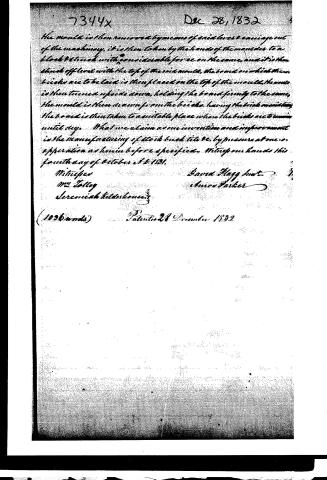
The mould is then removed by means of said lever and arrangement of the machinery, it is then taken by the hands of the moulder to a block & struck with considerable force on the same, and it is then struck off level with the top of the said mould, the board on which the bricks are to be laid is then placed on the top of the mould, the same is then turned upside down, holding the board firmly to the same, the mould is then drawn from the bricks, leaving the brick remaining, the board is then taken to a suitable place where the bricks are to remain until dry. What we claim as our invention and improvement is the manufacturing of stock brick tile &c. by pressure at one operation as herein before specified. Witness our hands this fourth day of October A.D. 1831.
Witnesses
Mrs. Zolley
Sereniah Kildershauser
Laura Hagg Just
Amos Parker
(1036 words) Patented 28 December 1832
Published accounts: journal notice
Notice in the monthly list of patents, with remarks
Journal of the Franklin Institute, new ser., vol. 11 (1833), p. 383 · View the page
30. For a machine for Making Stock Brick, Tile, &c.; David Flagg, jr., city of New York, and Amos Parker, Sweden, Oxford county, Maine, December 28.
Remarks. In this machine we do not perceive any thing new in principle, and but little variation in point of arrangement from other machines now in use. A vertical shaft is to be turned by means of a sweep, a tub surrounding the shaft at its lower end; arms extending from this shaft, work between others on the sides of the tub, and by these the clay is to be mixed. Openings are left on opposite sides for the clay to pass out into chambers, from which it is to be pressed into moulds by means of lever power. The moulds are placed on carriages carried backward and forward by a rack and pinion. The claim is to "the manufacturing stock brick, tile, &c. at one operation, as above specified."
About this record
- Patentee
- DATAMP
- Date
- the Name and Date index of patents, DATAMP, USPTO records
- Invention
- DATAMP
- Listed in
- the Name and Date index of patents, DATAMP, USPTO records, Jim Shaw's X-patent list, the Journal of the Franklin Institute, Burke's List of Patents (1847)
- Burke's 1847 Patent Office list gives the same patent.