

Drawings and documents
National Archives restored drawings: drawing
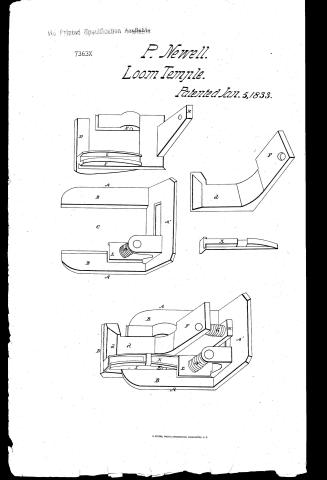
Peter Newell's Patent Drawing for a Temple

National Archives, Restored Patent Drawings (Record Group 241) · Full-size scan at the National Archives · Catalog record
Show the text on the drawing Hide (38 words)
Words on the drawing as machine-read by the National Archives; not checked. Useful mainly for searching.
Tex / Par. 96 - Reisened Lees 2, 1836 / VEAVING. / [95] / Temples. / PETER NEWELL'S. TEMPLE. / CLASSIFICATION / #7363x / 7363X X / Patented, 5 th, Jan. / DIV ISION. / 1833. / ab / is
USPTO scan
The patent as scanned by the USPTO
-
 Page 1
-
 Page 2
-
 Page 3
-
 Page 4


U.S. Patent and Trademark Office · Google Patents
Show the transcription Hide (809 words)
Machine transcription (LightOnOCR) of the pages as scanned by the USPTO, most of them the handwritten copies made when the records were restored after the 1836 fire. Not checked; it can misread handwriting, so compare it with the scan.
Page 1.
No Printed Specification Available
7363X
P. Newell.
Loom Temple.
Patented Jan. 5, 1833.
Page 2.
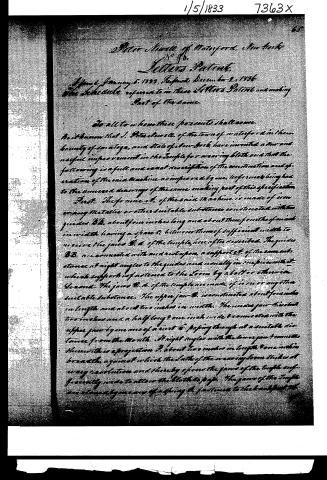
Peter Stowell, of Waterford, New York
No. 96.
Letters Patent.
Issued January 5, 1833, Reissued December 2, 1836
The Schedule, referred to in these Letters Patent, and making
Part of the same.
To all to whom these presents shall come.
Be it known that I, Peter Stowell, of the town of Waterford in the
county of Saratoga, and State of New York, have invented a new and
useful improvement in the Temple for weaving cloth and that the
following is a full and exact description of the construction and op-
eration of the said machine as improved by me, reference being had
to the annexed drawings of the same making part of this specification.
First. The frame A. of the said machine is made of iron
or any metallic or other suitable substance constructed with two
guides B. B. about five inches long and about three-fourths of an inch
in width having a space C. between them of sufficient width to
receive the jaws D. d. of the temple, hereafter described. The guides
B. B. are connected with and rest upon a support E. of the same sub-
stance at right angles to the guides and usually in one piece with it
which support is fastened to the beam by a bolt or otherwise.
Second. The jaws D. d. of the temple are made of iron or any other
suitable substance. The upper jaw D. is constructed about four inches
in length and about two inches in width. The under jaw d. is about
two inches and a half long and one inch wide and connected with the
upper jaw by means of a rivet E. passing through at a suitable dis-
tance from the mouth. At right angles with the lower jaw is connected
therewith is a projection F. about two inches in length and one inch in
breadth, against which the latch of the weaving loom strikes at
every revolution and thereby opens the jaws of the temple suf-
ficiently wide to allow the cloth to pass. The jaws of the Temple
are closed by means of a spring G. fastened to the beam and the
Page 3.
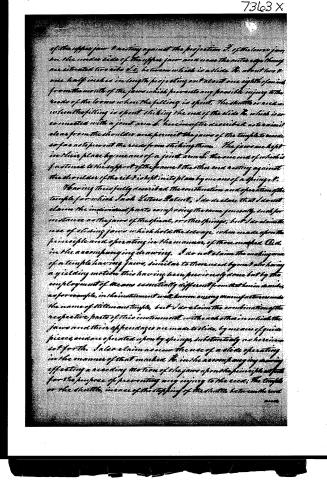
7363 X
of the upper jaw meeting against the projection 2. of the lower jaw on the under side of the upper jaw and near the outer edge, they are situated two ribs 2.2. between which is a slide 2. about two & one half inches in length projecting out about one eighth of an inch from the mouth of the jaws which prevents any possible injury to the reed of the loom when the filling is spent, the shuttle or needle when the filling is spent, striking the end of the slide 2. which is connected with a joint arm 2. herein after described as a ratchet clear from the shoulder and permit the jaws of the temple to recede so far as to prevent the reed from striking them. The jaws are kept in their place by means of a joint arm 2. the one end of which is fastened to the support of the frame & the other end resting against the shoulder of the rib 2. is kept in its place by means of a spring 2.
Having thus fully described the construction and operation of the temple for which such Letters Patent, I do declare that I do not claim the individual parts composing the same generally, such for instance as the jaws of the frame, or other springs; but I do claim the use of sliding jaws which hold the selvage, when made upon the principle and operating in the manner, of those marked O.d. in the accompanying drawings. I do not claim the making of a temple having jaws, similar to those used by me, also having a yielding motion this having been previously done but by the employment of means essentially different from that herein described, as for example, in the instrument well known among manufacturers under the name of Stillman’s temple, but I do claim the combination of the respective parts of this instrument with each other in which the jaws and their appendages are made to slide, by means of guide pieces, and are operated upon by springs, substantially as herein set forth. I also claim as new the use of a slide operating in the manner of that marked 2. in the accompanying drawing effecting a receding motion of the jaws upon the principle aforesaid for the purpose of preventing any injury to the reed; the temple or the shuttle, in case of the stopping of the shuttle between the jaws.
Published accounts: journal notice
Notice in the monthly list of patents, with remarks
Journal of the Franklin Institute, new ser., vol. 12 (1833), p. 18 · View the page
4. For an improvement in the Temple used in Weaving Cloth; Peter Newel, Waterford, Saratoga county, New York, January 5.
Remarks. The claim in this patent is to "the yielding motion of the jaws in the frame at every revolution of the lathe of the loom, which prevents the selvage threads from breaking. Also the motion of the bolt which raises the joint arm, and gives the receding motion to the jaws, and thereby prevents any injury to the reed." The specification, with the aid of the drawing, would undoubtedly suffice to render the invention intelligible had there been "written references" to the latter, agreeably to the absolute demands of the patent law; as it is, the construction and operation of the thing are far from being plain; this difficulty would most probably be removed by an examination of the model, which is, unfortunately, too frequently relied upon, as though it made a part of the patent.
About this record
- Patentee
- DATAMP
- Date
- the Name and Date index of patents, DATAMP, USPTO records
- Invention
- DATAMP
- Listed in
- the Name and Date index of patents, DATAMP, USPTO records, Jim Shaw's X-patent list, the Journal of the Franklin Institute, Burke's List of Patents (1847)
- The Franklin Institute's journal spells the name differently.
- Burke's 1847 Patent Office list gives the same patent.