

Drawings and documents
National Archives restored drawings: drawing
C. H. Strong and C. A. Sterry's Patent Drawing for Hoes

National Archives, Restored Patent Drawings (Record Group 241) · Full-size scan at the National Archives · Catalog record
Show the text on the drawing Hide (80 words)
Words on the drawing as machine-read by the National Archives; not checked. Useful mainly for searching.
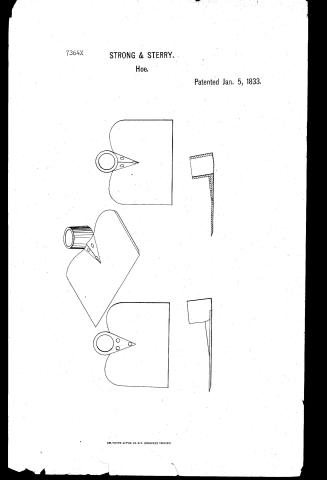
p1 / C. H. Strong & Hoes, 6.A. Herry. / 55 HARROWS AND DIGGERS. / Hoes. / Patented 5, 5th They 1833, / CLASSI NUATION / 7364-X / File burned in Datent office fine / DIVISION. / OlA / References. / Patent Office Def 9 1841 / Fid.1. perspective of hoe / Fir.2. under side / Made under the direction of the Commipioner of Patents, / Fin3. upper / Fro .4. side / in conformity with act of Congrep, 30 March 1837, / Fig: 5, section / M sumorth / Commiproner of Patints,
USPTO scan
The patent as scanned by the USPTO
-
 Page 1
-
 Page 2
-
 Page 3


U.S. Patent and Trademark Office · Google Patents
Show the transcription Hide (471 words)
Machine transcription (LightOnOCR) of the pages as scanned by the USPTO, most of them the handwritten copies made when the records were restored after the 1836 fire. Not checked; it can misread handwriting, so compare it with the scan.
Page 1.
7364X
STRONG & STERRY.
Hoe.
Patented Jan. 5, 1833.
AM. PHOTO-LITHO. CO. N.Y. (OSBORNE'S PROCESS)
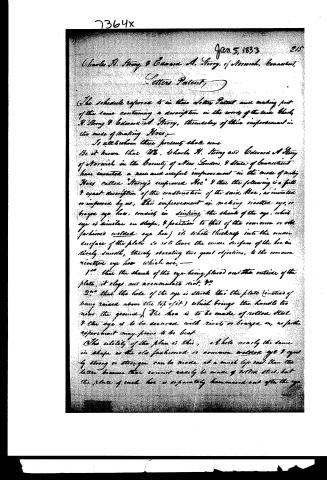
Page 2.
Jan 5, 1833
Charles H. Strong & Edward A. Strong, of Norwich, Connecticut,
Letters Patent,
The schedule reference to in their Letters Patent and making part of the same containing a description in the words of the same Charles H. Strong & Edward A. Strong, themselves of this improvement in the mode of making Hoes.
To all to whom these presents shall come
Be it known that We, Charles H. Strong and Edward A. Strong of Norwich in the County of New London & State of Connecticut have invented a new and useful improvement in the mode of making Hoes called "Strong's improved Hoe" & that the following is a full & exact description of the construction of the said Hoe, as invented or improved by us. This improvement in making rivetted eye or brayer eye hoe, consists in sinking the shank of the eye, which eye is similar in shape & position to that of the common or old fashioned welded eye hoe) its whole thickness into the inner surface of the plate so as to leave the inner surface of the hoe in closely smooth, thereby obviating two great objections, to the common rivetted eye hoe which are,
1st that the shank of the eye being placed on the outside of the plate, it clogs and accumulates dirt, &c.
2nd that the hole of the eye is stuck thru the plate (instead of being raised above the top of it) which brings the handle too near the ground. The hoe is to be made of rolled steel & the eye is to be secured with rivets or brayer on, as further experiment may prove to be best.
The utility of the plan is this, a hole nearly the same in shape as the old fashioned or common welded eye & good by strong or stronger can be made at a much less cost than the latter because their cannot easily be made of rolled steel, but the plate of each hoe is separately hammered out after the eye
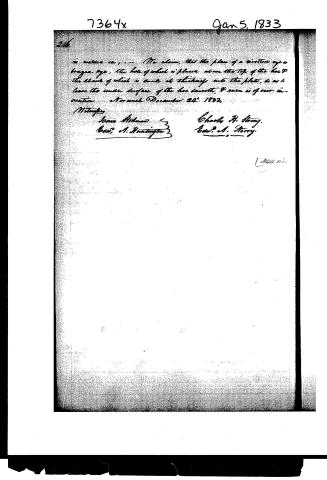
Page 3.
Jan 5, 1833
is welded on. The claim, that the plan of a rivetted eye or braced eye, the hole of which is placed above the top of the bar & the thick of which is sunk its thickness into the plate, is as to leave the under surface of the bar smooth, & same is of our invention.
Testified this 24th December 1832.
Witnesses:
James Aldman
Lewis A. Huntington
Charles H. Storry
Lewis A. Storry
Published accounts: journal notice
Notice in the monthly list of patents, with remarks
Journal of the Franklin Institute, new ser., vol. 12 (1833), p. 19 · View the page
5. For an improvement in making Garden Hoes; Charles H. Strong, and Edward A. Sterry, Norwich, New London county, Connecticut, January 5.
Remarks. The improvement claimed consists in rivetting, or brazing, the eye on to the plate of which the hoe is formed, the hole being placed above the top of the hoe as in the old fashioned form; the shank of the eye is to be sunk its whole depth into the plate so as to leave the under surface smooth and even. This mode of making hoes, it is said, is less expensive, and gives them equal strength with those the plates of which are entirely forged out, whilst it admits of their being made of rolled steel. A model, it appears, is deposited in the office, but a drawing was considered as unnecessary; an opinion from which we dissent altogether, for whenever a model can be made "the nature of the case admits of drawings," and they are then imperiously required by the terms of the law.
About this record
- Patentee
- DATAMP
- Date
- the Name and Date index of patents, DATAMP, USPTO records
- Invention
- DATAMP
- Listed in
- the Name and Date index of patents, DATAMP, USPTO records, Jim Shaw's X-patent list, the Journal of the Franklin Institute, Burke's List of Patents (1847)
- Burke's 1847 Patent Office list gives the same patent.