

Drawings and documents
USPTO scan
The patent as scanned by the USPTO
-
 Page 1
-
 Page 2
-
 Page 3
-
 Page 4


U.S. Patent and Trademark Office · Google Patents
Show the transcription Hide (1,322 words)
Machine transcription (LightOnOCR) of the pages as scanned by the USPTO, most of them the handwritten copies made when the records were restored after the 1836 fire. Not checked; it can misread handwriting, so compare it with the scan.
Page 2.
United States Patent
Patent No.: X7365
Isaac Van Gorder of Warren, Ohio
Letters Patent
The Schedule referred to in their Letters Patent and making part of the same, containing a description in the words of the said Isaac Van Gorder himself of his improvement in the construction of Wheels for Wagons and Carriages.
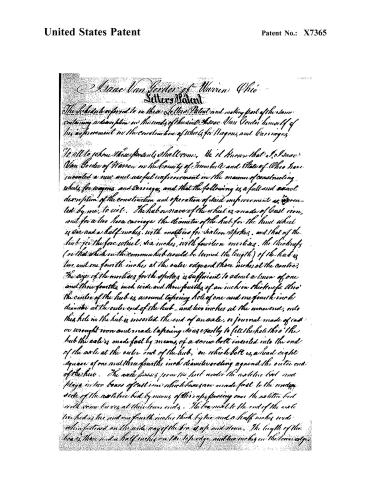
To all to whom these presents shall come, Be it known that I, Isaac Van Gorder of Warren in the county of Humboldt and State of Ohio have invented a new and useful improvement in the manner of constructing wheels for wagons and carriages, and that the following is a full and exact description of the construction and operation of said improvement as invented by me, to wit. The hub or nave of the wheel is made of cast iron, and for a two horse carriage the diameter of the hub for the hind wheel is one and a half inches, with mortises for sixteen spokes, and that of the hub for the fore wheel, six inches, with fourteen mortises. The thickness (or that which in the common hub would be termed the length) of the hub is two and one fourth inches at the outer edge and three inches at the center. The size of the mortises for the spokes is sufficient to admit a tenon of one and three fourths inch wide and three fourths of an inch in thickness. Also the center of the hub is around tapering hole of one and one fourth inch diameter at the outer end of the hub and two inches at the inner end, into this hole in the hub is inserted the end of an axle, or journal made of cast or wrought iron and made tapering so as exactly to fill the hole. Into the hub the axle is made fast by means of a screw bolt inserted into the end of the axle at the outer end of the hub, on which bolt is a head eight square of one and three fourths inch diameter resting against the outer end of the hub. The axle passes from the hub under the axle tree bed and plays in two bears of cast iron which bears are made fast to the under side of the axle tree bed by means of three upsparsing over the axle tree bed with some screws at their lower ends. The bearing to the end of the axle tree bed is two and one fourth inches thick by two and a half inches wide when fastened on the wide way of the box is up and down. The length of the box is three and a half inches on the top edge and two inches on the lower edge.
Page 3.
United States Patent
Patent No.: X7365
On the top edge of the box at each corner and running lengthways of the box is a flange or projecting lip of about 3/8 of an inch wide, the whole top of the box, and likewise on the center of the upper edge of the box is a tongue rising to the same height and running in the same direction with the lips at the edges (the tongue is half an inch wide). These are bedded into the under side of the axle box but to keep the box firm to its place.
A round hole of one and three-fourths inch diameter is made thro’ the box lengthways, in which the axle runs.
A plate of iron four inches long, two inches wide and of suitable thickness, with a hole thro’ at each end runs across, under the box, thro’ which pass the lower ends of the stirrup bars on which there is, a screw, with a burr at the under side of the plate by means of which the plate is pressed hard against the under edge of the box to keep it tight to the under side of the axle box. The box fastened from the hub is made two pieces, of cast iron about four inches long and an inch and a half wide. The top piece is 3/8 of an inch thick and the lower piece 3/8 thick. The lower piece is made with a cross in the middle, the other with a hollow on one side and a square projection on the opposite side. The pieces are made in such a manner that when laid together with the hollow side next to each other a round hole is formed between them, one and three-fourths diameter in which the inner end of the axle plays.
These pieces have holes thro’ the ends and are fastened to the axle box bed in the same manner as the iron plate mentioned in the description of the other box. The square projection on the top piece as mentioned before is bedded in the wood above to keep it steady to its place.
The axle is cast or wrought iron. The length to be determined by the width of the carriage, it is intended that when the carriage is put together the inner ends of the axles will run within four inches of each other, so that for a carriage or wagon of five feet track, the length of the axles will be about two feet four inches, including that part which goes thro’ the hub. The axle is round and tapering, growing smaller from the hub towards the inner end, that part which goes into the hub has been already described. The diameter of the axle where it runs in the outside box is one and three-fourths
Page 4.
United States Patent
Patent No.: X7365
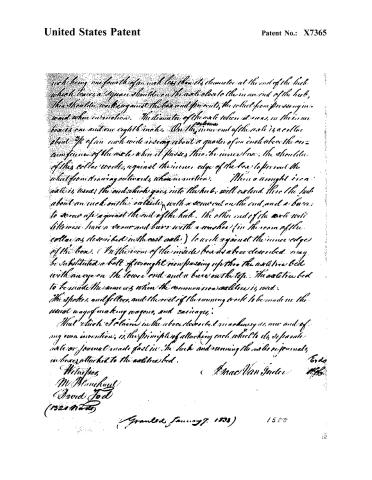
in which being one fourth of an inch less than its diameter at the end of the hub which bears a square shoulder on the axle close to the inner end of the hub, this shoulder works against the box and prevents the wheel from pressing inward when in motion. The diameter of the axle when it runs in the inner box is one and one eighth inches. On the inner end of the axle is a collar about 3/8 of an inch wide in a way about a quarter of an inch above the circumference of the axle when it passes into the inner box. The shoulder of this collar works against the inner edge of the box to prevent the wheel from moving outwardly when in motion. When a wrought iron axle is used, the end which goes into the hub will extend three or four inches about an inch on the outside, with a screw cut on the end, and a bar to screw up against the end of the hub. The other end of the axle will likewise have a screw and bar with a washer (in the room of the collar as described in the cast axle) to work against the inner edges of the box. (In the room of the inside box as above described may be substituted a bolt of wrought iron passing up into the axle tree bed with an eye on the lower end and a bar on the top. The axle tree bed to be made the same as when the common iron axle tree is used. The spokes, and felloes, and the rest of the running work to be made in the usual way of making wagons, and carriages.
That which I claim in the above described machinery as new and of my own invention, is, the principle of attaching each wheel to its separate axle or journal made fast in the hub and securing the axles or journals in boxes attached to the axle tree bed.
Witnesses,
M. Blanchard
David Ford
(1320 M.D.)
(Granted January 7, 1858)
1500
Published accounts: journal notice
Notice in the monthly list of patents, with remarks
Journal of the Franklin Institute, new ser., vol. 12 (1833), p. 20 · View the page
7. For an improvement in the Wheels of Wagons and Carriages; Isaac Van Gorden, Warren, Trumbull county, Ohio, January 7.
Remarks. When, or by whom, the improvement here patented was first made we know not, but we are very certain that it belongs to "auld lang syne," as the claim will serve to show to those who are adepts; it is to "the principle of attaching each wheel to its separate axle or journal, made fast in the hub, and running the axles, or journals, in boxes attached to the axle tree bed." It has been before patented, but even this was done in its old age.
About this record
- Patentee
- DATAMP
- Date
- the Name and Date index of patents, DATAMP, USPTO records
- Invention
- DATAMP
- Listed in
- the Name and Date index of patents, DATAMP, USPTO records, Jim Shaw's X-patent list, the Journal of the Franklin Institute, Burke's List of Patents (1847)
- The Franklin Institute's journal spells the name differently.
- Burke's 1847 Patent Office list gives the same patent.