

Drawings and documents
National Archives restored drawings: drawing
Isaac Doolittle's Patent Drawing for a Domestic Calendar for Cloth

National Archives, Restored Patent Drawings (Record Group 241) · Full-size scan at the National Archives · Catalog record
Show the text on the drawing Hide (100 words)
Words on the drawing as machine-read by the National Archives; not checked. Useful mainly for searching.
2% CLOTH FINISHING / Calenderin / cl / $3.50 / calendorm / Saac Doclitte / ASSIGNATION / 4401 X / Domestic Calender. for cloth clastroller / DIV ISION. / Vol m.py. 21. / Patented Seb. 1. 1833 / go / b. / Patent offies been 7.1941. th / Preferences a.a The most b.b. Rear posts. C.C bottom cylinder d moveable frame C. e. mortises h third cylinder i. forth cylindrawith made Patents under the direction of the Commification / a crank. f. cloth C ring g sprindrod l treadle. / of in conformity with act of / It L Pumarth / ch. L. fleischman / Commisionerof Patents
USPTO scan
The patent as scanned by the USPTO
-
 Page 1
-
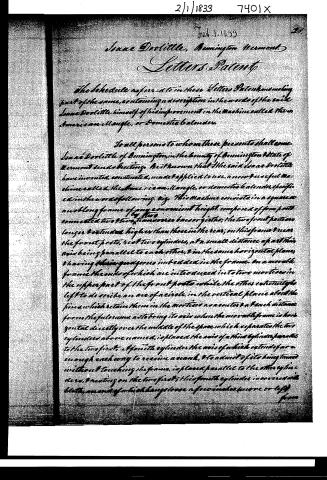 Page 2
-
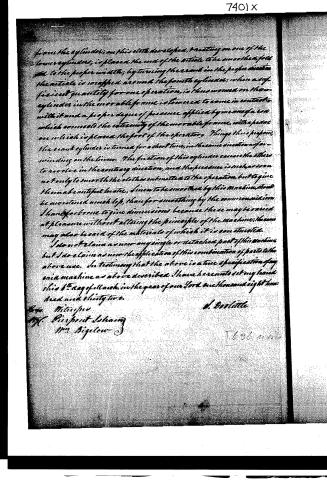 Page 3


U.S. Patent and Trademark Office · Google Patents
Show the transcription Hide (695 words)
Machine transcription (LightOnOCR) of the pages as scanned by the USPTO, most of them the handwritten copies made when the records were restored after the 1836 fire. Not checked; it can misread handwriting, so compare it with the scan.
Page 1.
X0007401
I. Doolittle.
Cloth Finishing Mach.
Patented Feb. 1, 1833.

N. PETER, PHOTO LITHOGRAPHER, W. WASHINGTON, D.C.
Page 2.
2/1/1833 7401X
Feb 1, 1833 31.
Isaac Doolittle, Bennington Vermont
Letters Patent
The Schedule referred to in these Letters Patent and making part of the same, containing a description in the words of the said Isaac Doolittle himself of his improvement in the Machine called the American Mangle, or Domestic Balander.
To all persons to whom these presents shall come. Isaac Doolittle of Bennington in the county of Bennington State of Vermont sends Greeting. Be it known that the said Isaac Doolittle have invented, constructed, made & applied to use, a new & useful Machine called the American Mangle, or domestic balander, specified in the words following. viz. This Machine consists in a square or oblong frame of any convenient height, composed of four parts connected two & two by two cross bars or girdles; the two front parts are longer & extended higher than those in the rear; on this frame & near the front parts, rest two cylinders, at a small distance apart their axis being parallel to each other, & in the same horizontal plane, & having their grooves imbedded in the frame. On a movable frame the ends of which are introduced into two mortises in the upper part of the front parts while the other extremities left to describe an arc of a circle, in the vertical plane about the frame which retain them in the mortises as a center & at such distance from the fulcrum as to bring its axis when the movable frame is horizontal directly over the middle of the space which separates the two cylinders above named, is placed the axis of a third cylinder parallel to the two first; & from the cylinder the axis of which extends far enough each way to receive a crank, & to admit of its being turned without touching the frame, is placed parallel to the other cylinders, & resting on the two first; this fourth cylinder is connected with both, an end of which hangs loose & free in either fore or left frame
Page 3.
7401x
from the cylinder; on this cloth developed, pressing on one of the lower cylinders; is placed the end of the article to be smoothed, folded to the proper width; by turning the crank in the proper direction the article is wrapped around the fourth cylinder; when a sufficient quantity for one operation, is thus wound on the cylinder in the movable frame is lowered to come in contact with it and a proper degree of pressure applied by means of a rod which connects the extremity of the movable frame with a pedal on which is placed the foot of the operator. Things thus prepared, the crank cylinder is turned for a short time, in the same direction as for winding on the linen. The friction of this cylinder causes the others to revolve in the contrary direction, and the pressure is such as not only to smooth the cloth submitted to the operation, but to give them a beautiful lustre. Linen to be smoothed by this machine, should be moistened much less, than for smoothing by the common method. I have forborne to give dimensions because these may be varied at pleasure without altering the principle of the machine; the same may also be said of the materials of which it is constructed.
I do not claim as new any single or detached part of this machine but I do claim as new the application of this combination of parts to the above use. In testimony that the above is a true specification of my said machine as above described I have hereunto set my hand this 8th day of March, in the year of our Lord one thousand eight hundred and thirty two.
J. Doolittle
Copy. Mitryper
W. C. Pierpont Isham
Wm. Bigelow
Filed 36. 1832
Published accounts: journal notice
Notice in the monthly list of patents, with remarks
Journal of the Franklin Institute, new ser., vol. 12 (1833), p. 85 · View the page
4. For a Mangle; called the American Mangle, or Domestic Callender; Isaac Doolittle, Bennington, Bennington county, Vermont, February 1.
Remarks. This mangle has four cylinders, two of which stand near to each other, and in the same horizontal plane, their axes resting on the frame of the mangle. A third cylinder rests on these two, its periphery touching them both; this cylinder is to be turned by a crank; it is covered with cloth, and sustained in such a way as to allow it always to be in contact with the lower cylinders, adapting itself to the varying thickness of the clothes to be mangled, which are to be wound round it. Above this last cylinder is a fourth, the gudgeons of which run in a movable frame, whereby it is allowed to rise and fall. This is called the pressing cylinder, and it is to be brought down upon the middle cylinder by means of a treadle attached to a lever, to which the foot can apply sufficient force. The crank is to be constantly turned in the same direction, the reciprocating movement of the com mon mangle being thus avoided. The claim is to "the general arrangement," which seems to be simple and good.
About this record
- Patentee
- DATAMP
- Date
- the Name and Date index of patents, DATAMP, USPTO records
- Invention
- DATAMP
- Listed in
- the Name and Date index of patents, DATAMP, USPTO records, Jim Shaw's X-patent list, the Journal of the Franklin Institute